

[ad_1]
News | 31-05-2023 | 16:23
The proposal for the Minimum Tax Bill 2024 was submitted to the House of Representatives of the Dutch Parliament today. The proposal ensures that multinational and domestic groups with annual revenues of EUR 750 million or more pay an effective tax rate of at least 15% on their profits. By introducing this legislation, the Netherlands is implementing an international agreement reached by 138 countries in October 2021. This is an important measure in the fight against global tax avoidance. With the bill submitted to Parliament today, the Netherlands is taking the lead in the EU.
Companies will only be subject to the new supplementary tax if the group they belong to pays corporate income tax at an effective rate below the minimum tax rate. This will be determined by deducting the effective tax rate calculated for the state from the minimum tax rate of 15%. The minimum tax rate of 15% has been internationally accepted. The following simplified example shows how the main measures work:
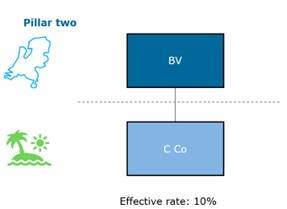
The company “C Co” has an effective tax rate of 10%. It is part of a group whose parent company is based in the Netherlands (“BV”). Due to the positive difference of 5% (i.e. the minimum tax rate of 15% minus the effective tax rate of 10%), C Co is a low-tax entity and therefore Pillar 2 rules apply. This means that BV is subject to a complementary tax of 5% on C Co’s profits.
Reduced profit shifting
The bill reduces the incentive for companies to shift profits to low-tax countries. The bill also aims to set a floor for states to compete on corporate income tax rates. This should prevent a race to the bottom in corporate income tax rates and, moreover, level the playing field for multinational corporations.
“I applaud this new initiative, which will lead to a global approach to combating tax avoidance,” said Marnix van Rij, State Secretary for Tax Affairs and the Tax Administration. “The fight against tax avoidance is a priority for me. Due to tax avoidance, the cost of funding public services is borne entirely by individuals and companies who pay taxes. This is unfair, not least because those companies that avoid taxes still benefit from services funded by taxes.”
background
The global minimum tax (Pillar 2) is part of the OECD agreement on reforming the international tax system and has been signed by 138 countries. The European Commission proposed a directive to implement this minimum tax in the EU. EU Member States agreed on the proposal on 15 December 2022. Member States are obliged to implement the directive in their national legislation by 31 December 2023. The Netherlands has launched an online consultation on the draft implementing bill at the end of 2022. After processing the responses to this consultation, the bill has been submitted to the Council of State for an advisory opinion.
The bill will be debated by the House of Representatives in the coming months and then by the Dutch Senate. The bill is expected to come into force on December 31, 2023. The Tax Administration will work hard to put the new rules into practice efficiently.
[ad_2]
Source link
