

[ad_1]
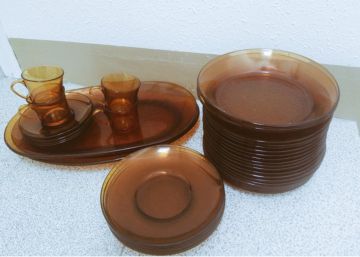
“Do you know anyone who has this cutlery too?” the user asked on Twitter on February 19. @Malhellfica An image of a series of amber plates and cups is displayed. Immediately, thousands of reactions and comments begin to appear, with people admitting that they still own this tableware or that they have eaten all their lives from this Duralex tableware, which originated in France and began to be sold in neighboring countries in 1945. How did it arrive in Spanish homes? Why does it evoke so much nostalgia?
If many still keep some of this cutlery, it’s because it is “virtually unbreakable” – as the brand itself boasted in its advertising in the sixties – thanks to its material: tempered glass, which is gradually heated until it reaches a temperature of 700 degrees Celsius and suddenly cooled. “It resists shocks, from boiling water to cold water without breaking,” they declared.
“It’s a stronger glass and if it breaks it breaks into little balls which prevents you from cutting yourself,” he explained Jules Verne Isabel Campi in a telephone conversation Design History FoundationThe 68-year-old remembers vividly “the first clear barrel glass with two edges going through the middle to strengthen it,” which the brand called Gigogne (big-bellied). “The first plates were shaped like daisies,” he adds.
Campi, who is originally from Barcelona, doesn’t remember when the tableware started being sold in Spain, but he does remember that his family and other Catalan families traveled to Andorra in the 1950s to buy it. “It’s very typical when you want to buy some French products and you still can’t find them in the shops here,” he said. “Then they started being sold in places like the Gerplex store,” he added. In Madrid and Seville, you can find them at Galerías Preciados In this newspaper ad ABC Since 1961.
Tempered glass was discovered by the French company Saint-Gobain in 1939, but had other uses. “Originally, the material was used to make car windows,” says Campi. But the start of World War II transformed it into a new product for the humblest households (durable tableware), which was registered in 1945 under the brand name Duralex. “It was an inexpensive product, suitable for working-class families and for everyday use,” explains the president of the Design History Foundation.
Later, green and amber versions were added to the first clear Duralex tableware. “In Spain, it was a revolution because before that people used earthenware and porcelain, which were only used for special occasions; Duralex earthenware could withstand more work,” Campi said, adding that he does not believe that “there was a family in Spain at that time. There was no such earthenware in the sixties and seventies.”
“To meet the impressive market demand,” he explained This article comes from ABC October 1963Saint-Gobain then founded Vidriería de Castilla in Spain and inaugurated a glass factory in Azuqueca de Henares (Guadalajara) that same year, promoting the industrialization of the region, creating more than 500 jobs, previously supported by agriculture.
This article comes from Guadalajara Diary Keep in mind that the “glass factories” of Azuqueca, as they are called in the Henares Corridor region, were doing well because “Duralex tableware entered all Spanish homes to the point where they were seen as part of the modernizing progress of society”. “This tableware and other foreign designs, such as nylon stockings that also appeared in that period, symbolized progress,” Campi added.
As the author of Theresa Villarosa explains The disenchanted monkey. A cultural critique of the Spanish transition (1973-1993)– exist This interview is for jumpreplacing pottery with Duralex was a gesture to break with the period of autarky of economic liberalism that prevailed in much of the world (including Spain) from the 1970s onwards: “When they told the people in the towns to throw away their pottery, the pottery and buy Duralex.
But the company – which also has two factories in France in addition to its Spanish plant – reportedly began to decline in the late 20th century. Five days in the text: “For consumers it started to become outdated and had to face competition, which was a result of the beginning of a globalized world.” “We eventually got a little tired of Duralex, it was business as usual: the same glasses and plates, everywhere. I guess we got bored and stopped buying them,” Campi said.
Although the company was on the verge of collapse in 2008, it was the global economic crisis that saved it. “Families once again needed to spend as little as possible. Shockproof tableware helped meet this need,” he explains. Five days. Today, this tableware is still sold. All you have to do is type Duralex in Google and the search engine will return results for several stores that sell glasses, plates, dishes and other products of this brand on the Internet at quite affordable prices.
During its existence, Duralex pieces also made the leap from store shelves to museum showcases. The first vase model, the “Gigogne,” is on permanent display at the Musée des Arts Décoratifs in Paris. MOMA’s online design store Another model for sale is the multi-colored version of the Picardie – narrower, with a larger bevel, which Daniel Craig uses to drink whiskey in the movie Heavy rain– 41.95 EUR per unit.
What about you? Do you have (or do you have) Duralex cutlery at home? Do you still use it? The classic, amber or green? Tell us what memories it brings back for you? via Twitter or respond To this email.
What about you? Do you have (or do you have) Duralex cutlery at home? Do you still use it? Classic, amber or green? If you like, please dust off your dishes and send us a photo like our colleagues @mluzpeinado pic.twitter.com/RTrSSTGWAi
— Jules Verne (@verne) February 27, 2020
*You can also follow us Instagram yes Flipboard. Don’t miss Jules Verne’s wonderful works!
[ad_2]
Source link

