


[ad_1]
Did the United Nations International Boundary Commission really “side with Argentina” when it expanded Argentina’s maritime border in the South Atlantic by one third to include the disputed Falkland Islands (Malvinas)? It has been widely reported?
In fact, Commission on the Limits of the Continental Shelf (CLCS) did not do so. CLCS is 1982 United Nations Convention on the Law of the Sea To do one thing: verify scientific data submitted by a country to determine the limits of that country’s outer continental shelf and, therefore, the extent of the area over which that country has exclusive rights to the resources of the seabed.
A country’s Exclusive Economic Zone (EEZ) is between 12 and 200 nautical miles from its coast, and beyond that is the Outer Continental Shelf, which can extend up to 350 nautical miles, or possibly even further. Because the scientific basis for making such claims is highly technical, the United Nations established the Commission on the Continental Shelf to assess countries’ claims. From the outset, it was recognized that in many cases, countries’ claims could legitimately overlap.
Claims and counterclaims
For example, suppose that countries A and B are 500 nautical miles apart. Country A proposes that there is a continuous seabed that extends all the way to country B. In this case, the 200 nautical miles closest to country A would clearly be part of country A’s EEZ, the 200 nautical miles closest to country B would clearly be part of country B’s EEZ, and the 100 nautical miles in between would appear to be awarded to country A.
However, while disputes over land territory or coastal waters are zero-sum games, meaning that one country’s gain is necessarily another country’s loss, in this case the scientific evidence supporting country A’s claim for geological continuity of the seabed is likely to support the same claim made by country B.
The Law of the Sea recognizes this by separating scientific verification from the actual demarcation of boundaries. After verifying the scientific basis for any claim, the CLCS refers the issue to arbitration or a tribunal, whereupon the countries with legitimate claims to the rights divide the shared space. Often this is simply a matter of drawing a line down the middle. However, this line may be adjusted—for example, due to demographic differences or historical factors among competing countries. Alternatively, the two countries may decide to jointly manage the overlapping seabed and share resource revenues equitably.
Share and share equally: it works in the Arctic
Despite the widely-held view that there is a growing desire to claim Arctic territory, competing nations acknowledge that they have common interests in it. Establishing universally accepted scientific dataSo while Canada, Denmark, Russia, and the United States are ultimately competitors for the Arctic Ocean floor, they generally recognize that recognition of each nation’s claim (including their own) depends on universal acceptance of scientific data. As a result, they have been working closely together to map the seafloor, sharing costs, exchanging expertise and equipment, and uploading the data to a publicly accessible website: International Bathymetric Chart of the Arctic Ocean.
A similar situation may exist in the South Atlantic, but due to the long-standing dispute between Argentina and the United Kingdom over the Falklands/Malvinas Islands, which has sometimes led to open military conflict, most recently the Falklands War in 1982. There are no similar land territorial disputes between Arctic states, but rather maritime territorial disputes.
IBRU/Durham University, Author provided
Not Over Yet
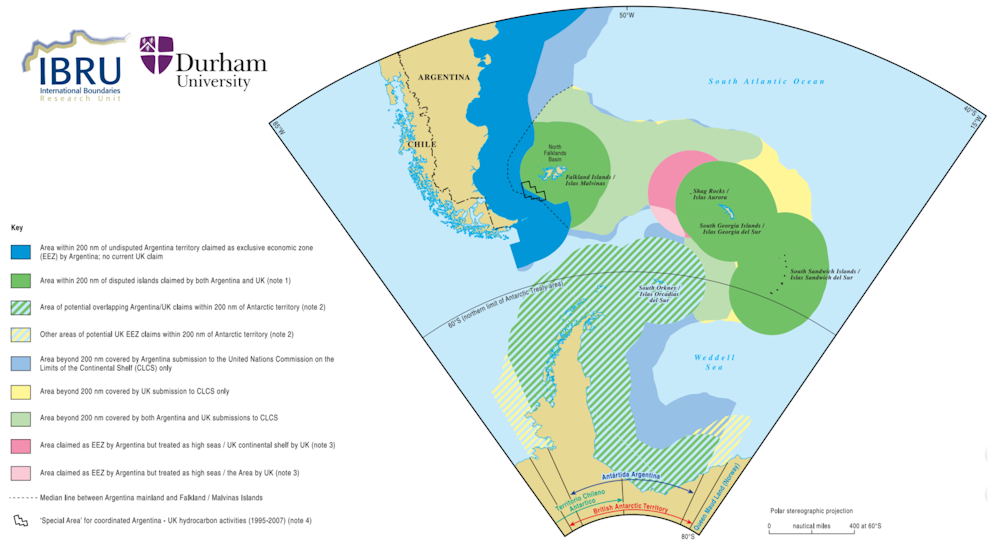
The CLCS is well aware of this dispute and therefore has moved cautiously in relation to the South Atlantic. In 2009, both the United Kingdom and Argentina made submissions to the CLCS with considerable overlap, as shown in the following map produced by IBRU, Border Research Center At Durham University.
This is a case where shared science can support the claims of both sides. In 2012, when the Commission on the Limits of the Continental Shelf authorized a subcommission to make a preliminary determination on Argentina’s claims, it noted that a final determination could not be made until the Falklands/Malvinas sovereignty dispute was resolved. So even though this subcommission has now recognized Argentina’s science, and although it has been promoted as a “win” for the Argentine government (and in a sense a “loss” for the UK), in fact it has not moved the process forward. No progress can be made until the sovereignty issue is resolved.
The fact that the CLCS has determined that Argentina’s scientific research is reliable could also strengthen the UK’s claim to the disputed seabed around the islands. If the UK’s claim to the islands is recognized, the CLCS ruling would make it more likely than ever that the seabed between the UK and mainland Argentina will need to be shared.
In the long run, Britain and Argentina must work to find common interests – and perhaps the two countries can even achieve Ease through science (and the hope of sharing in the region’s oil and mineral wealth). Unfortunately, in the short term, the ruling has only stoked passions and political posturing and done nothing to resolve the South Atlantic’s problems.
[ad_2]
Source link

