


[ad_1]
Kathmandu, July 1. Kathmandu Deputy Mayor Sunita Dangol laid the foundation stone for the reconstruction of apartments next to the Bhadrakali (Lumdhi Azima) temple on June 27. The Metropolitan Corporation has also awarded a contract worth Rs 360 million to Tulsi Ambuja JV, while demolition of Rana-era apartments continues.
Amid disagreements among local residents, some Gudiyals, archaeologists, conservation engineers and the archaeological department, the Metropolitan Corporation is starting to build the apartment in a new form, which is about to destroy the originality and historicity of the archaeological heritage.
The Archaeology Department has not given its approval to build Newari style apartments as proposed by the Metropolitan Municipal Corporation. Ram Bahadur Kunwar, spokesperson of the department, said that although the Municipal Corporation has discussed the issue of building apartments around Bhadrakali with the department, the proposal has not been approved. “This is an archaeological heritage and cannot be rebuilt without the permission of the department,” he said. “The department has not got the consent of the Metropolitan Municipal Corporation for the construction style. It should be rebuilt in the neoclassical style of the Rana period.
Mandatory permission must be obtained from the Department of Archaeology for the reconstruction of heritage sites. Under the Conservation of Monuments Act 2013, the Department of Archaeology is responsible for ensuring the conservation of public and private monuments and archaeological sites.
The law stipulates that maps submitted by people who want to build, repair, reduce or rebuild houses or buildings in local protected areas must first be approved by the archaeological department before the municipal government can adopt them in accordance with the regulations. Current law. In this way, after studying the maps submitted for approval, the archaeological department can approve them, or not approve them or approve them with modifications.
There is also a provision that if a house or building is constructed, repaired, added or reconstructed within the protected area not in accordance with the approved map, the archaeological department can issue an order to stop the construction, repair, addition or reconstruction.
The Archaeology Department has sent back the proposed design to the metropolitan city to build the Bhadrakali apartments in a newer style than the current one. Therefore, the Guthi Institute is also waiting for the department’s opinion on the construction of the flats. According to the law, the Guthi Sansthan has the right to inspect, provide technical services and provide guidance on heritage sites on the Guthi Sansthan land.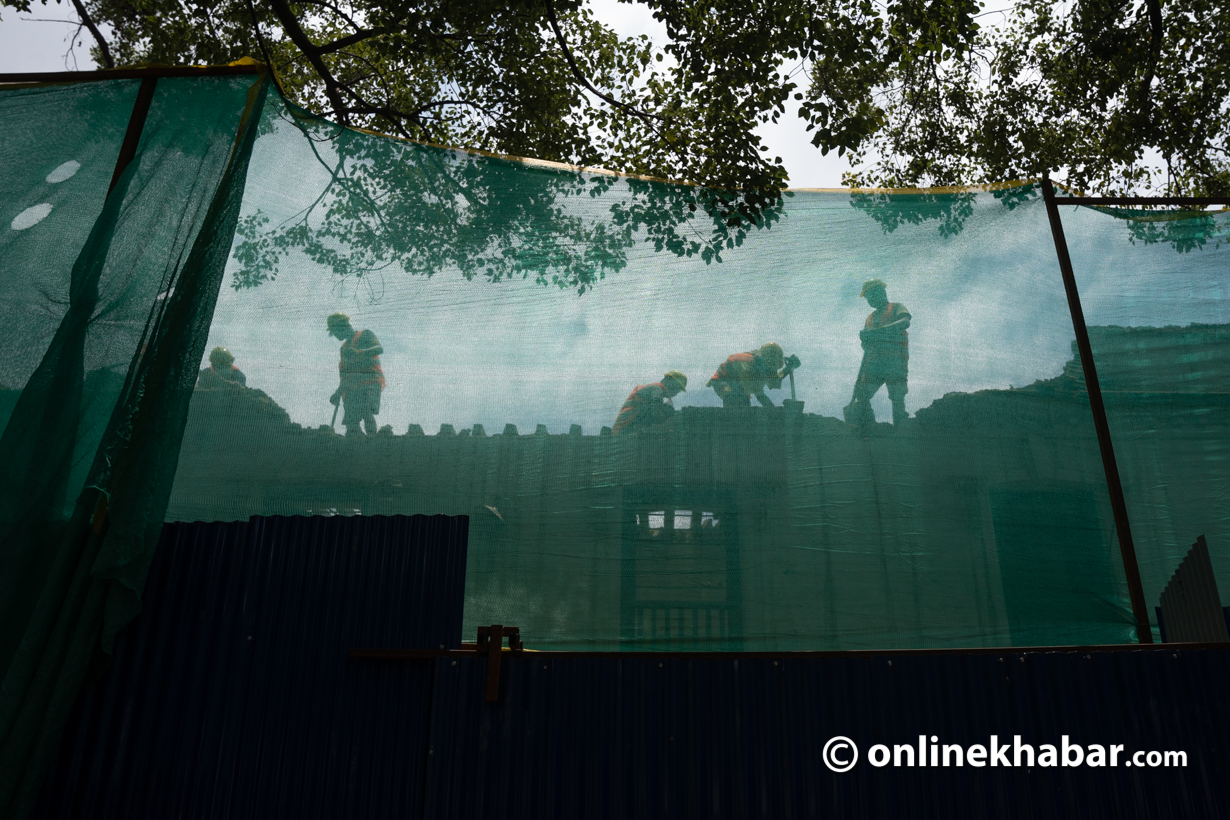
The persistence of illegal migrant workers in metropolitan areas
Despite being aware of the legal system, the city of Kathmandu has not given up its stubbornness.
The Metropolitan Company had signed the contract on June 6 and issued the order on June 3 to build the plane annotation of the Rana period and to build it in the “Neva style”, which was illegal.
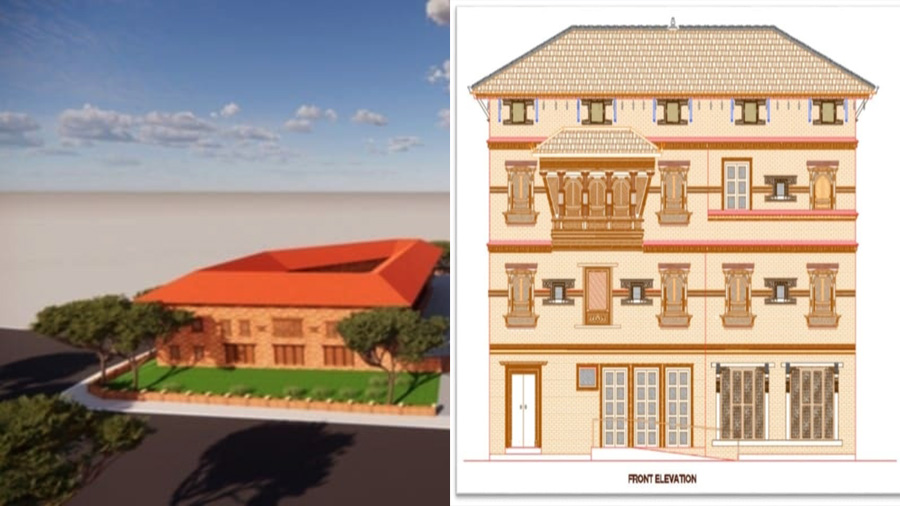
The proposed new apartments will have carved wooden doors, windows and thatched roofs with handles. It is said that the archaeological department has been tasked to prepare documentation (as is and as is) of the structure, craftsmanship and style of the temple area during reconstruction, but the department is yet to do so.
After the foundation stone laying ceremony, Deputy Chief Dangor mentioned in his speech that Bhadrakali is the god of faith of all believers and said that if its antiquity is preserved, it will become a monument that everyone can be proud of. However, she concealed the fact that she carried out the construction without the consent of the archaeological department.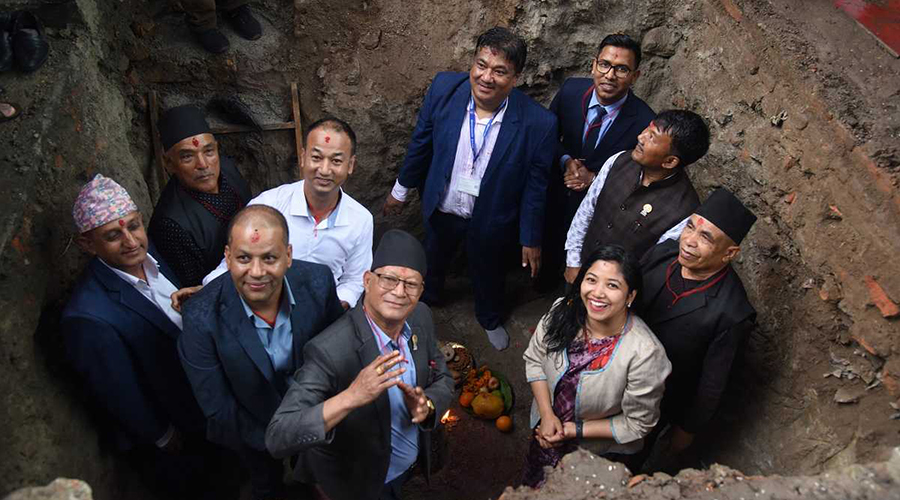
The Bhadrakali temple is geographically in ward No. 11, though it belongs to Sector 11, but the Jatra festival, rituals, culture and traditions associated with it, Sector 22 are also associated with the inner ward. Kumari Rai, head of the city’s heritage and tourism department, said, “This is a reconstruction exercise that is being done using multilateral relationships.” However, the Metropolitan Municipal Corporation is moving forward in a single way, seeking cooperation from everyone.
On June 30, a meeting of the “Lumdhi Bhadrakali Mandir” chaired by Deputy Mayor Dangol decided to start the reconstruction work from the southwest. The meeting decided that Guthi Sansthan and the Lumdhi Bhadrakali Management Committee should vacate the space for reconstruction. However, from the Guthi Institute to the Archaeology Department, they did not adopt this decision of the Metropolitan Municipal Corporation.
Mayor Balen Shah informed about the plan on Facebook on June 27 and said he would not listen to others. Although the local and archaeological departments have asked to build it in the British style, our position is to build it in our ancient Newari traditional style and it will be built in this style. He wrote, “This is the beginning, a return to our traditional style.”
Before Barun, even when Vidyasunda Shakya was mayor, the earthquake-affected apartment was planned to be rebuilt in Newari style. According to Saroj Basnet, then vice chairman of Kathmandu City Planning Committee, the building was constructed in Newari style with permission sought from the Archaeology Department. The Newari style design was prepared by the then committee.
Basnet said that during Shakya’s tenure as mayor, the archaeology department rejected the Newari-style design, saying the apartment should be built in the current “neo-classical” style.
The Town Planning Commission then investigated whether there were any Newar-style apartments on the site, but Basnet said no such history had been found.
Therefore, based on the department’s input, new designs were prepared to build the structure in a ‘neoclassical’ form, which is its current form. “In the past, the place where the Bhadrakali temple stood was a mound with fields around it and the locals worshipped by placing the deity at different places,” he said.
He said that the present Sattal around Bhadrakali might have been built during the Juddha Shamsher or Bhim Shamsher era. Therefore, the conclusion was that the apartment was an archaeological heritage and should be constructed in its original form, former Vice President Basnet informed.
Barun again insisted on changing the original form of Sattar and rebuilding it, saying that he wanted to return to the Newari style. Without resolving the dispute, the contract, foundation laying and demolition work were completed.
“Evidence and foundation are needed”
Locals, experts and archaeological stakeholders were happy and agreed with the move by the Met, who believed that the Met should search, study and discuss the old forms before creating new ones.
Archaeologist and former director of the Department of Archaeology Bishnuraj Karki said if any heritage building is to be constructed in a style different from the existing buildings, there needs to be a basis and reason to prove that the new design is compatible with the past period. “I don’t know on what basis the city has chosen the new design, but if a different style is to be adopted in rebuilding the heritage building than the current one, then there needs to be a basis and reason to prove that the style was to be built in the past,” he said.
He reminded that before the earthquake, the temples in the middle of Ranipokhari were in dome style, but it was rebuilt by collecting evidence of Granthakut style that preceded the Rana period. He is the coordinator of the expert group formed to carry out this work.
“We propose to design the temple in the style of the Malla period based on various images and archaeological evidence from Rani Pokhari,” he said.
Karki said the archaeology department, the city government, historians and experts who study traditional forms should draw conclusions on the evidence.
Not only officials of the department but even environmentalists say the city’s decision to make the Rana-era Sattar in Newari style is not even valid. Conservation engineer and advocate Sanjay Adhikari said the Bhadrakali apartments were built during the Rana period and should be rebuilt in the same way.
“Recently, there is a widespread belief that by removing the tachiappa and calling it a Nirvana period property and after saying that, the property no longer retains its old form,” the official said, “the same style is now being adopted in the Sattals of Bhadrakali. The claim that it was adopted in the Sattals is 100 per cent wrong.”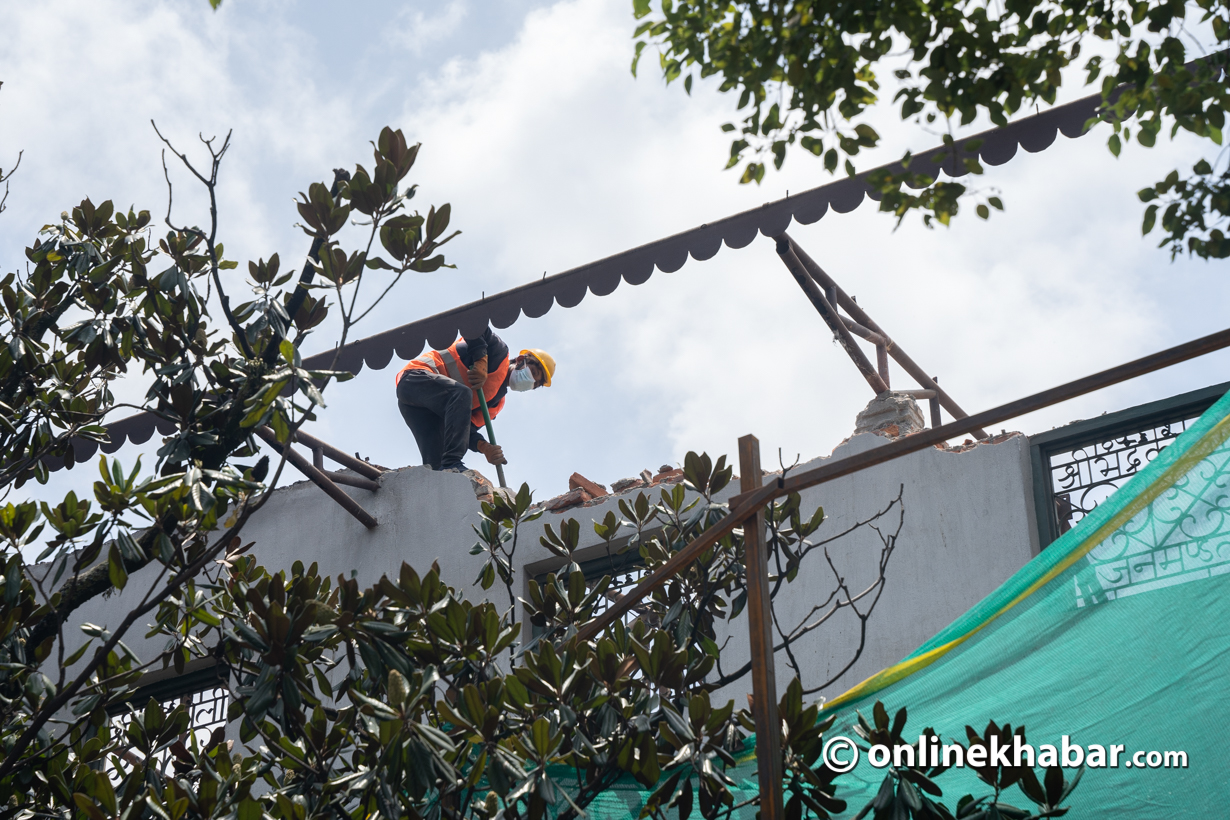
The executive officer recalled that there were recent attempts to destroy Rana-era properties and he had gone to court and fought to save Bagh Durbar, which the city was trying to demolish. He also cited examples of places like Thapathali Darbar, Rashtra Bank Bhavan in Baluwatar, where the archaeological presence had been erased in the name of reconstruction.
“They are trying to discredit the palaces and properties of the Rana period as black history,” he said.
The project leader said that if the style of the old buildings is changed and new styles are built, it will not represent history and future generations will not know their history.
The official said that if it is to be built in Newari style, it needs to be confirmed by an expert group that the building was built in this style in the past. The advocate said that when determining the new format, there should be photographs, records, inscriptions or factual evidence that is different from the current format. The advocate warned that if the heritage is rebuilt without contacting the archaeological department, it will be against the law and the public and activists will resist it.
Kalki, the former director of the Department of Archaeology, said everyone should accept the fact that there is no single style in the history of any country. “Each style represents each era, the culture and architecture of its respective era, and Nepal at that time,” he said.
Former director general Karki said Gaurav should be protected, saying it is better to maintain the original nature of the heritage site. He said the palaces and properties built by the Ranas under western influence should be loved and the history hidden in them should be accepted and protected. “The neoclassical heritage is also our treasure,” Karki said. “If it is destroyed, the importance of the architecture of an era will be lost.”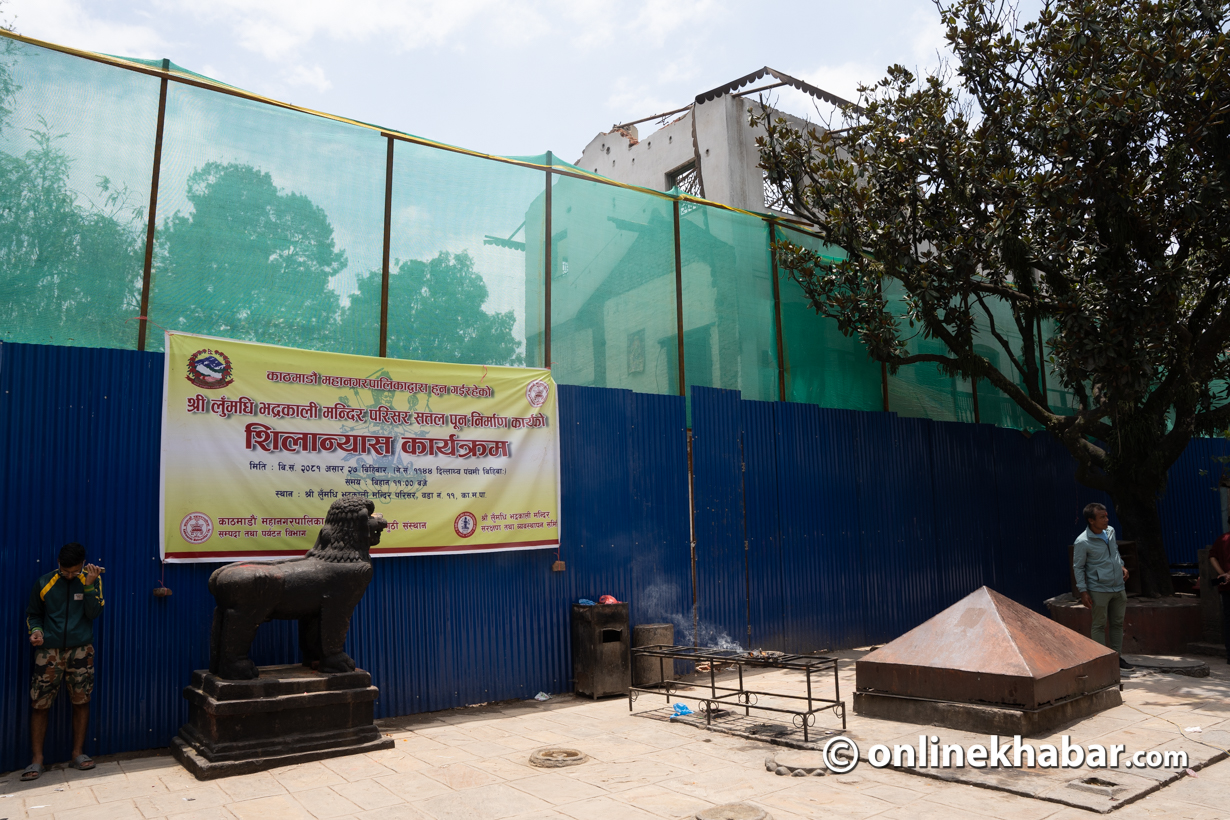
Appeal to the estate
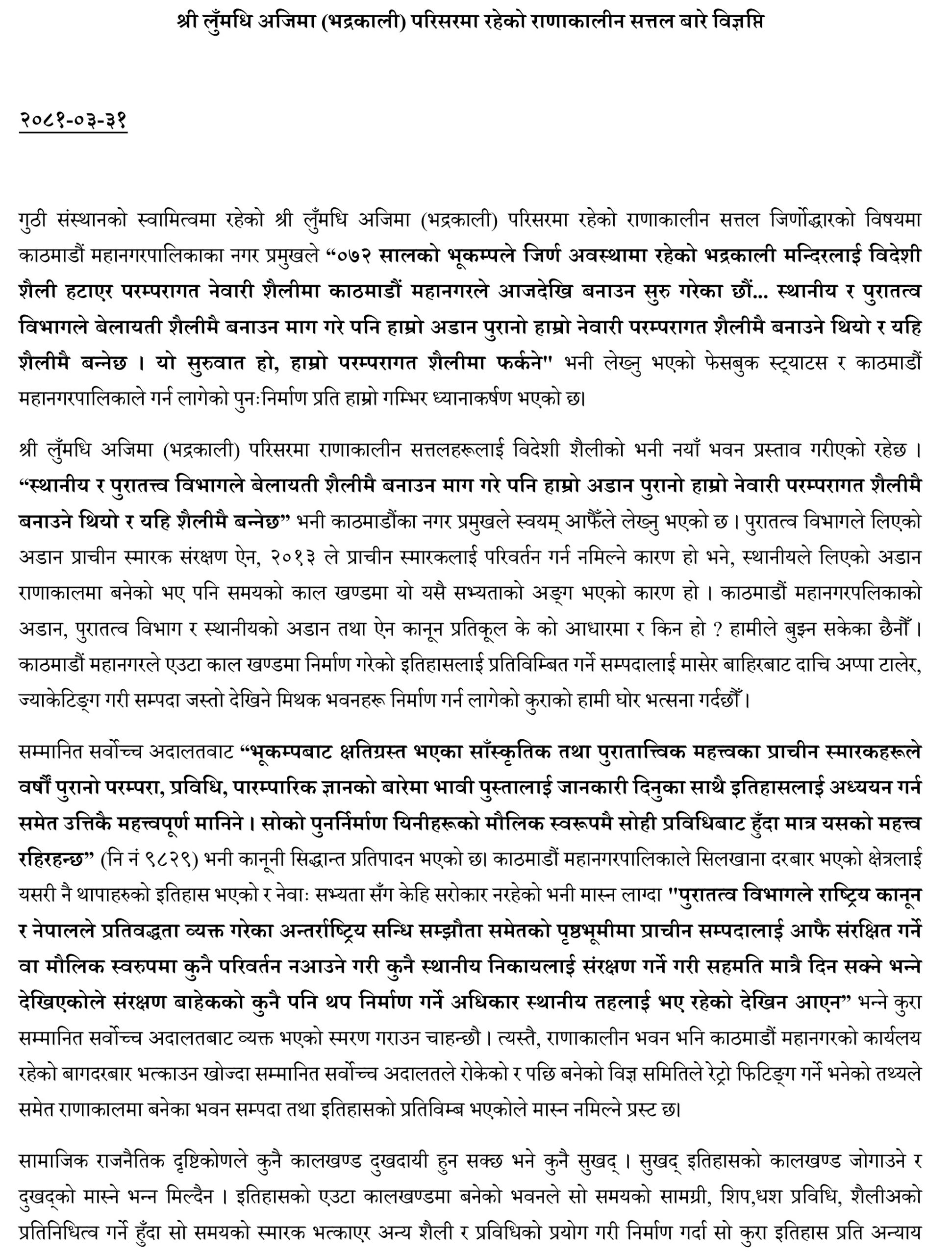
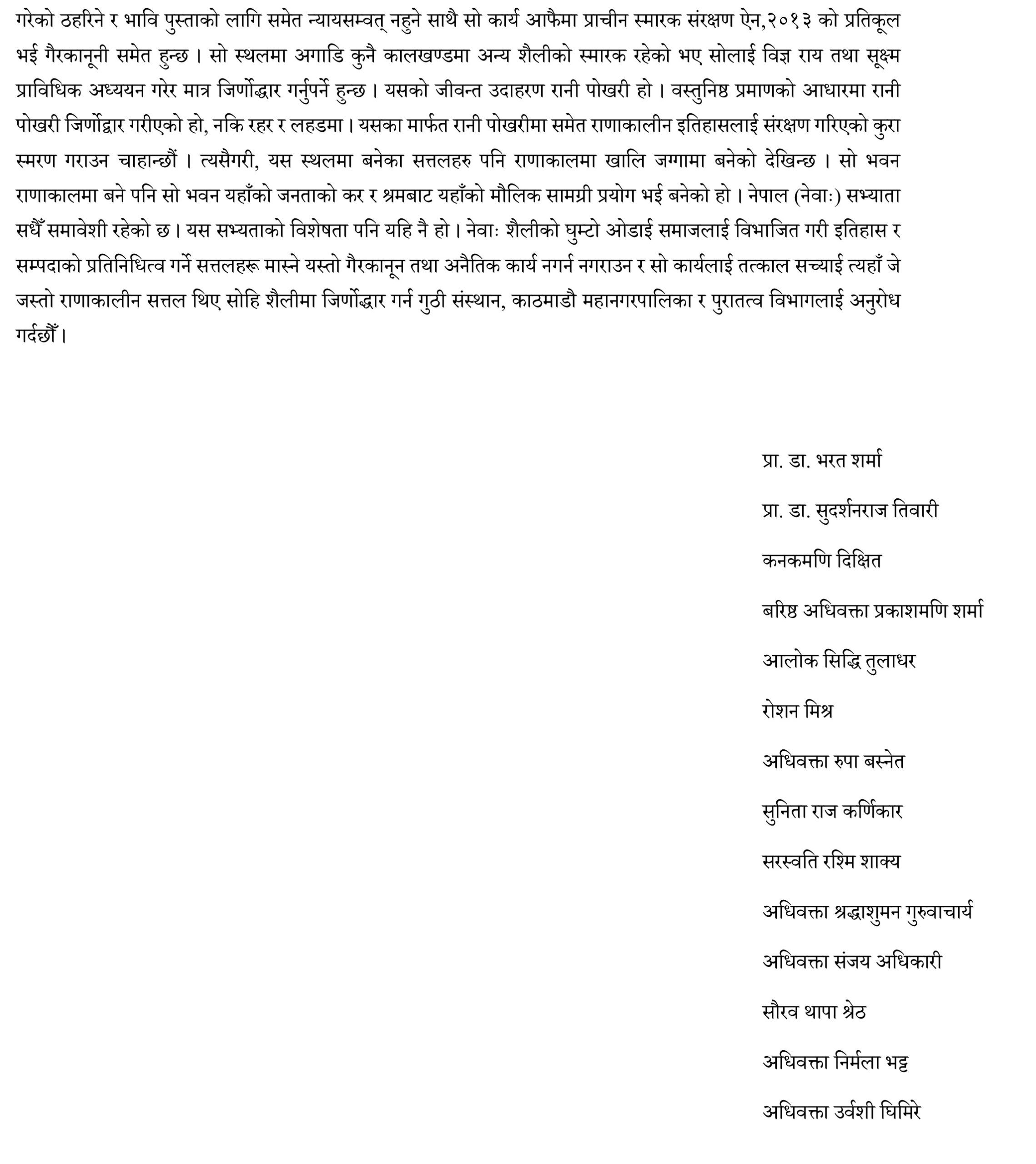
Heritage experts, activists and civil society leaders also issued statements opposing the metropolis’ move. In a joint statement issued by 14 people on Sunday, it was mentioned that Mayor Barun drew attention to the proposal to construct a new building for the Rana-era palace in the Bhadrakali complex in a foreign (British) style.
“The stand taken by the archaeology department is that ancient monuments cannot be altered under the Ancient Monuments Protection Act, 2013, while the stand taken by the locals is that it is a part of this civilization, though it was built during the Rana period,” the statement said. “What is the basis and reasoning of the stand and reasoning of the locals and the law, why is it unfavorable? We cannot understand.”
The statement criticised that the Kathmandu Metropolitan Government will build a mythological building reflecting a period of history by removing the Great Chiappa from the outside and sheathing it to make it look like a heritage site.
The apex court said that ancient monuments of cultural and archaeological significance damaged due to earthquakes are considered equally important for imparting traditions, technology, traditional knowledge to future generations and studying history and spelled out the legal principles through a memorandum.
They argue that the fact that the Supreme Court blocked attempts to demolish Bagdarbar, the Kathmandu Metropolitan Office, a Rana-era building and that an expert committee later ordered its transformation clearly shows that buildings built during the Rana period are a reflection of heritage and history.
If there are any other style monuments in Bhadrakali from any period, it has been brought forward through demanding statement that it should be restored only after expert opinion and detailed technical study. “Though it was built during the Rana period, the building was constructed using original materials with the tax and labour of the people here,” the statement said, “The Nepali (Neva) civilization has always been inclusive. This is the characteristic of this civilization. We request Guti Sansthan, Kathmandu city and the archaeology department to not do such illegal and unethical act of destroying the Sattar which represents history and heritage by giving a veil of style to the society and restore it in the same style as the Rana era Sattar.”
See statement
What did Mayor Barron say?
Photo: Chandra Iyer/Online News
[ad_2]
Source link

