


[ad_1]
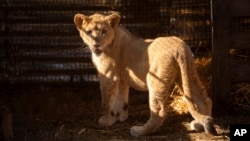
Freya, a 6-month-old lion cub rescued from the wildlife trade in Lebanon, curiously pokes her nose out of her transport box and sniffs the air. Content, she takes her first cautious steps into her new home at a sanctuary in South Africa.
Freya’s move to the Drakenstein Lion Park is only a partial success story.
She could never live as a lion in the wild. She was taken in for life by Drakenstein, which takes in other lions from zoos and circuses in France, Chile, Romania and elsewhere. Some of the lions have horrific backgrounds of abuse, as the sanctuary’s placard reads: Ares was rescued blind and neglected. Brutus was beaten so hard that his jaw was broken.
However, as Freya settles in Drakenstein, animal welfare groups are once again focusing attention on South Africa’s conflicting stance on a species that often symbolizes Africa’s wildlife.
While South Africa has a strong reputation for conservation and the creation of ethical sanctuaries like the Drakenstein, it also has a thriving captive lion industry, where big cats are kept for petting and other contact, but also to be killed in “captive safaris” or for the lion bone trade.
South Africa has special permission through the Convention on Trade in Endangered Species of Wild Fauna and Flora (CITES) to export lion bones and skeletons, mainly to Southeast Asia for use in traditional medicines. Captive hunting, which involves hunting and shooting lions in enclosures where they have no chance of a fair hunt or escape, is also legal.
Animal welfare groups have been calling for an end to the captive lion business, and the South African government recently announced plans to shut down the industry, which is expected to take two to three years if there are no legal challenges.
Audrey Delsink, African wildlife director at Humane Society International, which worked on Freya’s relocation, said it tarnished South Africa’s conservation reputation. She said it was important for people to realize that cute cubs meant for petting in some South African parks – but not in Drakenstein National Park – eventually grow up to become full-grown lions and are transported away and killed.
“They are taken from their mothers and raised in captivity for people to have their pictures taken with them, but eventually these lions will be shot as trophies and they will not be able to escape the camp and nothing more will be left than a bag of bones,” Delsink said.
South Africa has more than 300 captive lion facilities, housing more than 7,000 lions. That’s twice the number of lions in the wild in South Africa. Activists against the industry say it should be made clearer to tourists that the vast majority of South Africa’s lions live in cages in the world’s largest captive lion industry.
“We can’t deceive tourists anymore,” Delsink said.
As for Freya, rescuers hope she will eventually bond and live in the same enclosure with Pi, the male cub who is Freya’s brother and whom rescuers brought back from Lebanon in April.
Jason Mier, head of the animal protection organization Lebanon, which rescued Pi and Freya, said Pi was illegally trafficked and used by a man to promote his TikTok account. Pi’s mouth was often taped shut when he was filming videos or taking selfies, and he was locked in a small cage at night. Mier said he was used as a symbol of his owner’s status, “to show off that I am powerful, I have money, look at me.”
Freya and Pai are the latest in a string of nearly two dozen big cats rescued from various predicaments by Lebanese animal protection groups. Some of the cats have come to Drakenstein, where petting or close contact with cubs is not allowed, but visitors are welcome to come and see the lions and learn about them.
If Freya and Pi were released into the wild, they would not survive, so the sanctuary was their best option. The people involved in rescuing Pi said they still remember the first time they saw the cubs playing in the grass in Drakenstein, although it is likely that he and Freya will spend the rest of their lives in this enclosure.
[ad_2]
Source link

