

[ad_1]
The city of Bobo-Dioulasso will organize a canine rabies vaccination campaign from August 9 to September 8, 2024. This campaign will contribute to the elimination of rabies transmitted by pets in Bobo-Dioulasso. The campaign, which aims to vaccinate approximately 8,000 pets, was officially launched on Friday, August 9, 2024, by Dr. Amadou Dicko, the Minister’s Delegate in charge of Animal Resources.
In order to protect the population of Bobo-Dioulasso from rabies, a contagious and deadly disease, the Directorate of Agriculture, Animal and Fisheries Resources of the Oue Province is organizing a mass vaccination campaign in collaboration with the municipality of Bobo-Dioulasso. This action is supported by the Food and Agriculture Organization of the United Nations (FAO). The campaign is planned to last for one month and will be held in Bobo-Dioulasso from August 9 to September 8.
The campaign has several objectives, including informing and raising awareness of the importance of rabies vaccination among political, administrative, religious and customary authorities; informing and raising awareness of the importance of rabies among children, especially school children, so that they can pass on this information to their parents; and also providing information and raising awareness among the urban population and pet owners to vaccinate them annually against rabies transmitted by pets. A total of 8,000 pets are expected to be included in the campaign.
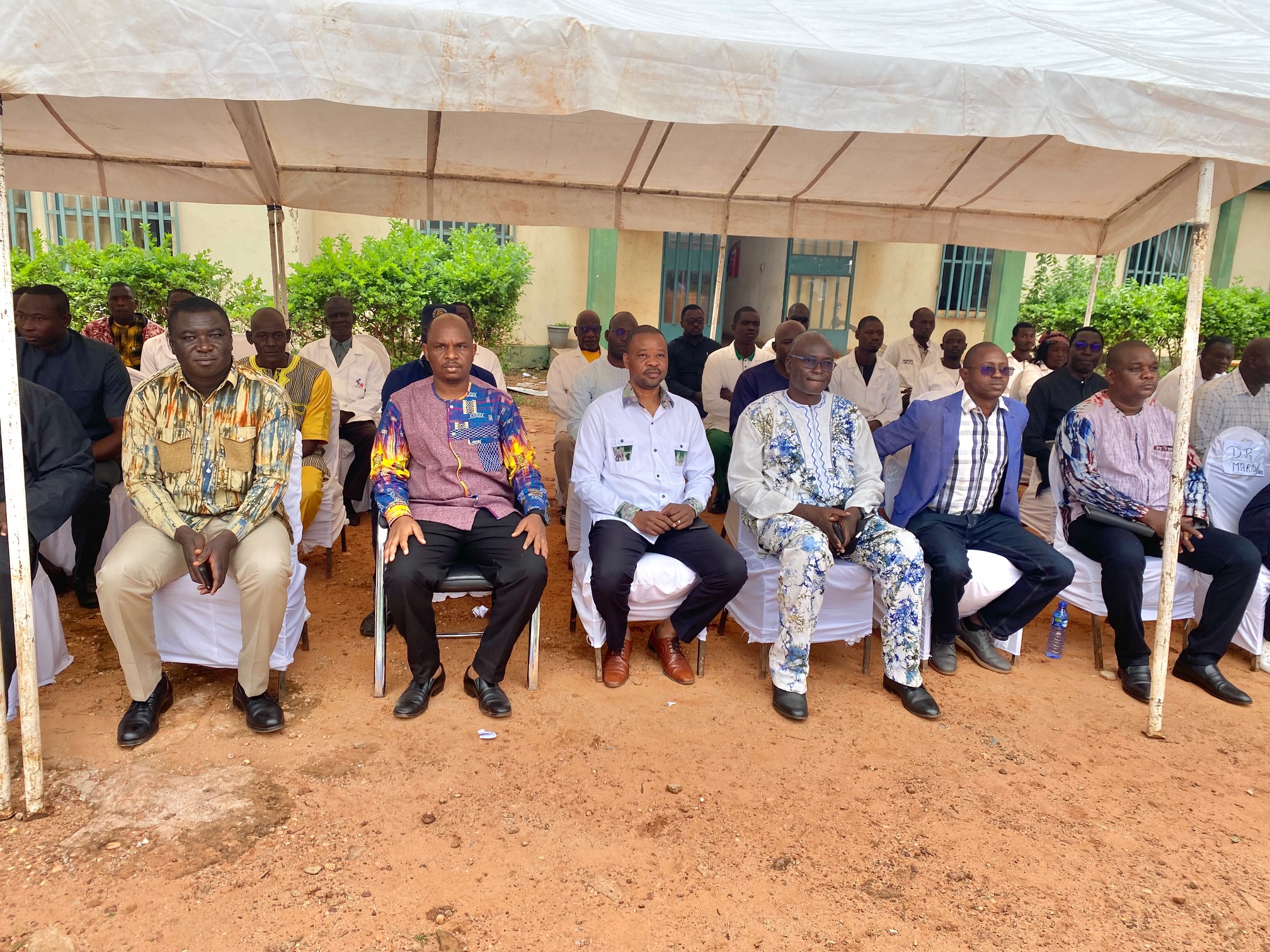
Officials attend the launch ceremony of the vaccination campaign
Rabies is a public health problem
In fact, rabies is a public health problem, since it is a major zoonosis that can be transmitted from animals to humans and vice versa. According to the Provincial Department of Animal and Fisheries Resources, in 2020, the commune of Bobo-Dioulasso had about 17,000 pets of all breeds (dogs, cats, monkeys, etc.). These animals constitute the main vectors and reservoirs of canine rabies. Rabies is transmitted to humans through bites, scratches or licks of broken skin or mucous membranes from animals infected with rabies.
Once symptoms appear, coma and death can occur within hours to days. Pets should therefore be vaccinated against rabies on a regular basis every year in order to protect the health of both pets and the general population. The disease is endemic in Burkina Faso and cases are reported every year in susceptible animals and, unfortunately, in humans as well. As a result, the health authorities recorded 5, 2, 3 and 1 confirmed human deaths from rabies in 2015, 2016, 2017 and 2018, respectively.
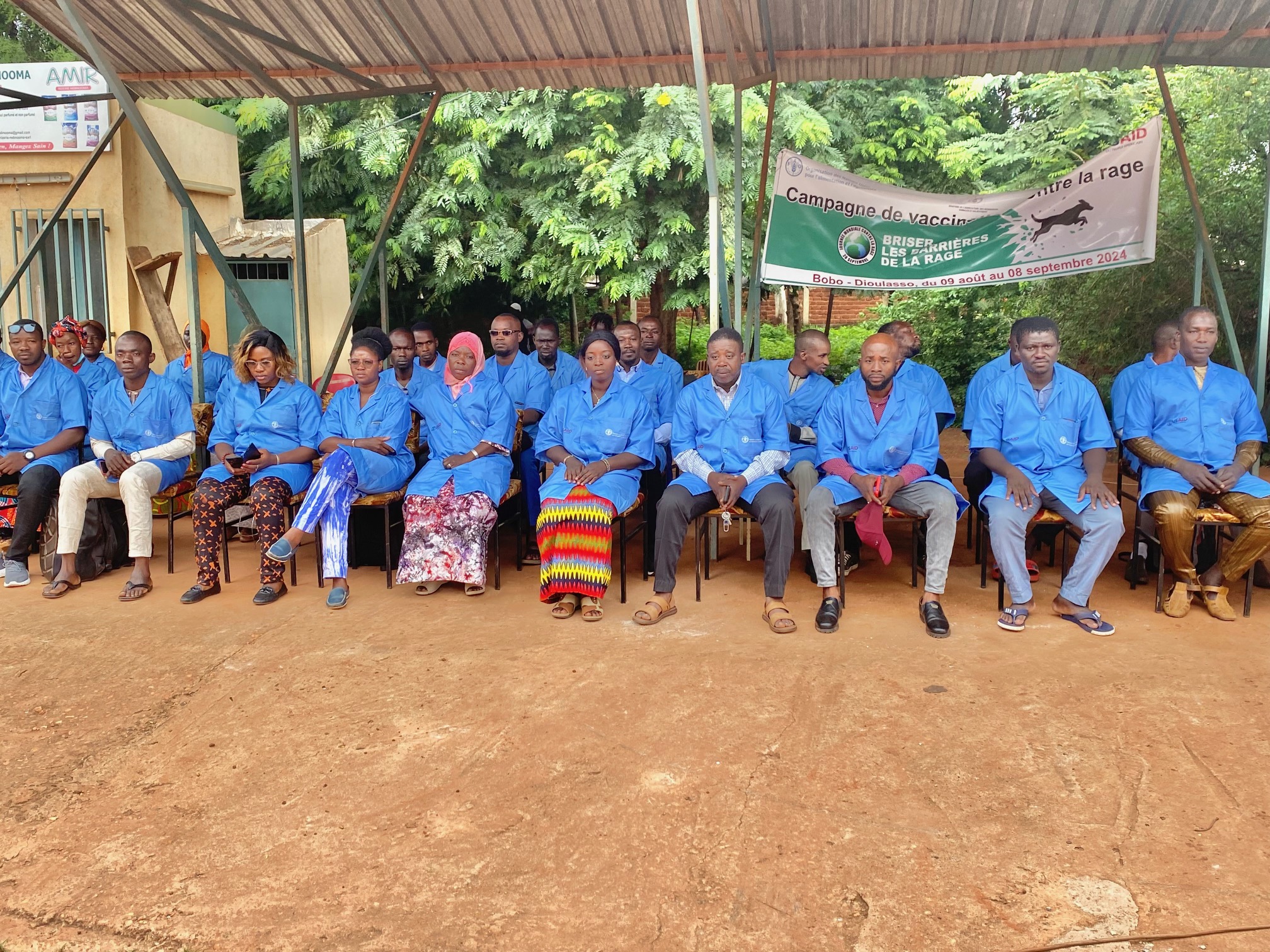
Vaccination staff are ready to be deployed to various vaccination sites
For the Ministry of Health, the case of bites illustrates the importance of the risk of spreading the disease to the population. To protect the population from this infectious disease, the Ministry of Health and its partners organize every year a large-scale rabies vaccination campaign. “This campaign is taking place in all towns and villages across the country, because vaccination remains the only measure to limit the spread of the disease,” recalls Dr Amadou Dicko. The campaign is therefore technically supported by FAO and financed by its usual partner, USAID.
FAO engages with authorities in Burkina Faso
Given the severity of the disease, FAO has been fighting alongside the Burkina Faso authorities for years, contributing to its control through various technical and financial support. FAO has contributed more than 36 million CFA francs to the current operation. With its support, FAO is working to organize large-scale awareness campaigns and vaccinate animals by purchasing vaccine doses for this purpose. FAO’s support also includes ensuring the mobility of technical teams that go to the field to carry out this activity. “Besides this, we are also providing other types of equipment, such as refrigerators and other small equipment, to support vaccination campaigns,” said Benjamin Sobega, FAO Acting Representative in Burkina Faso.
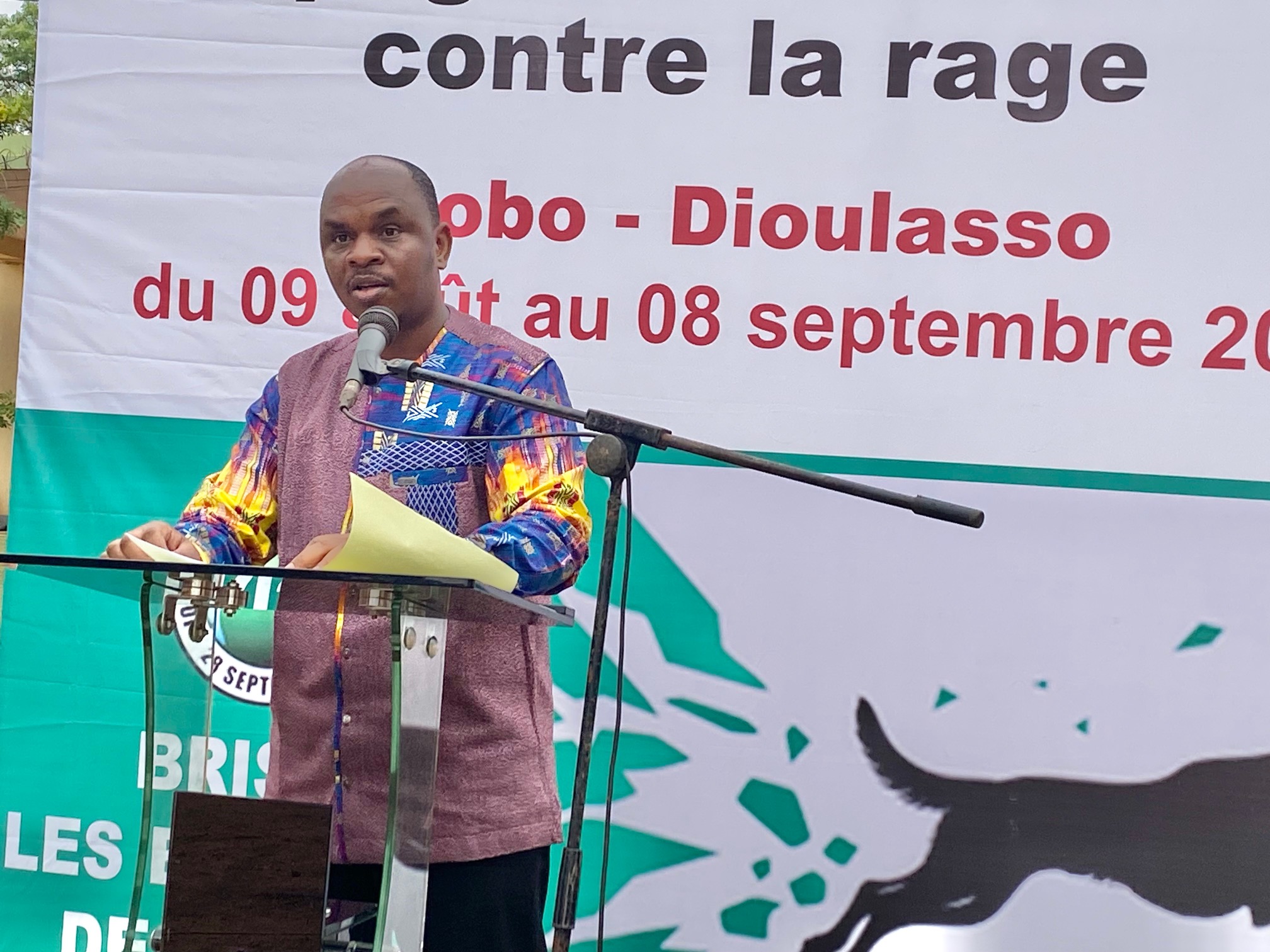
Minister Amadou Dicko invites all stakeholders to support the vaccination campaign
He recalled that through a global multisectoral approach, the disease is listed among the five priority zoonoses. Since 2019, the commune of Bobo-Dioulasso has seen an average of 530 pet bite cases per year. “Given all these factors, FAO saw the need to support the community through the sector to vaccinate their pets. This vaccination campaign will be combined with a public awareness campaign so that they can vaccinate their animals,” he said. At the end of the operation, it is expected that 8,000 pets will have been vaccinated.
To make the canine rabies vaccination campaign a success, several strategies will be implemented. First, it involves a communication strategy to create awareness among the people through mass media. There is also a strategy to train the vaccination teams before they are deployed to various vaccination sites. These teams will be placed at defined vaccination centers in the seven districts of the city.
A permanent technical team has been set up, consisting of the veterinary clinic of the Directorate of Agriculture and Animal Resources of the Oue Department, existing private clinics and veterinary clinics in the city of Bobo-Dioulasso. These teams will intensify their work every day during the campaign, that is, from August 9 to September 8, 2024. The technical team composed of four people will ensure the distribution of the vaccine and the coordination and supervision of the teams of clinics and private clinics at the district level.
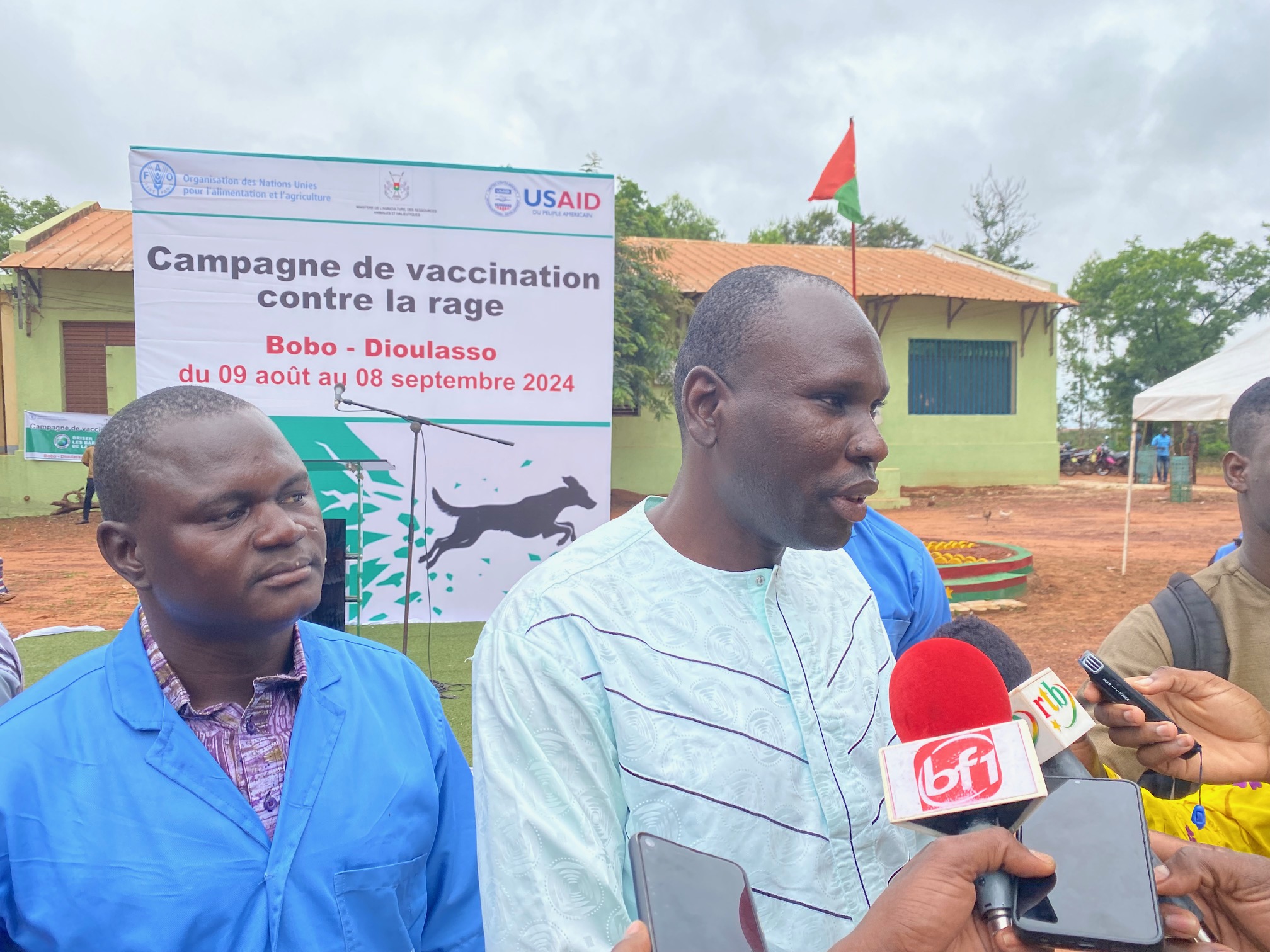
Benjamin Soubeiga, Acting FAO Representative in Burkina Faso, explains the type of support FAO is providing to the event
The ceremony of 9 August 2024 thus marked the official start of the rabies vaccination campaign in the commune of Bobo-Dioulasso. Its organization also involved the municipal authorities and was therefore attended by Laurent Kontogom, president of the Special Municipal Delegation. Benjamin Soubega said that FAO was not the first organization to support the country. He stressed that the agency supports the Ministry of Agriculture on a daily basis to strengthen rabies diagnostic capacities through on-site training in reference laboratories and the procurement of equipment, reagents and consumables. “So, at the global level, FAO, together with the other partners of the Tripartite Alliance, namely the World Health Organization, OMSA and GARC, are pushing countries to take action towards the global elimination of rabies by 2030,” he suggested.
In this context, FAO supports Burkina in 2022 to finalize its rabies prevention and control strategy by 2030. The FAO representative reiterated that the UN agency can support the Burkinaese government in the fight against animal diseases in general and rabies in particular. Minister Amadou Dicko invited all stakeholders to support the activities carried out within the framework of this vaccination campaign organized by Sya.
Romuald Dauphiny
Lefaso.com
[ad_2]
Source link

