

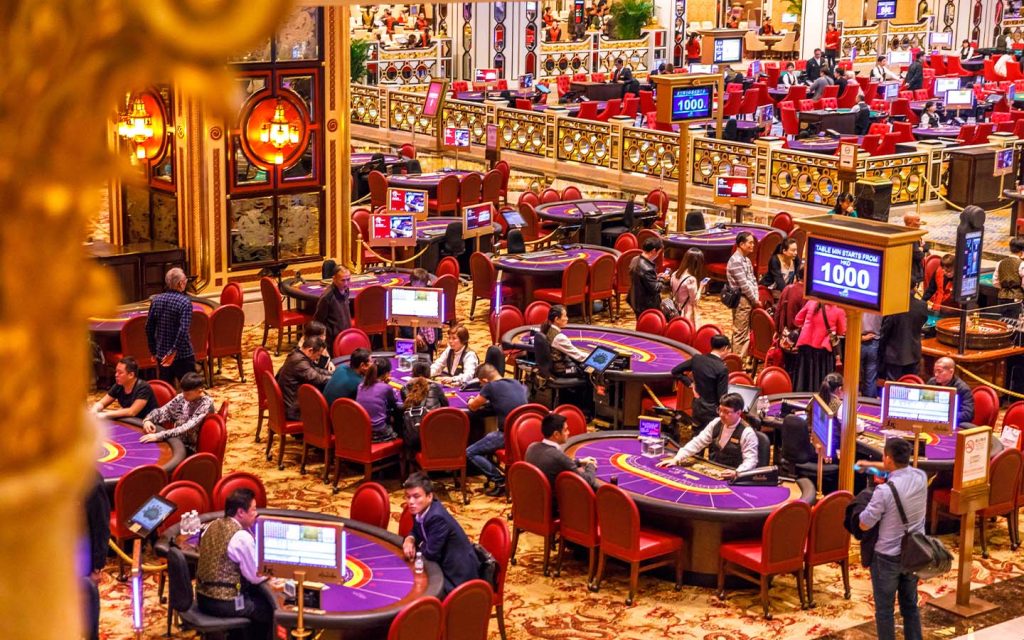
Walk into any casino in Macau and you’ll find crowds huddled around baccarat tables, placing bets and trying their luck.
The game, which bears a French name, is so popular here that Macau earned more than 29 billion patacas ($3.6 billion) from baccarat and VIP baccarat last year, according to the Macau Gaming Authority. Gaming Inspection and Coordination Bureau (known by its Portuguese acronym DICJ.) This accounts for almost 84% of Macau’s total gaming revenue.
[See more: The biggest better over the Labour Day holiday was a South Korean]
In other words, Macau yes Baccarat. Still, the game is more closely associated with James Bond and Monaco’s Monte Carlo Casino than the bustle of the Cotai Strip. To outsiders, it’s also a bit of a mystery.
Before you place your bets, here’s what you need to know about Macau’s classic card games.
What is Baccarat? How to play?
The simplest formBaccarat is a contest between two hands of cards – the “dealer hand” and the “player hand.” (Note that “dealer” and “player” do not refer to any specific people; they are just names for the cards.)
The winning hand is the one that is as close to 9 as possible but not more than 9. As a gambler, you are betting on whether the dealer or player’s hand will win, or whether they will tie.
[See more: Nearly 22 billion patacas were collected in gaming taxes in the first quarter]
Game rounds are called “coups” and the dealer is called a “croupier”. To start the game, you place a bet. The croupier deals a face-down card to the player, then a card to the dealer, and then one card each to the player and the dealer.
In Macau, a ritual is almost always performed before the cards are turned over. Chinese gamblers like to squeeze or peel the cards, slowly revealing one number at a time. It is a process full of superstition, as if they are praying to the gods to change the numbers in their favor.
Typically, the dealer will give the highest bettor the right to flip the cards, allowing them to try their luck.
Cards 2 through 9 of any suit are valued at face value. 10, J, Q, and K are worth zero, and Ace is worth one. If the total of the two cards drawn is greater than 9, the first digit is removed. For example, if a hand consists of a 6 and a 7, they are worth 13, but removing the first digit 13 makes the final value 3.
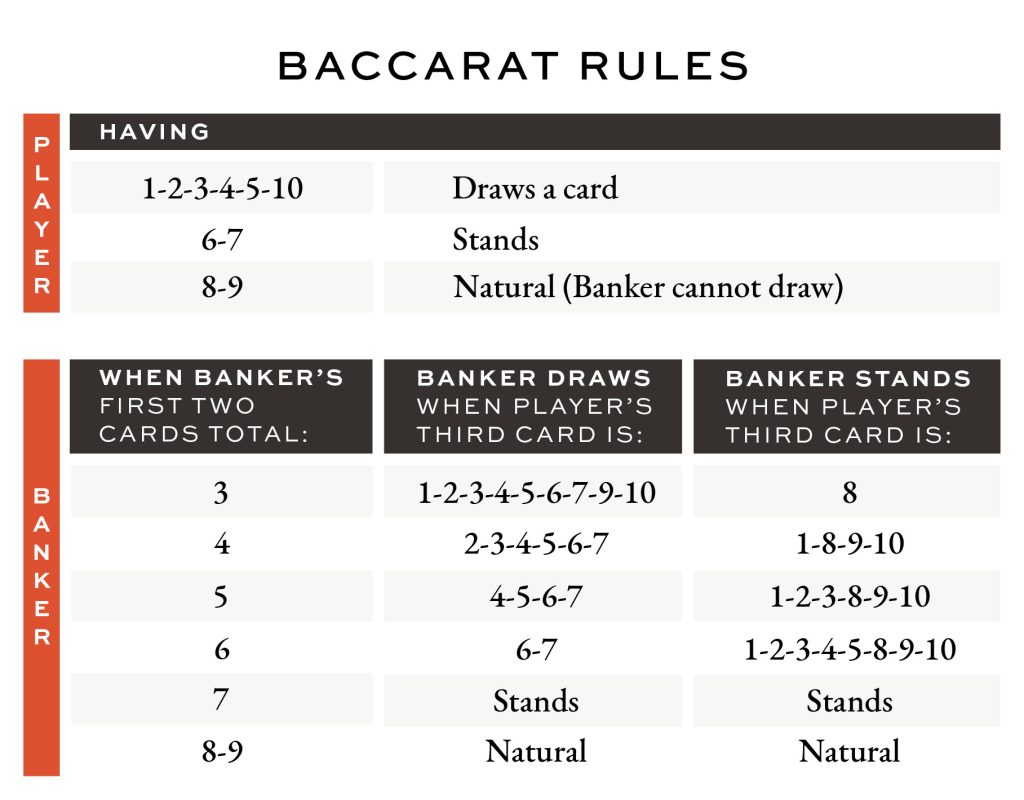
If the player or dealer’s hand totals 8 or 9 after the first deal, the game is over. This is called a natural eight or natural nine. If the player’s hand is 6 or 7, stand. If the total is 5 or less, a third card is dealt.
The rules for players are simple, while the rules for the banker are more complicated.
In Baccarat, gamblers cannot decide whether to draw a third card. Unlike in Blackjack, where players can decide to draw another card or stand, in Baccarat, drawing a third card is determined by the total points shown by the player and the dealer and a special rule sheet called a “card table”.
For example, when the dealer’s first two cards total 5, if the player’s third card is 4, 5, 6 or 7, the dealer will draw; if the player’s third card is 1, 2, 3, 8, 9 or 10, the dealer will stand.
Remember: These outcomes are not determined by the gambler. The dealer must remember the bet and stick to it.
How to win at Baccarat?
Each round has three possible outcomes: the player wins, the dealer wins, or the two tie.
Player bets are always paid 1-to-1. If you bet HKD 1,000 on the Player hand, you win HKD 1,000. In standard Baccarat, the Banker bet is charged a 5% commission, meaning that 5% is deducted from your winnings. But No Commission Baccarat (NCB) simplifies the game.
[See more: Mass-market baccarat revenue soars year on year]
In NCB (which is currently the most popular form of Baccarat in Macau, as there is no “tax” on gamblers), the banker’s bet is also 1 to 1, unless the banker wins with 6 points. In this case, you only get 50% of the bet amount.
Standard baccarat is usually reserved for VIPs and high rollers. In fact, one gaming industry insider who wished to remain anonymous said that more than 90% of the baccarat played in Macau’s main casino floors is NCB; at the VIP tables, “[NCB] Probably only 1% of gameplay.
Where did the game of Baccarat originate?
While pop culture fans often associate baccarat with fictional spy James Bond, who, among other vices, has a penchant for the high-stakes card game, the game’s roots run deep.
Some people say that Baccarat is from Pai Gowan ancient Chinese card game. Pai Gow Translated as “make nine”, nine is the highest score in Baccarat, so the two are related. The game may have first appeared in Italy over 700 years ago. This supports the idea that it originated in China, as Marco Polo returned to Europe from his travels in Asia in the late 13th century.
[See more: RFID tables could give Macao authorities vast amounts of data]
Despite this, the sport is often associated with France. According to a paper written by Theodore Whiting, History of Baccarat Researchers at the University of Nevada, Las Vegas’ Center for Gaming Research say baccarat was probably introduced to France in the late 15th century during the reign of Charles VIII. Baccaratwhich is said to mean “zero” in Italian, although Whiting disputes this.)
However, Baccarat does not appear in historical records until the 19th century. During the Napoleonic era, in the early 19th century, Baccarat became strict Whiting writes that a similar situation existed among the French nobility. The situation was completely different then. Baccarat Bankthis is played between three people.
Later versions were called railway (French for “railway”) turns it into a two-player game. Bank Point The Macau version was developed in Cuban casinos in the 1940s. American casino operators then brought it to Las Vegas, where it has since become a global phenomenon.
Why is Baccarat so popular in Macau?
Today, baccarat can be played everywhere from Monaco to Las Vegas, and Macau has become the world’s top destination for the card game.
Some speculate that this is because it appeals to the Chinese preference for consensus and collective action. Unlike the individualism of poker or blackjack, where gamblers are dealt their own cards, there are only two hands in baccarat – the player’s hand and the dealer’s hand. According to a source in the gambling industry, “usually everyone will bet on the same hand” in the hope of combining their luck to beat the house.
However, the more direct reason can be attributed to pure mathematics.
Unlike poker or blackjack, baccarat requires no complex strategy, no splitting, holding or doubling, no skill, and no knowledge of the other players’ abilities. You simply bet on the banker or player. It is a game of pure luck, and this simplicity means that baccarat has the lowest house edge of all games.
[See more: How to eat, drink and entertain yourself for free at Macao’s casinos]
With the Banker bet, the house edge is just 1.06%. By comparison, the house edge on Macau’s European roulette, which has only one zero (0), is 2.7%. If you play American roulette, which has an extra pocket, double zero (00), the house edge is even greater at 5.26%.
As long as you avoid tie or other odd bets (which can give the house an edge of up to 10-16%), you have a better chance of beating the house when playing baccarat than when playing roulette.
In other words, Hong Kong SAR’s savvy gamblers have found a game that gives them a better chance of winning: baccarat. But don’t expect that to change any time soon.
[ad_2]
Source link

