


[ad_1]
Biratnagar, July 18. In front of Dingbandu Goyal’s house at Biratnagar Bus Park, there is a stretch of road connecting Biratnagar to Dharan. Some time ago, when the road was upgraded, it reached the height of the house. Since then, his house has started to flood even during normal rainfall.
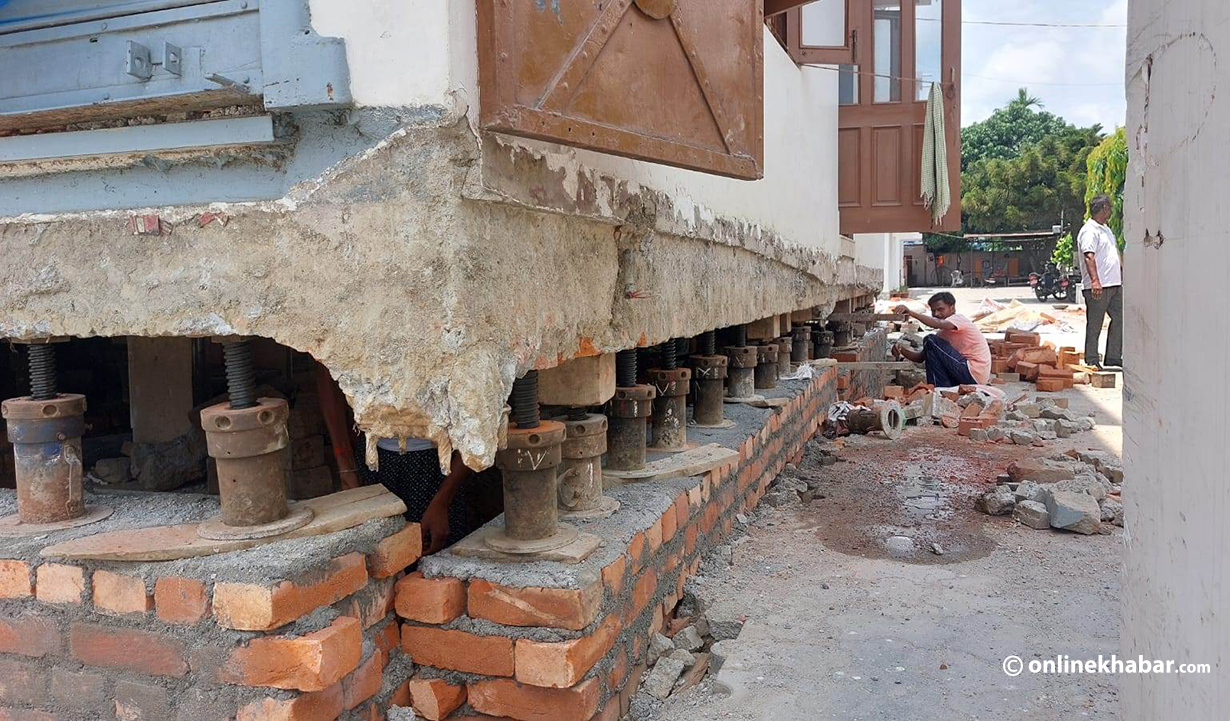
To save existing houses from flooding, Goyal has adopted a new method called lifting technology. By using this technology, he recently raised his house by nearly 4 feet. After using the lifting method, Goyal’s house has come to the road surface. At the same time, he also moved another building from one place to another.
Goyal is not the only one who has used crane technology to move his concrete house from one place to another in Biratnagar. Earlier, industrialist Rajendra Raut also used crane technology to move his two-storey building from one place to another.
Raut, who is also the president of Federation of Nepali Chambers of Commerce and Industry of Koshi district, moved the building to a location about 55 feet away from its original location.
Raut said that in order to build the new hospital structure, the old building was moved from one location to another. “The building has been moved on top of the old foundation by cutting the old foundation and building the new one. This is probably the first building in Nepal where the building has been adapted in this way,” he said.
According to Raut, the building was moved by preparing new foundation at a cost of 10-15% of the cost of building a new house. It took about two months to move the building from one place to another.
Industrialist Rakesh Surana had also built a four-and-a-half-foot single-storey building in his Duhabi of Sunsari about a year and a half ago. He said that during the road expansion, when the house built for office purposes was flooded, it was lifted using a crane. A team with Indian expertise was deployed to lift and move all three houses.
Surana claimed that there was no problem with the house even when it was lifted and moved from one place to another. “After the office was below the road, I raised it above the road by lifting and there was no such problem,” he said.
Surana said the problem of drowning has been resolved after the buildings were raised above the road through the hoisting method. Most of the old houses in the Biratnagar market area are below the road level. Therefore, there was a problem of drowning during the monsoon.
How does the building move?
For the “house lift,” technicians cut the beam structure at the base of the house and used a “pot” similar to the one used to lift a car to adjust the balance. After laying the foundation around the basement of the house, technicians rotated the foundation and lifted it up. After the foundation was laid, they built a concrete and brick structure on the empty lot.
Technicians claim that there is no risk in building a house using ordinary iron foundations. LBL House Lifting of India used 300 foundations and 30 workers to lift a two-storey house at a bus depot.
Lalchand Kumar Gupta, the engineer in charge of hoisting the house, said he was doing it safely using normal techniques.
Gupta, an engineer, said house lifting is also known as “Jag technology.” He said he works in India and Nepal. He said it takes at least two months to prepare and build a house.
[ad_2]
Source link

