


[ad_1]
Kathmandu, June 28. A landslide at Simaltal on the Narayangadh-Muglin road swept away two buses and carried them to the Trishuli River. But 20 hours later, the buses were still missing and at least 48 passengers on board could not be rescued.
Bharatpur Municipal Corporation-29 Simaltal was hit by a landslide around 3 am on Friday. Bagmati Pradesh-03-006 B 1516 Angel Deluxe bus travelling from Birganj to Kathmandu and Bagmati Pradesh-03-001 B 2495 Bagmati Deluxe bus travelling from Kathmandu to Gaur were swept away by the landslide in Lido and fell into the Trishuli river.
According to the ticket challan records registered by the bus commercial company, there were 27 passengers on the Ganapati luxury bus and 24 on the Angel luxury bus. But it is not clear how many passengers got off or boarded midway.
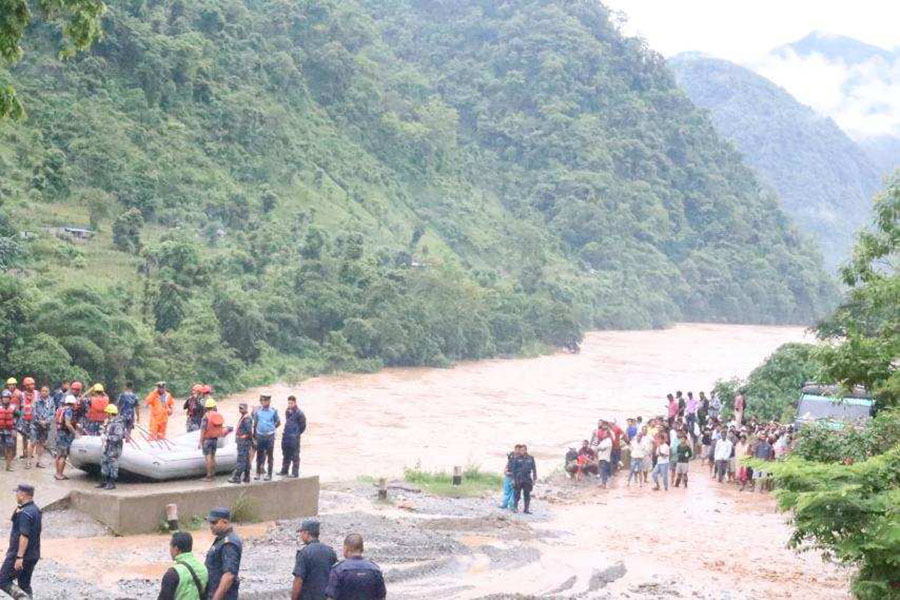
The three people in the car survived by swimming in the river. Based on the information they provided, the security personnel started the rescue operation from early morning. Nothing was found until the evening. According to DIG Kumar Neupane, spokesperson of the Armed Police Force, the rescue operation was suspended at around 6 pm.
The rescue team will start the search operation from 8 am tomorrow. “The water flow in the river has not decreased. DIG Neupane said that there is a risk at night, “even after searching 3-4 kilometers away from the incident site, nothing was found. All the rescue teams deployed there have returned.”
Due to continued rain and landslides, divers heading out to search for the missing bus and passengers also had to rush to the scene.
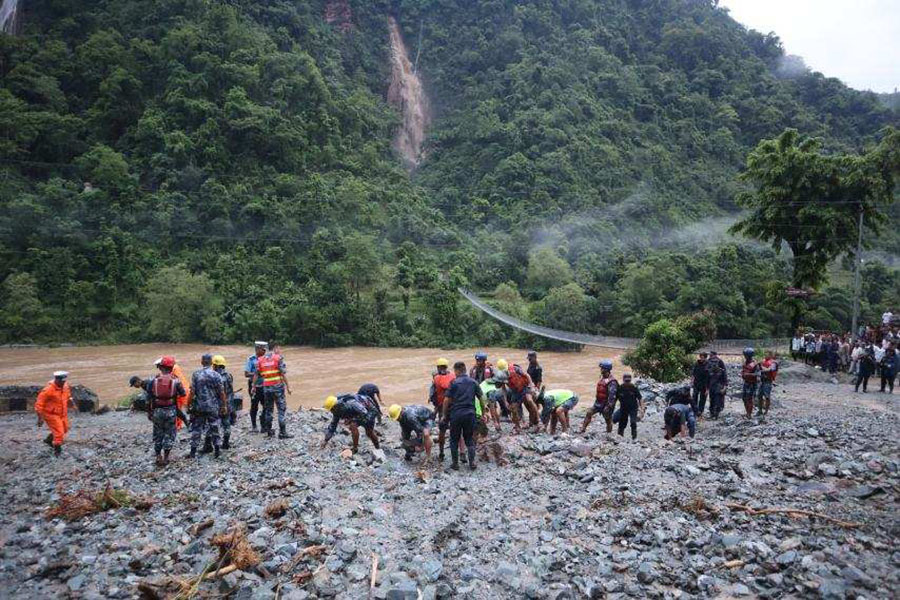
Neupane said that the Nepali police deployed four armed boats, five motorboats, diving teams, etc. to search for the missing bus in Trishuli. Rods and magnets were also used to find the missing bus. But until the evening, nothing was found except a piece of cloth that looked like a bus curtain.
This is not the first time that a bus has fallen into the Trishuli River on the Narayangadh-Muglin stretch, as there have been many accidents on the banks of the Trishuli River before. A total of 70 people, including 12 armed divers, 74 Nepal Army personnel, including five Nepal Army soldiers, Nepal Police and a large team started searching for the missing bus in Trishuli from the early hours of the morning, but they have not found it.
On August 9, 2007, the car of former chief secretary Madhav Prasad Ghimi, who was the home minister during the Giraj Regmi government, also met with an accident on the same stretch in Guptavir. The car he was travelling in fell into Thrissur, killing three people. His condition remains unknown.
Security agency rescue team members claimed that there was no lack of resources and equipment for disaster relief. According to members involved in the rescue, the problem was that the water flow was deeper and faster at the accident site.
According to the Armed Police spokesperson Nopane, the main reason for the delay in rescue was the heavy river flow and rain.
Although they have enough resources and means to carry out the rescue, the problem is caused by the continuous rain and the unabated flow of the river. “We have all the resources and equipment from trained divers to motorboats. We have searched using the highest search means,” said Newpane, “today the water is turbid and there are some obstacles due to the continuous rain. “It is not another problem.
SP Janak Puri of the Disaster Management Training School at Kulintar also said they had success in places with high water flow and turbid water. “Even in bigger and deeper rivers we have had success with the equipment we have,” he said, “but today the flow was high.” The rope used by the divers also runs the risk of being cut by rocks in murky water. That’s why it has to be stopped.
According to SP’s Puri, the ropes used by Nepalese divers are able to withstand up to 10 tons of water. “This is the same mop used all over the world,” he said. “Other than that, it’s not that we don’t have the equipment, but we don’t have the manpower.”
The roads are not safe either
Roads are being built with the help of foreign donors at an investment of billions of rupees, but Nepal is suffering huge losses due to lack of attention to road safety. The Narayangadh-Muglin stretch is an example. Passengers and freight vehicles coming from the east and west are being damaged and harassed due to this road.
This stretch of road, which was built with the help of the World Bank (ADB) at a cost of about Rs 300 crore, has been blocked many times not only during normal rainfall but also due to landslides during droughts. After the expansion of two dedicated lanes five years ago, landslides occur in some places every year. People have spent tens of millions of rupees to prevent landslides, but the effect is almost zero.
Dozens of fatal accidents occur every year on this stretch of road, but the authorities are oblivious. No road safety measures have been taken on this stretch of road. Even in places where landslides frequently occur, there are no warning signs.
It was only after the Simartal accident that the Ministry of Interior decided to put up warning signs at places where landslides and floods are likely to occur. The road department and traffic police will put up signs at places where there is potential danger.
According to the Bharatpur Highways Department, 12,000 vehicles pass through this stretch of the Muglin-Narayangadh road every day. This is the fourth time this year that the road has been completely closed due to landslides.
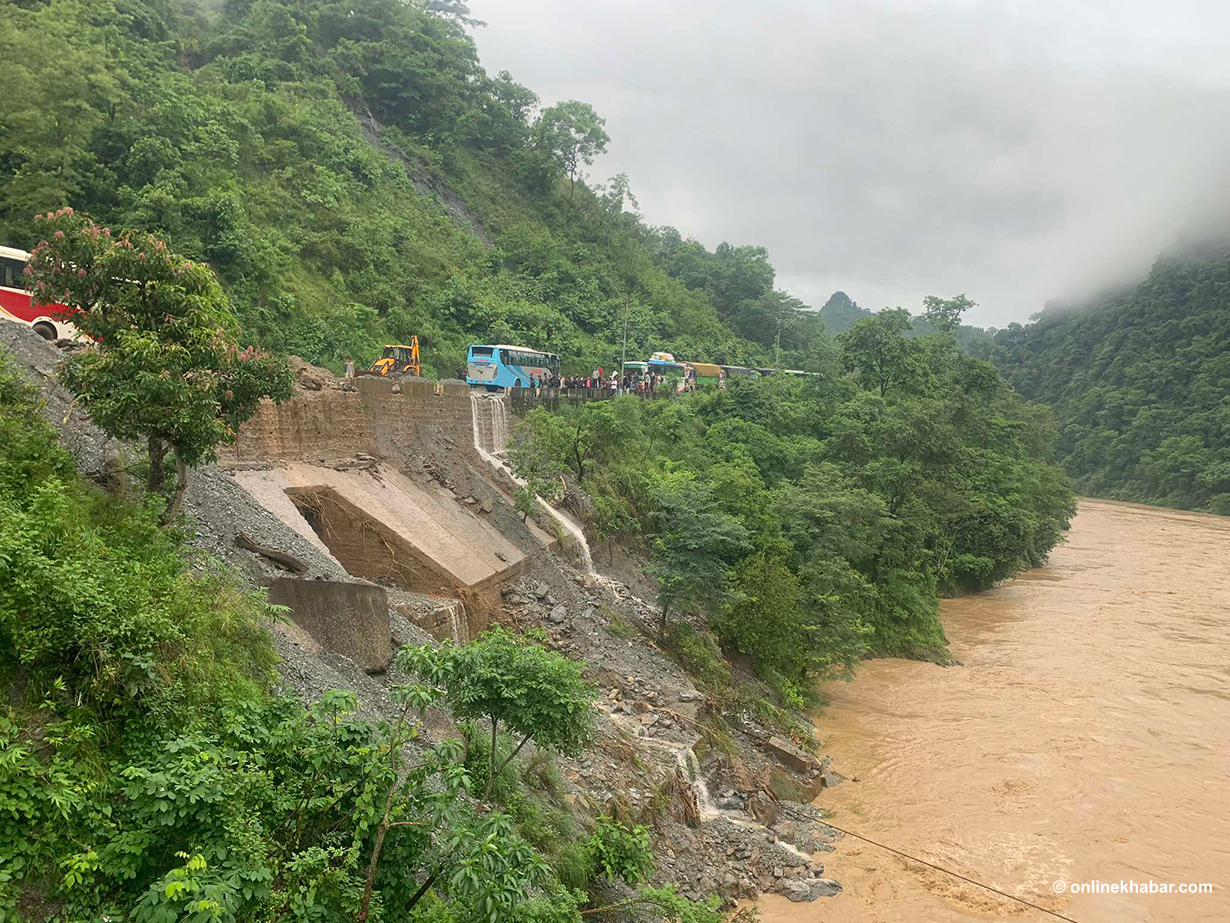
Experts believe that while pursuing development, building infrastructure without conducting scientific research will cause losses. Road safety expert Padam Bahadur Shahi said that there is not enough research on road infrastructure construction. “It seems that landslides falling from above are affecting road safety in many places. For this, a lot of research and studies need to be done,” he said.
Shiv Nepal, former director general of the highways department, said the competition among the three levels of government to build new roads in the name of development in recent years has been a disaster. He said the three levels of government have focused more on building new roads rather than investing in upgrading and repairing existing ones.
Nepal said that while the plan was initially to stabilise the land at 36 locations on the Narayangadh-Muglin road where landslides were likely, it was not continued. ‘Work had been going on for some time. But then it was stopped and now it seems that there are many new landslides,’ he said. ‘We should re-examine it and move forward with the plan.’
Nepal also said that digital information boards have been placed on the Narayangadh-Muglin section and the VP Highway for about 70 years to inform of possible accidents. “The technology made by the Japanese was shut down after they left. We can neither invest nor have the manpower to repair it,” he said. “We don’t know if the technology is working now.”
No night riding
As the number of accidents increased due to rains, the administration has decided to ban night driving in areas where a ‘red warning’ (high risk notice) has been issued, including the Muglin-Narayangad stretch.
The decision was taken at a meeting held at the Disaster and Conflict Management Department of the Ministry of Home Affairs on Friday. The schedule will be arranged by the Transport Management Department and transport professionals, said Bhishma Kumar Bhusal, director of the Disaster and Conflict Management Department of the Ministry of Home Affairs.
However, instead of paying attention to road safety management, the government has adopted a policy of stopping vehicles from running at night, which has caused dissatisfaction among stakeholders. Transportation professionals and security personnel have suggested that simply stopping night bus operations will not solve the problem, but rather recommend paying attention to road safety.
Who will bear the losses when services are stopped? Some places may have to close! However, it should not come to a standstill,” said Saroj Sitaula, senior vice president of the Nepal National Federation of Transport Professionals.
Vigyanraj Sharma, former AIG of Nepal Police, also said that it is not appropriate to ban night bus operations for the entire summer. He believes that while stopping services for a few days or a period of time is okay from a safety point of view, it is not appropriate to stop services for a long time.
“The state cannot stop the movement of Monchi and say you can’t walk. There is no need to decide to stop for 2/4 hours or a day or two because of floods and landslides,” said former AIG Sharma, “but it does not make sense to stop forever.”
[ad_2]
Source link

