


[ad_1]
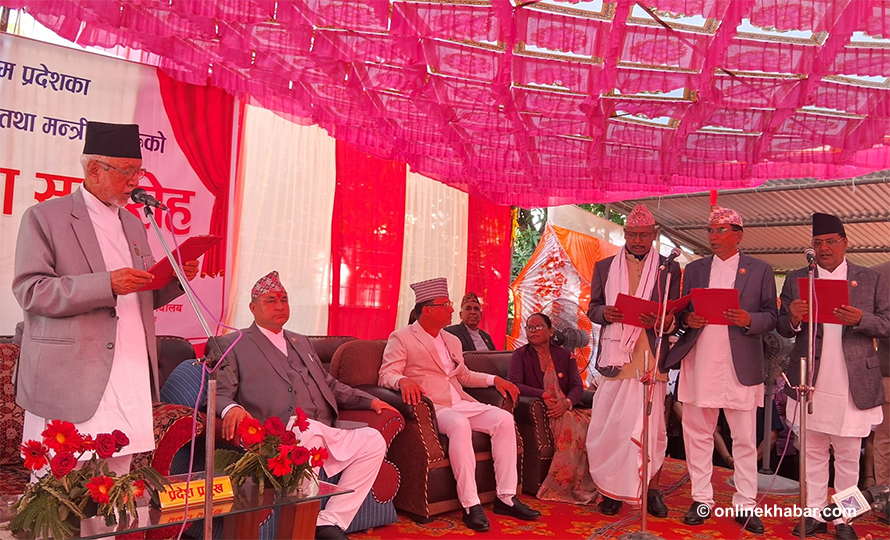
Far Western Minister sworn in
Dhangadi, July 21. Far Western Province Chief Minister Kamal Bahadur Shah has completed the formation of the cabinet immediately.
Earlier, on January 26, 2079, he completed the Council of Ministers in just five and a half months after taking office as the Chief Minister for the first time.
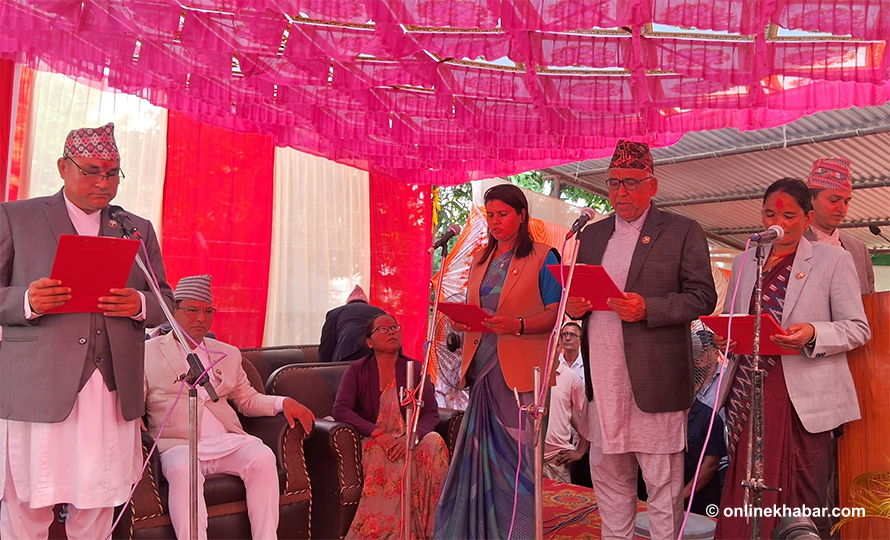
On Monday, Shah appointed two ministers and two state ministers from the Nepali Congress, three ministers and one state minister from the Communist Party of Nepal-Unified Marxist-Leninist and one minister from the Civil Liberation Party.
Bahadur Singh Thapa of the Congress is in charge of economic affairs, Meghraj Khadka is in charge of social development affairs, Surendra Bahadur Pal of the UML is in charge of physical infrastructure development affairs, Hira Sarki is in charge of home affairs and law affairs, Bir Bahadur Thapa is in charge of land administration, agriculture and cooperatives and civic liberation affairs and Lakshman Kishore Chaudhary of the party’s industries, tourism, forestry and environment departments.
Congress’ Prakash Bahadur Bam is the Minister of State for Economic Affairs, Saraswati Khadka is the Minister of State for Social Development and UML’s Nirmala Devi Saund is the Minister of State for Physical Infrastructure Development. Along with the Chief Minister, the ministers and ministers of state assumed office on Monday after taking oath of office and keeping confidentiality.
Shah said that by providing integrity to the government, he was sending a message that it was ready to work quickly. “You saw the process of forming the government today, we did it in one go. After watching the formation process, the message was that the government will work quickly,” Shah said.
He recalled that he used to worry for a long time about who would be the minister.
Shah first assumed office as the chief minister on January 26, 2079 and besides the Ministry of Physical Infrastructure Development and the Ministry of Economic Affairs, he also holds four other ministries.
On June 6, 2080, on his 101st day in office, Shah expanded his cabinet for the second time by adding three ministers and a state minister. On July 10, 2080, he completed his third term in office.
Rajendrasingh Rawal, leader of the main power partner party, CPN-UML state congress party, said the government had been given immediate completeness to speed up development work in the state, which was in a budget vacuum, to allay public discontent.
He said the government had achieved integrity at the same time because both sides took seriously the issue of wasted work time when departments were caught in disagreements.
“We have taken this seriously from the beginning. If we get into Bhagabandha, there is a risk of internal conflict. We have had bitter experience of different types of people playing inside political parties,” Rawal said. “Both parties will not be allowed to fail now.”
The UML left the government led by United Socialist Party leader Lon Sodari after the budget was not passed and the power equation changed.
Since then, the government, which lost its majority, has been unable to pass the budget, leaving it in a budget vacuum from July 1. Congress-UML leaders said this is why there is moral pressure to complete the government.
A leader of the alliance said that the provincial government could accomplish it in one go due to the initiative of the top leadership.
“Though state-level leaders discussed the issue of partition among themselves, no agreement was reached,” the leader told Khabar Online. “This became possible after Congress president Sher Bahadur Deuba and Prime Minister KP Sharma Oli decided on the name of the partition, along with the ministers and central ministries.”
According to the leaders, the top brass of both parties have finalised the list of ministers and directed the government to complete it on Monday.
In this cabinet, Shah also had senior ministers like Megraj Khadka, Bahadur Singh Thapa, Surendra Bahadur Pal who had retired from politics.
The government also became inclusive as women, tribal and Dalit communities also had a place in Shah’s cabinet.
The Council of Ministers has more leaders from the erstwhile Seti and Mahakali regions.
[ad_2]
Source link

