


[ad_1]
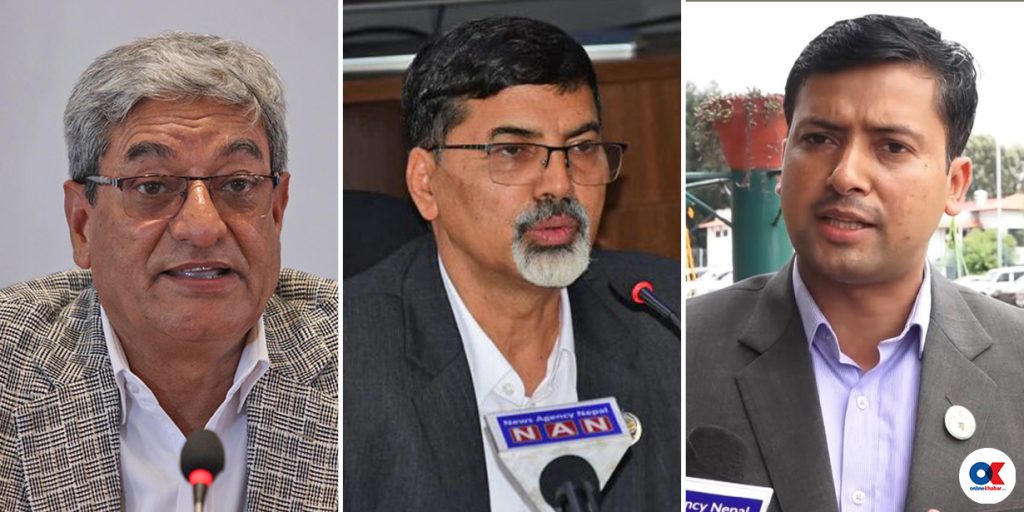
The leaders are Ramesh Akhtar, Janardhan Sharma and Mahesh Bertaula.
Kathmandu, 8 July. The three main political parties have agreed to arrange for penalties for those who committed serious human rights violations during the armed conflict to be reduced by up to 75 per cent from current law.
The leaders said they were ready to submit a report to the top leadership tomorrow after seeking consensus on the remaining issues.
The bill to amend the Missing Persons Investigation, Truth and Reconciliation Commission Act has long been pending in the House of Representatives Law Committee. The committee resolved most of the issues and sought the highest consensus on four issues.
Despite numerous discussions and agreements, the bill has yet to move forward.
The top leaders of the three parties had last entrusted the three leaders to agree on the controversial issues on June 13. The task force comprising Ramesh Ukhtar of the Congress, Mahesh Bertaula of the UML and Janadan Sharma of the Maoists is ready to submit a report to the top leaders tomorrow after finalising all the issues.
Cases of serious human rights violations are prosecuted, but in accordance with the principles of transitional justice in such cases, the bill provides that the penalties should be reduced to those provided for under existing law.
At a meeting held in Baluwatar on Tuesday, the leaders reached a consensus on reducing the punishment.
According to the proposed bill, in cases of human rights violations, reconciliation can be carried out with the free consent of the victim, but in cases of serious human rights violations, a case can be filed. In such cases, the bill will reduce the sentence in accordance with the current law in accordance with the principles of transitional justice.
To this end, there are some conditions, such as revealing the truth of the incident and submitting a statement of the truth to the committee or court, assisting the judicial process, confessing the incident and apologizing to the victim.
On this basis, there is a provision in the bill that the Attorney General can take up the case by requesting a reduction in sentence. But the two sides failed to agree on the amount of the reduction in punishment. Mahesh Bertaula, who is also the whip of the ruling party, said: “We are close to reaching an agreement on the reduction of sentence, with a reduction rate of about 70%.”
According to sources, an additional compensation of Rs 700,000 has been agreed to be paid to the families of the deceased security personnel. Earlier, they were given only Rs 300,000 while other victims of the armed clashes were given Rs 10 lakh.
That is, we assume that under current law, a maximum sentence of 20 years in prison cannot be reduced to less than 6 years when a sentence reduction is requested in transitional justice.
Another contentious issue is the definition of a serious human rights violation. There is a dispute over who should be included in arbitrary brutal killings or murders other than double confrontations. “The final result is not yet complete, but we are close to reaching agreement on arbitrary killings,” said a member of the working group.
Janadan Sharma, deputy secretary general of the Maoist Centre and a member of the task force, said that relief to the families of the deceased security personnel had also been finalised.
According to sources, it has been agreed to give an additional compensation of Rs 7 lakh to the families of the deceased security personnel. Earlier, they were given only Rs 3 lakh while other victims of armed clashes were given Rs 10 lakh. Now it has been agreed that everyone will get the same Rs 10 lakh and Rs 7 lakh will be deducted from the earlier Rs 3 lakh.
Now, what to do if no victim freely agrees to reconciliation in human rights violation cases, and the treatment and relief of militants under the age of 18 who are finally proven to be incapable, remain to be resolved.
At the meeting on Tuesday, Prime Minister Sharma Oli also took interest in the progress made so far. He also said that addressing transitional justice issues with victims at the centre was a priority for the government.
The ruling party’s chief whip, Bertaura, said the prime minister had also drawn their attention, “We will meet again tomorrow. After that, we will provide the conclusion to the top leader so that we can withdraw tomorrow.”
Sharma, another member of the working group, also said an agreement could be reached at tomorrow’s meeting.
[ad_2]
Source link

