

[ad_1]
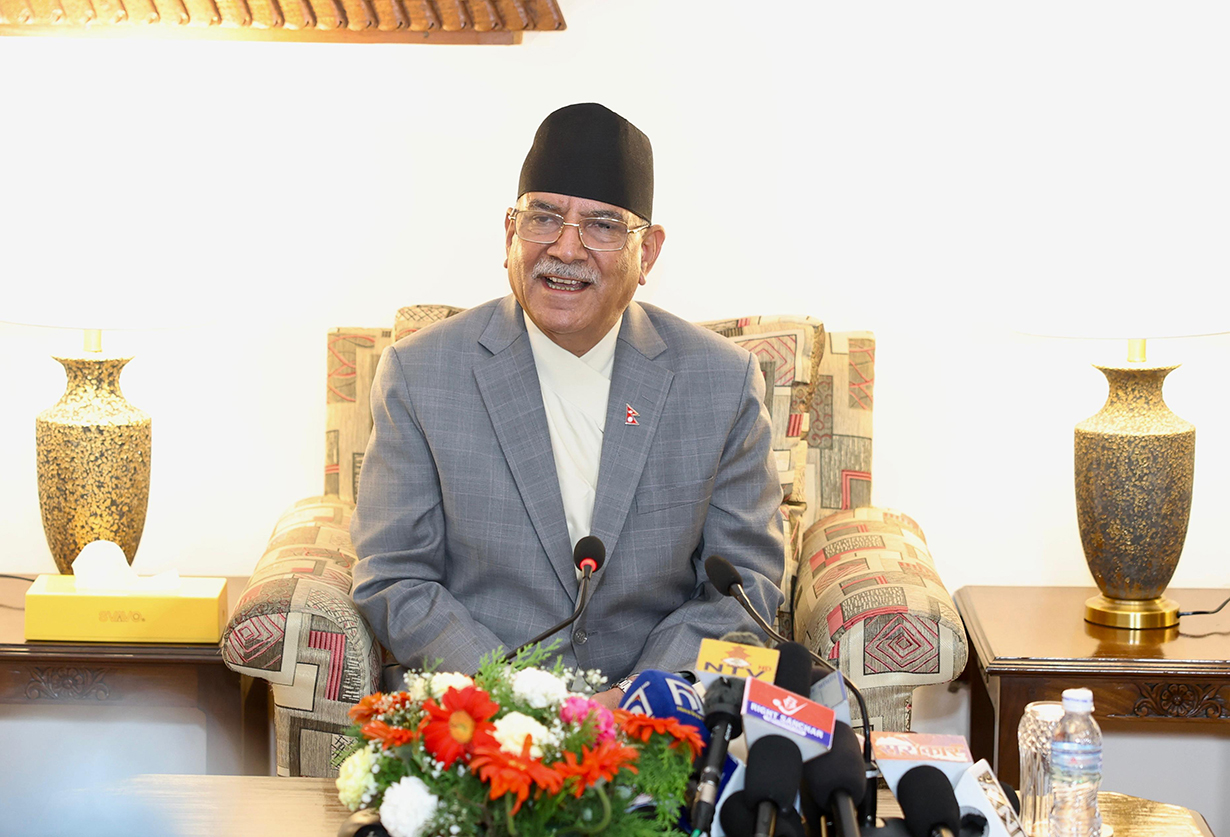
Kathmandu, June 28. Prime Minister Pushpa Kamal Dahal Prachanda, who arrived in Delhi to attend the inauguration ceremony of Indian Prime Minister Narendra Modi, has returned home hoping to initiate a mechanism to discuss issues between the two countries.
Prime Minister Prachanda travelled to New Delhi on Sunday to attend the swearing-in ceremony of Indian Prime Minister Narendra Modi, who was appointed as the Prime Minister for the third term, on Sunday.
On Sunday evening, Modi and Prime Minister Prachanda had a one-on-one meeting. Prime Minister Prachanda also had a courtesy call with Indian President Murmu, while Indian External Affairs Minister Subrahmanyam Jaishankar met Prachanda.
Prime Minister Prachanda said that during his meeting with Indian Prime Minister Narendra Modi and External Affairs Minister Jaishankar, he raised only one issue – the activation of SAARC, issues concerning the Nepal-India border and the mechanism between the two countries must be activated. Prime Minister Prachanda said that he returned to Nepal with optimism because his interest and request were positively responded to by Indian Prime Minister Narendra Modi and External Affairs Minister Jaishankar.
“Prime Minister Narendra Modi and External Affairs Minister S Jaishankar have responded positively to this. I hope – now the dialogue will start through the mechanism,” Prachanda told reporters at Tribhuvan Airport.
The South Asian Association for Regional Cooperation (SAARC) includes South Asian members such as Nepal, Bangladesh, Bhutan, India, Maldives, Pakistan, Sri Lanka and Afghanistan.
Since the 18th SAARC Summit was held in Nepal in 2014, there has been no handover of SAARC leadership. After Nepal, it was Pakistan’s turn to host the 19th SAARC Summit. However, due to the tensions between India and Pakistan, the 19th SAARC Summit failed to take place.
A side meeting of SAARC foreign ministers was held during the UN meeting, but the foreign ministers of India and Pakistan did not attend at the same time.
Prime Minister Prachanda believes that this foreign ministerial mechanism will now be initiated.
The bilateral mechanism between Nepal and India to discuss the border issue is also inactive. According to the Ministry of External Affairs, the highest bilateral mechanism between Nepal and India to discuss the border issue is the Joint Commission.
At the third meeting of the joint committee, a new mechanism called the Nepal-India Border Task Force was formed to repair the collapsed boundary pillars, restore the old pillars, transgressions and clear the areas of Dashgaja region except Kalapani and Susta.
It is headed by the Director General of the Surveyor General’s Department of Nepal and the Surveyor General of India. The Nepal-India Boundary Working Group also has a technical committee.
The Ministry of Foreign Affairs said that there is a mechanism for resolving the Kalapani and Susta issues, which consists of the foreign ministers of the two countries. But so far, no meeting of the mechanism at the foreign ministerial level has been held to resolve the Kalapani and Susta issues.
In addition to the border issue, there are also joint committees, ad hoc committees or mechanisms at the secretary-general level and joint secretary level between Nepal and India related to trade, transportation, energy, tourism, etc.
Nepal and India have also set up a joint committee to discuss issues such as politics, security and borders, economic cooperation and infrastructure, trade and transport, energy and water resources, and culture, education and communications.
Besides the prime ministerial level meetings between Nepal and India, the Joint Commission was established in 1987 and is seen as a strong diplomatic mechanism.
The second meeting of the joint committee was held in 1991. After that, the mechanism, which had been idle for 23 years, was revived after Indian Prime Minister Narendra Modi came to power. The Ministry of Foreign Affairs said that the mechanism was supposed to be held alternately in Nepal and India, but it did not play the expected role.
What has not been made public yet is that the Enlightened People’s Group (EPG) was formed with the responsibility of updating past treaties/agreements between the two countries, resolving border issues, and balancing trade imbalances.
Indian Prime Minister Narendra Modi agreed to form the EPG when he visited Nepal in 2014. The EPG formed accordingly includes Dr. Vesh Bahadur Thapa, Nilambar Acharya, Suryanath Upadhyay and Dr. Rajan Bhattarai from Nepal. The Indian side includes Bhagat Singh Kosiari, Professor Mahendra P Lama, BC Upreti and Jayant Prasad.
The last meeting of the EPG was held on June 16, 1975. Although six years have passed since the organization unanimously prepared this report, India is not ready to accept it and many issues in Nepal-India relations remain controversial.
Former Foreign Minister Saood said India’s willingness to initiate bilateral mechanism is an opportunity for Nepal. “If the Indian government says it wants to resolve the dispute through bilateral mechanism, then it is an opportunity for Nepal,” Saood told Online News.
He suggested that the government should hold a national vote and sit down at the negotiation table to resolve the dispute between the two countries. Congress leader Shat said, “In some cases, the parties in the ruling coalition do not seem to agree with Prime Minister Prachandaji, so I don’t think the current government can maturely advance the positive issues of resolving disputes through bilateral mechanisms.”
He mentioned that the party congress favoured a national consensus on international relations, adding, “The prime minister should understand that issues between the two countries should not become political issues but should be resolved through diplomatic means.”
[ad_2]
Source link

