

[ad_1]
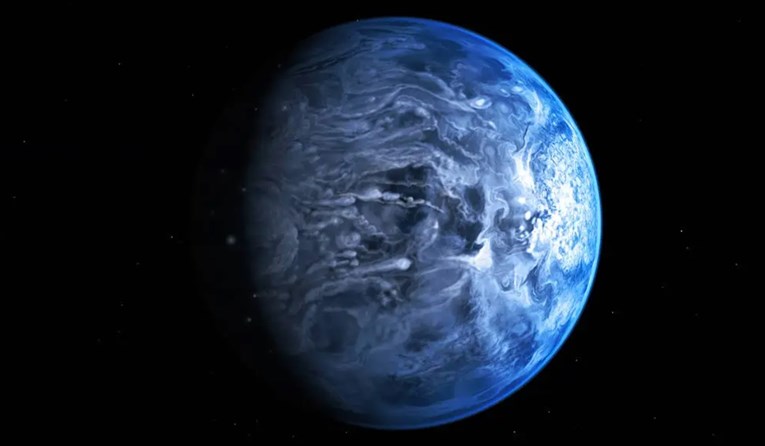
How to overcome that? Add hydrogen sulfide, a compound that produces the stench of rotten eggs. New data from the James Webb Space Telescope provide a more complete picture of HD 189733b, already one of the most studied planets outside our solar system, scientists announced today.
Traces of hydrogen sulfide have been detected in its atmosphere, which has not been observed on any planet outside the Solar System.
“Yes, the stench does add to its already notorious reputation. It’s not a planet we humans want to visit, but it’s a worthwhile target to deepen our understanding of planetary science,” said Guangwei Fu, an astrophysicist at Johns Hopkins University in Baltimore, who led the study published in the journal Nature.
It is a type known as a “hot Jupiter,” which includes gas giants similar to the largest planets in our solar system that are much hotter because of their proximity to their parent stars. This planet is 170 times closer to its star than Jupiter is to our sun.
The temperature on the side of the planet facing the star is about 930 degrees Celsius. “They are very rare. They are found in less than one in every 100 solar systems,” Fu said of hot Jupiters.
The planet is 64 light-years from Earth in the constellation Vulpecula in our Milky Way galaxy.
“The short distance makes it bright and suitable for detailed studies. “For example, it would be much more difficult to detect the hydrogen sulfide observed here on other, more distant planets,” Fu explained.
“While we are not looking for life on HD 189733b – it is so hot and mostly hydrogen and helium it is not like Earth, for example – understanding its atmosphere allows us to understand how physics and chemistry behave in different environments and begin to piece together the ‘secrets’ of planet formation,” he said.
[ad_2]
Source link

