

[ad_1]
A senior Hamas official said ceasefire talks had not made progress but the Palestinian group was still prepared to “be positive” about any proposal that included a “permanent ceasefire”.
The Palestinian Foreign Ministry has issued a statement condemning Israeli authorities’ reported plans to tax churches in occupied Jerusalem.
“Israel is an occupying power and has no sovereignty over Jerusalem,” the ministry said, adding that “Israel’s imposition of these taxes is illegal.”
The ministry added that the plan was part of a wider “systematic Israeli policy of persecution and attacks on Palestinian Christians and clergy.”
In recent months, municipalities in Israel including Tel Aviv, Ramla, Nazareth and Jerusalem have either sent warning letters to churches or taken legal action against them over alleged tax arrears, the heads of the Catholic, Greek Orthodox and Armenian Orthodox Churches said last week.
Church leaders wrote to Israel’s prime minister, calling the warnings and lawsuits a “coordinated attack” and part of “the Israeli authorities’ drive to expel Christians from the Holy Land.”
Here are the main events of the evening:
- Israeli forces carried out airstrikes and artillery shelling on the southern Gaza cities of Rafah and Khan Younis, while a ground offensive continued in the Shujaiya area north of Gaza City. The number of victims was not immediately clear.
- The Euro-Mediterranean human rights monitor accused Israeli forces of carrying out a “massacre” in Gaza City, saying it had received reports from teams on the ground that soldiers had executed “dozens, possibly hundreds of victims.”
- Israeli police have been brutally dispersing anti-government protesters in cities including Tel Aviv and West Jerusalem, with an opposition lawmaker accusing officers of assaulting her and pulling her hair.
- On June 8, Israeli Noa Argamani, freed from Hamas captivity, made her first public comments since returning home, calling on the Israelis to do “everything possible” to repatriate the remaining captives.
- International outcry intensified over Israel’s decision to legalize five settlements, with Egypt calling for global intervention to halt construction and Saudi Arabia saying “these violations undermine prospects for peace and exacerbate the conflict.”
Israel extends authority over one-fifth of West Bank
Israeli Finance Minister Bezalel Smotrich’s plan to recognize five illegal settlement outposts in the occupied West Bank has drawn condemnation from many governments, as well as representatives of the European Union, Arab League and United Nations.
In addition to recognizing the outposts, Smotrich’s plan would also remove civilian powers related to construction and zoning in one-fifth of the occupied West Bank, the so-called “Area B.”
in accordance with Oslo Accords The occupied West Bank was divided into Areas A, B and C in 1995, with Area B controlled by Palestinian civilians and controlled by Israeli security forces.
Arab League Secretary-General Ahmed Abu Gheit said Smotrich’s plan “eliminates any semblance of Palestinian autonomy, including in Area B” and represents “a complete and final rejection of the Oslo Accords.”
Saudi Arabia condemns Israeli settlement expansion efforts
The Saudi Foreign Ministry issued a statement expressing the Kingdom’s condemnation and condemnation of Israel’s decision to “blatantly expand its settlement activities in the West Bank.”
The ministry said Saudi Arabia “strongly opposes Israel’s ongoing violations of international law and internationally legitimate resolutions.”
The ministry said Israel’s actions had “serious consequences” given the “lack of international accountability mechanisms,” adding that “these violations undermine prospects for peace, exacerbate the conflict and undermine regional and international security and stability.”
What happened to Israel’s weekly anti-government protests?

Al Jazeera reports from outside Israel because the Israeli government prohibits it from doing so.
Demonstrations took place in 80 different locations across Israel, with protesters demanding immediate elections and the resignation of Prime Minister Benjamin Netanyahu.
Tens of thousands of people gathered in Tel Aviv for the weekly demonstrations, but we also saw thousands outside the Israeli prime minister’s residence in West Jerusalem. Now the police have forcibly dispersed these demonstrators, some of them quite violently, and detained several people in West Jerusalem.
The move comes after a new poll by Israel’s Channel 12 found that two-thirds of respondents want Netanyahu to resign and exit political life. About 66% of Israeli voters also want to see a change in Israel’s government.
These demonstrations have been going on for months, and the demands appear to be growing. They want to see a deal for the return of remaining Israeli prisoners, they want Netanyahu to resign, and they want the war to end.
Organizers of those demonstrations said they would continue until their goals were achieved, but Netanyahu said the war would continue until absolute victory was achieved.
Fighting continues in the Shujaya area of the Gaza Strip.
What is happening now is a direct military conflict between local Hamas militants and the Israeli army.
Palestinian militant groups said they ambushed and trapped Israeli soldiers, attacking them with a variety of explosive devices and anti-tank missiles.
Israeli troops continue to attack residential areas and Hamas militants. They say they are targeting remaining Hamas battalions as they try to rebuild their military capabilities.
Homes in these areas were heavily bombed, killing dozens of Palestinians.
Piles of garbage and ‘unbearable’ heat are worsening sanitary conditions in Gaza: UNRWA
UNRWA spokeswoman Louise Watage said Gaza’s summer heat had become “unbearable” and many families were “living under plastic sheets” as “temperatures soared”.
Watridge also noted that sanitary conditions for displaced people living “next to mountains of garbage and sewage” have become desperate.
Recent Events Review
- The Palestinian Red Crescent Society said its temporary headquarters in Khan Younis had been evacuated due to a “direct fire”.
- UN spokesman Stephane Dujarric said Israel’s ground offensive on the Shujaya neighborhood in Gaza City has displaced “at least 60,000” residents.
- The Israeli military said two soldiers were killed in Shujaiya.
- Four members of the Ghazi family, including a child, were killed when Israeli forces attacked a water point in Gaza City.
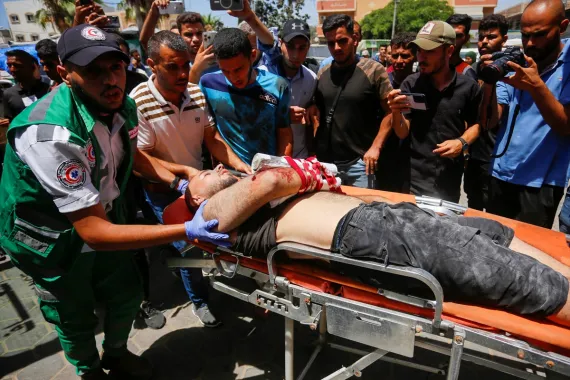
- The Gaza Health Ministry said that in the last 24 hours of the reporting period, Israeli attacks killed 40 Palestinians and injured 224.
- Massive demonstrations in Tel Aviv demanded the resignation of Prime Minister Benjamin Netanyahu’s government and a prisoner swap deal.
- Senior Hamas official Osama Hamdan said Hamas remained “ready to look positively at any proposal to ensure a permanent ceasefire.”
- Qatar’s Foreign Ministry said Israel’s settlement expansion plans and the brutal war in the Gaza Strip posed obstacles to a “just peace” in the region.
India exported missiles, explosives to Israel during Gaza war, documents show
As New Delhi struggles to walk a diplomatic tightrope, documents and company statements seen by Al Jazeera suggest Israel is receiving Indian weapons through the war in the Gaza Strip.
On June 6, Al-Quds News released video footage of the debris of rockets dropped by Israeli warplanes after Israel bombed a UN shelter in the Nusserat refugee camp in the Gaza Strip.
Amid the jumble of parts, a label that reads “Made in India” is clearly visible.
Documents and company statements seen by Al Jazeera suggest that weapons parts from India are being quietly transferred to Israel, including over a period of months, even as India has long advocated for dialogue rather than military action to resolve the conflict. War in the Gaza Strip .
Analysts say a lack of transparency in Indian money transfers keeps them under the radar.
read more here .
[ad_2]
Source link

