


[ad_1]
Published: Tuesday, July 23, 2024 – 10:10 PM | Last updated: Tuesday, July 23, 2024 – 10:10 PM
There are dozens of sites with Sidi as the title along the 500 km stretch from Alexandria to Salloum on the Libyan border (starting from Sidi Kil, passing through Sidi Abd al-Rahman and ending at Sidi Barani). In addition to Salloum and thousands of kilometers beyond Morocco, there are hundreds of sites with Sidi as the starting point: since Islamic times, the southern Mediterranean coast has become a very religious coast, and it has been so in all eras, especially in AD.
In the middle of the coast of Alexandria we have a famous site called “Santo Stefano”. You can think of “san” as the Christian counterpart of the Arabic word “sidi”. Christian texts indicate that Stephen (Stephen in the Egyptian Church) was the first martyr of Christianity, whom the Romans tortured and sentenced to death by stoning in 34 AD (he was not even 29 years old at the time).
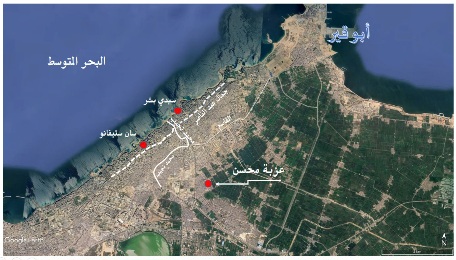 Map of the most important sites mentioned in the article
A few hundred meters further east, you will come across the “Sidi Bishr” Mosque, a unique and marvelous place. It is almost the only mosque that sits on a high hill facing the sea. Other Alexandrian mosques built for themselves entire lower floors and high stairs from where worshippers ascend to the upper floors for prayers, trying to imitate the nature of the original ancient Alexandria, which was originally built on a high hill.
For example, you will find this artificial imitation in famous mosques, such as the “Al-Qaid Ibrahim” mosque in the west or the “Al-Mandara” mosque in the east. Here, the importance of the site lies in its location in the middle of the coast, overlooking the blue sea, on top of the only remaining hill in the city.
I can think of the hill where the Sidi Bishr Mosque is located as a geography lesson for children. When we climb this small hill and enter the mosque, we are facing the “Qiblah”, from which the “Qibli” side gets its name, Upper Egypt is there, that is, to the south, and behind it is Mecca, Mukarramah, to the south (east) of Alexandria, but when we face the Qiblah, the sea is behind us, and the typical expression here is based on the concept of “seaside”, that is, facing north.
I have no doubt that the great sculptor Mahmoud Mukhtar, who built the statue of the leader Saad Zaghloul in the west of the city, expressed the presence of all Egypt by placing two beautiful women in front of and behind the leader: one looking out to the sea, dressed as a beautiful and charming Delta peasant woman, and one looking to the south, dressed as an Upper Egyptian woman with a beautiful, bold, slender figure.
The Sidi Bishr Mosque is about 10 meters from the coast. The explanation is very simple. Today’s Sidi Bishr neighborhood is a concrete jungle, built more than 50 years ago on an ancient sandbar area that was pushed inland by the sea.
The dunes are located on an ancient limestone ridge on the historic Mediterranean coast. Since the area was completely uninhabited 100 years ago, British colonists established the famous refugee camp on it to receive Russian refugees fleeing the communist revolution, the civil war, and the fall of the Tsar after the defeat in World War I.
Britain, hostile to Bolshevik Russia, provided support to Tsarist supporters hostile to the communist revolution, and then transported thousands of people to Egypt via the British fleet and established refugee camps for them.
Documents analyzed and interpreted by two great scholars, Gennady Gariyachkin and Vladimir Belyakov, tell us that the British health system in Egypt was very strict and that the Russian immigrants had to go through very difficult times, such as war, flight, asylum, famine and the arduous journey from the Black Sea ports to Port Said and Alexandria, where quarantine camps were initially set up for them.
Sidi Bishr is a remote, dry, sandy area far from the “real” Alexandria in the west: Al-Mansheya, Bahri, Al-Fanar (the castle), Ras El-Tin and El-Gomrok.
If we believe that climate change threatens to raise coasts and submerge low-lying cities, including Alexandria, then the Sidi Bishr Mosque will be the last thing in a city to sink.
I finished my walk in Sidi Bishr and planned to go to the south of the city. I first crossed the street “Mohamed Naguib”. I thought about the name carefully, which means that the name Mohamed Naguib has been angered in recent times, his memory and role were erased in the era of Abdel Nasser, and most likely no one used this name except this one for many years after him. In recent decades, perhaps in the era of Mubarak, he saw the beginning of the restoration of dignity to the role of Mohamed Naguib.
When you come up Mohammed Naguib Street again, it intersects with a crossroad that reads “Gamal Abdel Nasser,” and you smile at the political conflict that has left its mark even on the street names, which do not carry any of the flavor of what writers and historians call Alexandria’s “metropolis.”
There is absolutely no cosmopolitan ethnic, national, religious and colour diversity that characterized Alexandria in the late 19th and first half of the 20th centuries. In fact, there is “no” Alexandrian culture in this area, you won’t find any palaces, historic buildings, museums or any signs of the city’s former history.
The walk takes us to the railway line, where the train goes to the east of the city, to Abu Qir, from where people go to Idku and Rashid. This railway line is considered to be the dividing line between the two levels of urban development: the “Mediterranean” Alexandria in the north and the “Delta” Alexandria in the south.
The contact points between Alexandria are the “Tin”, a crowded square and a popular market called “Victoria”, named after the famous school in the area. The way the names of the school and the field are pronounced can be distinguished according to the context in which people speak, with learned people pronouncing it as “Victoria”, meaning “Victory”, while most people pronounce it as “Factia”, as if it were the name of a factory or workshop.
The railway crossing south from Victoria takes you through a street closely associated with the Republican events, called “Al-Jalaa”. The evacuation takes you to the street of Jamila Bou Harid, an Algerian freedom fighter who became a symbol of resistance to the French occupation of Algeria. Youssef Chahine directed a film about her, “Magda”, which won the Moscow Prize for Anti-Colonial Film. If Youssef Chahine or Magda had not seen this land with their own eyes, Youssef Chahine would not have traveled to Algeria until many years after the filming of the film.
I started browsing the streets that connected from Victoria, Al Jala, Sword Square and “Adeeb Moakab” until Al Faraki and from there to the estate and Delta Village, so I crossed “Nag Khattab” until I reached “Izbat Mohsen”.
In Ezbet Mohsen, I met Sheikh Refat after sunset prayers and asked him about the history of the influx, because he was my age, was born here and knew the details, and he told me a chapter of his memory about the influx of people who immigrated to work in the factories that had been opened in Alexandria 30-40 years ago.
The factories had no housing for their workers and the workers flocked to the farmlands, offering attractive terms to the farmers on the estates, who fell into terrible economic temptations and sold their land to immigrants from Beheira, Menoufia and Cairo, resulting in agricultural land being replaced by housing, buildings and concrete jungles.
Izbat Mosun and its sisters are missing, we have lost our farmland and food sources, we have lost our future!
Tired of roaming!
[ad_2]
Source link

