

[ad_1]
Oman’s rich seafaring heritage is reflected in its sailboats, which are renowned for their ability to cross the seas and connect Oman to the world. Omani sailboats come in all shapes and sizes, the most famous of which are the “jalboot”, “boom” and “ganja”.
Ali Juma Al Araimi, a boat builder in Sur, is a living testimony to the exquisite skills of Omani artisans. He stressed that the craft requires essential skills, including precise handling of wood and mastery of the intricate details of this delicate art.
The factory is located in Khor Al Bath, a few kilometers from Sur city, covers an area of 7,000 square meters and employs 20 people.
“Despite the widespread use of modern materials, wood is still commonly used in the shipbuilding industry,” Al Araimi said. “This is partly due to the growing demand for wooden boats in the tourism industry.”

Celebrating Omani shipbuilding tradition
Rich historical heritage
From its origins as a centre of trade and exploration to its current status as a major player in the global maritime arena, Oman’s relationship with the ocean is as enduring as the tides that lap on its shores.
Central to Oman’s maritime heritage are its ancient seafarers, the Dhofar culture, whose seafaring skills date back to 2500 BC. These skilled navigators sailed across the Indian Ocean in dhows, demonstrating Oman’s early mastery of maritime trade routes and exploration.
Throughout history, Oman’s strategic location at the crossroads of East and West has made it a vital link in the Indian Ocean trade network. From the bustling port city of Muscat, Omani merchants traded everything from frankincense to pearls, with influence reaching far beyond the Arabian Peninsula.
The height of Oman’s maritime power came during the Said dynasty in the 17th century. Omani sailors travelled to East Africa and Southeast Asia, opening trade routes and leaving a lasting mark on the region’s history. Muscat flourished as a commercial centre, attracting merchants from all over the world.
Foremost among Oman’s maritime heritage is its boatbuilding tradition, which dates back centuries. Artisans are renowned for their expertise in building dhows, using techniques that have been handed down from generation to generation. Today, although modern boatbuilding methods have been adopted, traditional dhow-building techniques still endure, standing as a testament to Oman’s maritime heritage.
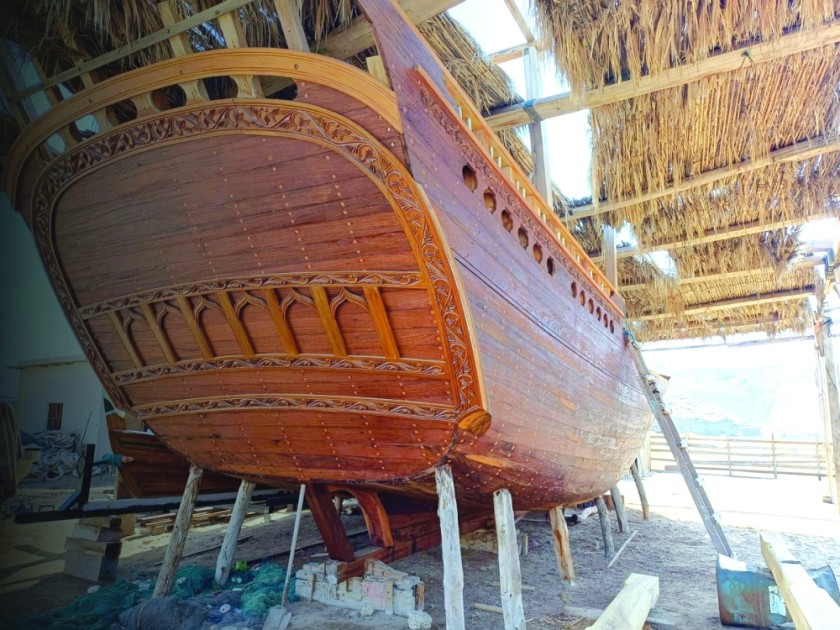
Celebrating Omani shipbuilding tradition
In modern times, Oman continues to harness the power of the sea to develop its economy. Investments in port infrastructure and maritime services have made Oman a key player in global trade and tourism. In addition, Oman’s navy plays a vital role in safeguarding its maritime interests and ensuring security in the region.
As Oman sails into the 21 century, its maritime heritage remains a source of pride and inspiration. From ancient navigators to modern sailors, the Sultanate’s relationship with the sea continues to shape its history and identity, creating a ripple effect that spans the ages.
Modern Challenges and Triumphs
“Ship production has declined in recent years due to a shortage of skilled labour and rising raw material costs,” he said, adding, “So now ship production is on demand and most consumers of these ships are for tourism purposes.”
Despite the decline in shipbuilding, workers believe that the entire shipbuilding industry is still thriving because what they do is inseparable from the development of the fishing industry, leading to a surge in demand for ships as they have multiple applications in fishing and trade.
There are two main methods used in Omani boatbuilding: the first involves meticulously aligning planks of wood, drilling holes by hand, and then securing them with ropes. The second method uses “nails”.

Celebrating Omani shipbuilding tradition
Omani-made ships are known for their extraordinary sturdiness and strength, and have stood the test of time, with some vessels lasting hundreds of years. Oman has a long history of building many types of ships, the most famous of which is the “baghlah”, one of the oldest and largest Omani ships. Built in Sur in the 17th and 18th centuries, the baghlah can carry a payload of around 500 tons, making it ideal for long-distance voyages.
The “ganjeh” is another Omani vessel, built in Sur Governorate. The ganja is characterized by its large size, with a deadweight of up to 400 tons, and is used for deep sea navigation. The ganjah is known for its beautifully crafted bow and rectangular stern, and can be up to 50 meters in length.
The Sambuk was one of Oman’s first vessels, and its size exceeded that of similar vessels in the Arabian Gulf. Used for voyages to India, Africa and South Asia, the Sambuk could carry up to 500 tons of payload, and its size varied depending on its intended use.
Regarding the future of Oman’s traditional shipbuilding industry, Al Araimi said that interest in the industry must be stimulated in order for it to continue. Currently, only close relatives are willing to get involved in this proud tradition, and he said that everyone must work together to preserve the knowledge and allow the industry to continue in the years to come.
[ad_2]
Source link

