

[ad_1]
Photo: Section 30 of the Criminal Records (Rehabilitation of Offenders) Act 2024
All provisions of the Criminal Records (Rehabilitation of Offenders) Act except section 30 have come into force.
byMarco Lopez
Belize City, Thursday, August 1, 2024
Section 30 of the Criminal Records (Rehabilitation of Offenders) Act applies to individuals convicted of certain offences or violations of the Misuse of Drugs Act and carries a penalty of a fine not exceeding 50,000 Belize dollars. This important provision provides that eligible individuals are entitled to automatic expungement of their records, regardless of whether they have completed their rehabilitation period.
The provision, which could clear the names of many small-time cannabis dealers and users who have fallen foul of the law, does not come into force along with other provisions of the Criminal Records (Rehabilitation of Offenders) Act.
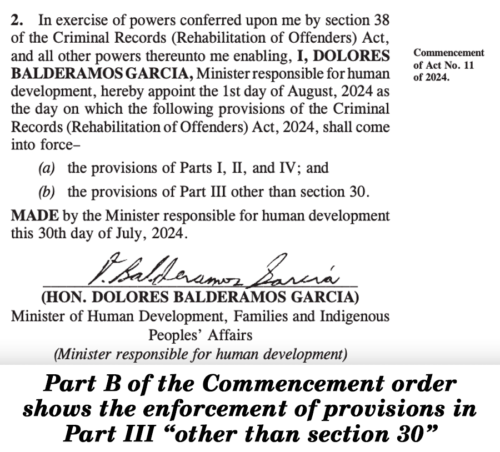
On July 30, 2024, the Minister of Human Development, Families and Indigenous Peoples, Dolores Balderamos Garcia, signed and issued a decree of entry into force, setting the effective date of the provision as August 1, 2024, Emancipation Day.
The provisions of Parts I, II and IV of the Act have come into force and “all the provisions of Part III except section 30” have come into force.
The enactment of this legislation is in line with the Government’s criminal justice system reform objectives. The Criminal Records (Rehabilitation of Offenders) Act, together with the Alternative Sentencing Act 2024 and the Criminal Procedure (Plea Discussions and Plea Agreements) Act 2024, aims to guide an efficient criminal justice system that investigates and adjudicates crime, promotes rehabilitation, and facilitates the reintegration of offenders into society.
This includes expunging criminal records.
Ironically, however, the legislation, which came into effect on the Emancipation Day holiday, fails to meet the needs of community members with bad criminal records.
“Having a criminal record can have serious consequences for an individual as it is often taken into account when applying for a job, obtaining a license, applying for a visa or applying to join an organization that serves the public,” the Attorney General’s Department said in a note released after the three pieces of legislation were enacted earlier this year.
It goes on to state that “the stigma of a criminal record is particularly unfair and unjust if a person committed a crime at a young age.”
Although the enactment of Section 30 has been delayed, the Act does provide that a person who fully complies with the conditions of his sentence and is not convicted of any other offence within a prescribed time is eligible to have any conviction quashed.
The exceptions are offences listed in Schedule III of the Act, namely serious crime, sexual offences and certain drug offences.
While this is a step towards repairing society and building a better criminal justice system, the delay in enacting Article 30 has had a particularly big impact on Emancipation Day, a holiday meant to celebrate freedom and liberation.
For descendants of enslaved Africans who have been severely impacted by criminal records for small-scale marijuana sales, the delay can be seen as a continuation of systemic injustice that denies them the opportunity to fully participate in the changes brought about by the new legislation.
[ad_2]
Source link

