

[ad_1]
Government won’t allow ExxonMobil to run rampant at public meetings
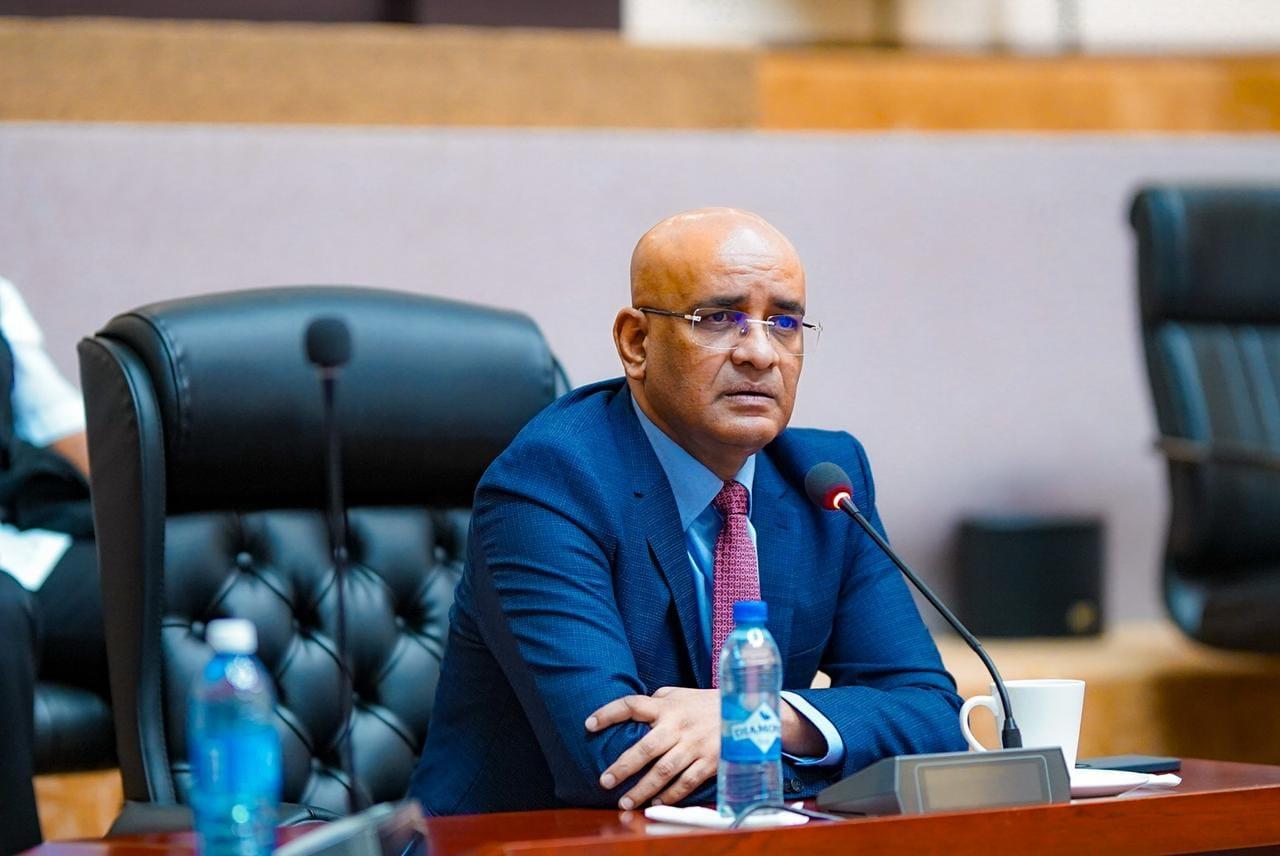
Dr. Bharrat Jagdeo, Vice President (VP)
…Jagdeo instructs oil minister to send representative; PNCR denies importance
Kaieteur News – Amid growing concerns about the management of Guyana’s oil industry, Vice President Bharrat Jagdeo said his government will not allow oil majors to run rampant during the public consultation on Hammerhead, the seventh oil project launched on Monday. He pledged to instruct Natural Resources Minister Vikram Bharrat to ensure that the government is adequately represented and warned oil companies not to mislead the Guyanese people, among others.
However, despite acknowledging the importance of the country’s multi-trillion dollar oil industry and the fact that these resources can transform citizens’ lives if properly managed, no opposition official attended the first two public consultations, while the main opposition People’s National Congress for Reform (PNCR) also denied the importance of the forum and said it would not attend.

Natural Resources Minister Vickram Bharrat
Observers viewed the absence of opposition representatives from the meeting as an insult to the Guyanese people, who expect their leaders to represent them at all levels, especially on issues as vital as the oil industry. ExxonMobil, operator of the oil-rich Stabroek Block, said last week that the public scoping meeting was aimed at providing information to the public about the project. The meetings began on Monday with two outreaches to residents of Region Three, at the Leonora Institute of Technology in West Coast Demerara and Umana Yana in Georgetown. ExxonMobil increased the number of meetings held in Region Four after the previous round of public scoping meetings drew criticism.
Three meetings are planned to be held in the country’s most populous areas – one at Umana Yana in Georgetown, another at the Neighbourhood Democratic Council (NDC) in Monrepos, East Coast Demerara, and one at the New Diamond/Grove Primary School on East Coast Demerara. A total of 10 meetings will be held during the 10-day consultation period. Notably, the oil company will also be involved in the hinterland areas, with two meetings planned in Region One. Hammerhead is expected to add 120,000 to 180,000 barrels per day of oil production capacity. The floating production storage and offloading (FPSO) vessel will be able to store approximately 1.4 million to 2 million barrels of oil. Third-party tankers are scheduled to offload oil from the FPSO to enable the oil to be exported to international markets.

Sherwood Lowe, Director of Public Relations, PNC
Hammerhead is located in the south-central part of the Stabroek Block, approximately 160 km from Georgetown. Current plans involve drilling via a drillship, using approximately 14 to 30 production and injection wells to produce oil. Production is expected to begin in 2029, subject to necessary regulatory approvals, and to operate for a minimum of 20 years. To date, ExxonMobil has received approval from the Guyana government to proceed with six development projects in the Stabroek Block – Liza Phase I, Liza Phase II, Payara, Yellowtail, Uaru and Whiptail. The first three projects are already producing oil at an estimated rate of 640,000 barrels per day.
Working with Kaieteur News On Tuesday, Jagdeo was asked about the absence of government officials from the first two meetings. “Where will these meetings be held?” he asked. “We should send people there. We can’t let these people (ExxonMobil) run wild. I don’t know what they will say, they tell people all kinds of stupid things… They… you know, like certain billboards we have had problems with.” The vice president then told the publication that he would “talk to Vikram Bharat and make sure we send representatives to every meeting.” The natural resources minister was also contacted for comment on the absence of his ministry, and he said “technicians will be there.”
PNCR denies importance of forum
Meanwhile, when asked about their absence from the public meetings, PNCR communications director and central executive committee member Sherwood Lowe said: “I will say that we consider these scoping meetings and public consultations to be mere formalities. We have seen no evidence that ExxonMobil or the government has considered any concerns of the public in redesigning or modifying any design aspects of these projects, so as far as we are concerned, these public consultations (and) scoping are just a sham.”
“Exxon and the government have made their decisions, and as I said, we have seen no evidence that they are willing to adjust based on the concerns of residents,” Lowe said. “Beyond raising questions, there are larger questions, concerns and challenges with these projects.”
Stating that the Environmental Protection Agency (EPA) had no influence, he questioned: “What is going on here? What are these public consultations all about? Is it for show? Is it for the sake of creating a false image? Is it for the sake of creating the false image that people matter?” Moreover, he made it clear that his party “is not going to be a part of this. We are skeptical of this process, and we have seen no evidence that these consultations will lead to any significant change. That, in a nutshell, is where we stand.”
AFC attends small meeting
When invited to comment, AFC president and oil and gas spokesman David Patterson said: “We usually… I usually go to very small meetings because the big public meetings at Umana Yana everyone goes to. I always go but I think there’s one meeting that’s really… I can’t remember which one I designated, it’s very small so you can speak for yourself. “We usually do that because when we go to Umana Yana everyone wants to speak. Last time I didn’t go to Umana Yana, I went to South Ruimveldt and there were very few people there but I was able to ask all the questions. So I don’t go to the (big) meetings, I go for the answers. So I’ll go to one of the meetings, I can’t remember which one I marked. It’s not on my desk at the moment but I’ll go to one of the meetings. I’ll tell you which one I’ll go to.”

David Patterson, Chairman of the Alliance for Change and Spokesperson on Oil and Gas
In a letter to the editor published in this newspaper on Tuesday, July 23, 2024, the author, Radeish David, stated that Guyana is a big show of plundering its oil, gold and other resource wealth. “The plunderers and their local accomplices are doing their best to distract Guyanese from watching this plundering show. Just as foreign exploiters from all over the world line up to grab a piece of land in Guyana under the guise of “foreign investors”, sports and music entertainers from all over the world also want to entertain Guyanese with their performances.”
David said Guyanese will talk about cricket and music, but not about ExxonMobil’s inflated bills, ring-fencing of oil projects, or getting more royalties, profit sharing and taxes from future oil projects, and full liability insurance for the parent company if there is an oil spill.
No plan to educate citizens
Earlier, Tosho Jaremi Boyar of the village of Wallapoka expressed concern about the way the indigenous community is involved in oil and gas activities. He said there is too much focus on money and benefits from the industry without educating the community about the dangers they may face during offshore activities.
During several public consultations held by ExxonMobil in the past, Tosho said he asked about the Shell Beach reserve, but his questions were not addressed. Oil spill modelling showed that the area could be affected by an oil spill; however, Tosho said: “It was not on the agenda… A lot of times, we sometimes try to understand what the impacts would be, how we would function if there was a spill, but it was not something we were aware of as a village.” According to him, “We only heard one aspect, that the production is high, we can make millions of dollars in the next 5, 10, 15, 20 years, and that it is growing very fast and we are one of the fastest growing economies in the world.” Even in the coastal area, ExxonMobil has been criticised for failing to address key issues in its operations. During a public consultation held last February on the sixth project, Whiptail, several questions raised were not answered.
related
[ad_2]
Source link

