

[ad_1]
The Ministers of Foreign Affairs of the Alliance of Sahel States (AES) stayed in Belgium from June 26 to 30, 2024, to participate in the Crans Montana Forum, where world leaders gather every year to discuss major world issues and concerns. A platform used by the AES delegation to convey the correct information to international opinion in the context of mass manipulation. The Minister of Foreign Affairs of Burkina Faso, Karamoko Jean-Marie Traoré, also met with authorities and politicians during his visit.
The 2024 Crans-Montana Forum was chaired by the President of the Comoros Islands, Azali Assoumani, with the central theme “Faced with multiple crises, the world searches for the future”, which is very appropriate for the challenges currently faced by the people of the Comoros Islands and the AES region. As such, the meeting was effectively attended by the Ministers of Foreign Affairs of Burkina Faso and Mali, as well as the Ambassador of Niger to Brussels, who represented their Minister. It was also the first time that the Union delegation officially went outside the African continent.
The forum, which plans to have a panel dedicated to African countries, is co-hosted by Foreign Minister Karamoko Jean-Marie Traoré, Abdoulaye Diop and Ambassador Alhassane Id. “We are here to explain, not to defend ourselves. We owe our just cause only to our people,” Minister Diop insisted at the outset. He went on to say that AES countries are not anti-democratic. “Democracy can only exist in states. We no longer have states. Our concern is to rebuild our states, and our interlocutors are preparing for elections. We cannot understand each other,” he said.
Minister Traoré endeavoured to explain the logic behind the birth of the AES. “For too long, the countries of the Sahel have been crying out. They were not heard. When they were heard, the response given was highly inadequate. Our countries finally understood that remaining in this space was tantamount to agreeing to disappear. The three countries also understood, after a call for help that remains a dead letter, that they must organize to take care of themselves,” said the Minister of Foreign Affairs of Burkina Faso. In line with his Malian counterpart, he insisted that “the fate of our countries will no longer be determined in Brussels, Paris, Washington, but in Bamako, Ouagadougou and Niamey”.
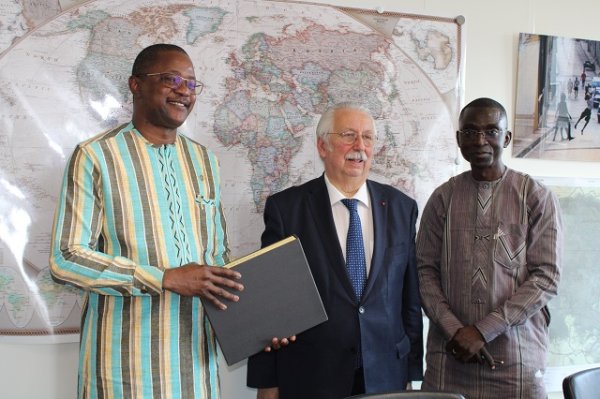
Speaking during the discussion, Ndiaye Mankere, former Senegalese Foreign Minister, regretted the three countries’ exit from ECOWAS. “I would be lying if I said I appreciated your exit from ECOWAS. I remain optimistic that you will come home,” he said. Minister Traoré was surprised that the focus of the debate was on the return of the three inside ECOWAS: “I observe that ECOWAS does not question itself or even adopt a posture of defensive criticism, which is sad.” For the Malian minister, this question no longer exists. He called on partners to take the AES position seriously. “President Goita said that we are on a path of no return, please pay attention,” he added.
Susi Cara Barbosa, Minister of Foreign Affairs of Guinea-Bissau (2016-2023) and President of the ECOWAS Council of Ministers, admitted that the highest deliberative body of ECOWAS has not responded to the opinions of the ministers. “The countries affected by insecurity have indeed knocked on the door of the organization for assistance. The ministers have spoken positively, but the heads of state who make the final decision have fallen on deaf ears,” Minister Barbosa revealed. Three panelists criticized the EU for refusing to sell lethal weapons to the Sahel countries, arguing that its text prohibits this. “So on what principle do you provide lethal weapons to Ukraine? Is the life of the Ukrainians better than that of the people of the Sahel? This is a double standard,” Minister Diop asked. The Ambassador of Niger condemned the EU’s support for the cynical sanctions imposed by ECOWAS on his country, while Minister Traoré pointed out that the EU continues to ask for positive signals as a guarantee of the resumption of peaceful cooperation. “Isn’t it a positive signal when thousands of people are resettled and schools are open? What other signal do you want?” he asked.
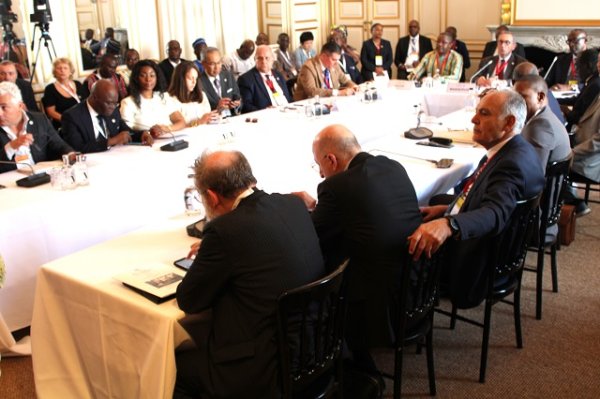
Speaking at the forum, Ms. Emmanuela Del Rey, EU Special Representative for the Sahel, stressed that despite this, the EU remains committed to supporting countries in the region in addressing security and economic challenges.
Minister Traoré’s busy agenda
During the forum, the AES delegation also met with the Group of African Ambassadors (GAAB) in Brussels. The group is an informal framework that allows diplomats to communicate, share and agree on issues of common concern. “We are here to give you the key to what is happening in the Sahel,” said Mali’s Foreign Minister Abdoulaye Diop. “You are the relays of security in your jurisdictions and in your countries. Too many words have been said. We are witnessing a misleading media campaign whose ultimate goal is to pollute international opinion. The latest events are related to the fake rebellion and imagined escape of the Faso president. A crude arrangement created by foreign powers because they believe it will destabilize us. Know that it is just a web of lies,” stressed the Burkinabe minister.
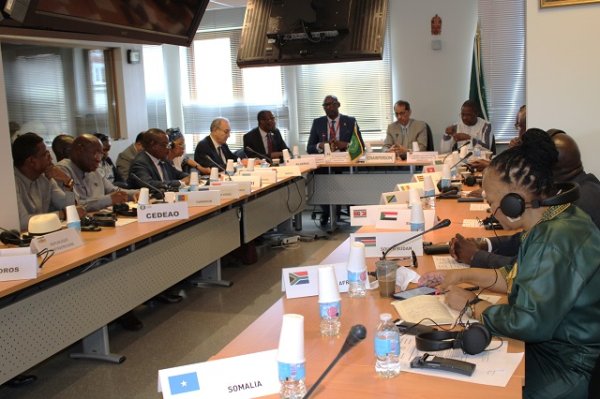
Awad Sakine, the African Union’s permanent representative to the European Union, welcomed the AES approach. “The AU does not leave its member states alone. She certainly loves democratic values. But when it is forced to resort to sanctions, the thread of dialogue is not interrupted. In the coming days, the AU plans to send a delegation to the countries concerned to resume the dialogue.”
In addition to this meeting, Minister Traoré also provided an audience diary. He was received by André Flahaut, Minister of State and Honorary President of the Parliament of Belgium, who has extensive experience and knowledge of socio-political and security issues in the Sahel. “I saw in him a man who listens well, a man who cares about the situation in Burkina Faso and wants to see things develop positively,” concluded Minister Traoré. He said he is confident that the Minister of State will continue to convey this message for the benefit of the Sahel region and the people of Burkina Faso in particular. The Burkinabe Foreign Minister had fruitful exchanges with the EU Special Representative for the Sahel, André Derré, and the Secretary-General’s Special Envoy for Asian Cooperation, ACP, and Claude Tran.
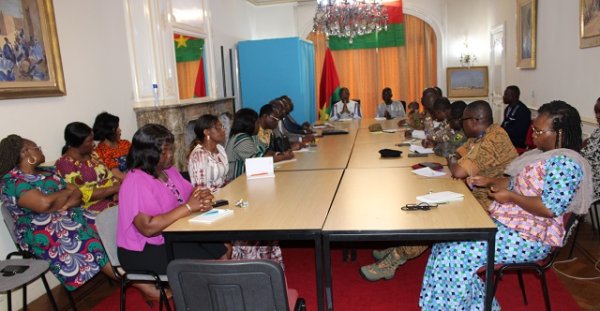
During this period, the Minister held two meetings with the staff of the Burkinabe Embassy in Brussels and with the Burkinabe community in the area. First, Minister Traoré spoke with the embassy staff. The focus was on the security situation in Burkina Faso and the challenges that need to be addressed within the framework of the mandate of the Burkinabe diplomatic representation. The Minister expressed his appreciation and congratulations to all the embassy staff and the government for doing their best under difficult conditions.
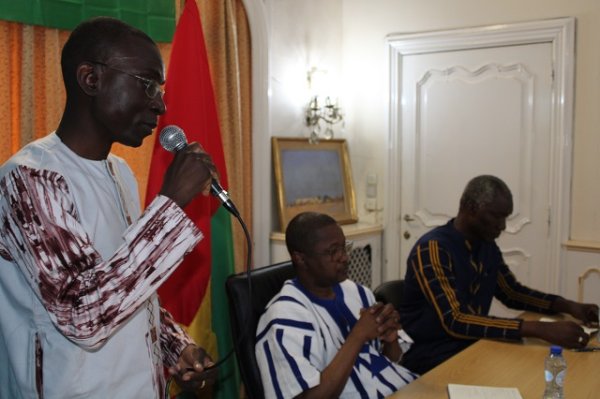
The second meeting involved all members of the Burkinabe community in the jurisdiction. It was the first meeting of its kind with the head of the Ministry of Foreign Affairs and mobilized communities from Luxembourg, the Netherlands, the United Kingdom of Great Britain and Northern Ireland and Belgium. The security situation took an important place in the discussions. The Minister was not unreassured. Above all, he entrusted a mission to the members of the community: “Recently, the Diaspora has been the victim of media pollution, as they and the people of Europe have been targeted. We took this opportunity to provide the correct information and thank the Diaspora for all the patriotic support. And tell them that we always welcome any of her opinions. Donations are not always in cash. The Diaspora is expected to play a role in the field of awareness, information and help fight any source of media pollution.”
Jeremy Neen
Brussels Press Officer
[ad_2]
Source link

