
[ad_1]
What the GAO found
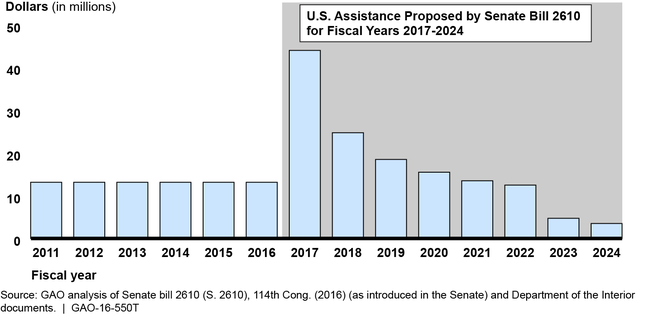
If enacted, Senate Bill 2610 (S. 2610) would change the schedule of U.S. aid to the Republic of Palau and improve the outlook for Palau’s Compact Trust Fund. S. 2610 would ratify a 2010 agreement between the U.S. and Palau governments to provide annual aid to Palau through 2024. Congress has not yet approved legislation to implement the 2010 agreement, which provides $216 million in aid to Palau in fiscal years 2011 through 2024. Since 2011, the United States has provided $79 million in economic assistance to Palau through annual appropriations. However, this amount is less than anticipated in the agreement and does not include a trust fund contribution. S. 2610 would modify the agreement schedule to provide the remaining $137 million in fiscal years 2017 through 2024, including a $20 million trust fund contribution in 2017 and smaller contributions in subsequent years (see figure).
U.S. assistance to Palau in FY2011-2016 and proposed assistance in Senate Bill 2610 for FY2017-2024
The Federated States of Micronesia (FSM) and the Republic of the Marshall Islands (RMI) face challenges in achieving their compact goals of economic growth and self-sufficiency. GAO previously found that neither country has made significant progress on reforms and that compact implementation is marked by unreliable performance data and challenges with accountability and oversight.
GAO has previously reported on the growth of immigrant populations from Palau, the Federated States of Micronesia, and the Republic of the Marshall Islands in U.S. regions and the impact of these compact immigrations. In Guam, Hawaii, and the Commonwealth of the Northern Mariana Islands (jurisdictions deemed affected by Congress), compact immigration increased from approximately 21,000 in 2003 to approximately 35,000 in 2013. In fiscal years 2004 to 2016, the Department of the Interior provided approximately $409 million to the affected jurisdictions to help cover the costs of education and health services resulting from compact immigration. In comparison, the affected jurisdictions estimated the cost of these services to be $2.1 billion from 2003 to 2014. However, GAO noted that these estimates have limitations in terms of accuracy, documentation, and comprehensiveness.
Why GAO conducted this study
The agreement between the United States and the Federated States of Micronesia and the Republic of the Marshall Islands came into effect in 1986 and was revised in 2003. The agreement between the United States and Palau came into effect in 1994. Legislation pending in the Senate would approve, fund and amend the 2010 agreement between the United States and the Palau government for their agreement.
Under the agreement, the United States provides each country with economic assistance, including grants and trust fund contributions; access to certain federal services and programs; and the ability to allow citizens of the three countries to immigrate to the United States and its territories without visa and labor certification requirements. Guam, Hawaii, the Commonwealth of the Northern Mariana Islands, and American Samoa are designated by law as jurisdictions affected by immigration under the agreement, and these territories will receive grants to help share the cost of immigration services.
This testimony explores (1) the potential impact of proposed legislation to ratify the 2010 Palau Accord, (2) challenges affecting implementation of the Accord between the Federated States of Micronesia and the Republic of the Marshall Islands, and (3) immigration from the Federated States of Micronesia, the Republic of the Marshall Islands, and Palau and its impact on U.S. territories. In this statement, GAO summarizes previous reports issued between 2007 and 2013 and incorporates updated information from Palau, the Department of the Interior, and the affected jurisdictions. GAO does not make any new recommendations in this testimony. GAO made recommendations in its previous reports, some of which have not yet been addressed.
For more information, please contact David B. Gootnick at (202) 512-3149 or gootnickd@gao.gov.
[ad_2]
Source link

