

[ad_1]
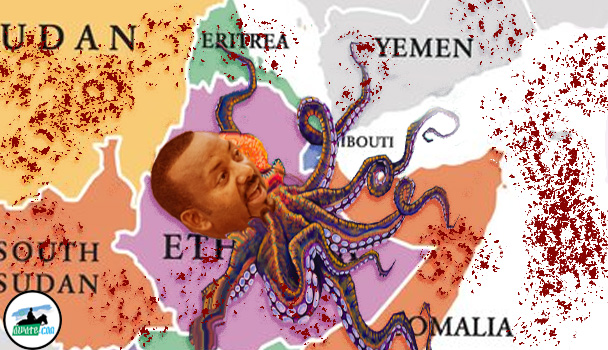
It has always been clear that Ethiopia’s false historical narrative will one day come back to bite it. In 1932, Abyssinia adopted the historically Greek name of Ethiopia in Africa. Today, its sunrises and sunsets prove that it cannot hold together many nations by force as it once did. The war with Tigray, the ongoing war in Amhara, the older but currently dormant war in Somalia, and many other peoples who are rising up to seek freedom from oppression, all show that things are no longer easy, or that things are falling apart, in the words of the great Nigerian writer and litterateur Chinua Achebe.
With war raging on almost every corner, the central government can no longer sustain itself. The Afar/Somali war, the Benishangul uprising, the conflict between the Amhara and Tigrayans, the Eritrean military involvement in western Ethiopia, and the recent misstep by Ethiopian leaders in signing a memorandum of understanding with a region in Somalia in an attempt to divert internal conflict to a neighboring country, all suggest that Ethiopia needs to pause and take a breath. What happened to the previous regime’s claim that this great nation was formed from ancient historical developments that emerged from within?
Some have called the MOU blunder a bold move by the current Ethiopian leadership, but in reality, one can only describe it as an ill-conceived, undiplomatic and reckless move that puts the ancient empire at risk. In fact, it is almost childishly aligned with those forces that may wish to see Ethiopia destroyed and split into its component nation-states that used to be held together by force. Mind you, the country is made up of 80 ethnic groups, some of which are large enough to be independent states, such as the Somali State, Sidama State, Oromia State, Amhara State, Tigray State, Afar State and many others.
If Emperor Haile Selassie could have known what was happening in the country that he had built through diplomacy and skill by many means and methods – both legal and illegal – he might have forced himself out of his grave, something that many Africans have so far failed to do.
Somalia’s claim to the current Ethiopian territory of the Somali State (including parts of the current Oromia region) has been refuted by the international community and the African continent. What makes the current Ethiopian regime believe that it can get away with this illegal MoU that challenges all established norms of territorial integrity and sovereignty between states? How can the Ethiopian regime, which is unable to unite its ethnic groups and has participated in the absolutely unnecessary massacres of its own people (Amhara, Tigrayan, Benishangul, Afar, Somalis and many others), be so short-sighted as not to notice that this will only further disrupt life in the Horn of Africa region?
Blatant interference in the affairs of neighboring countries can only lead to further destabilization in the region and in fact, it also challenges the very nature of the Somali people, who are known to never shy away from protecting their rights, land, sea, and even their lives. The undiplomatic faux pas of the current Ethiopian regime regarding the MoU will only exacerbate the ongoing civil war in Ethiopia and will not benefit Ethiopia in the slightest. Befriending and cooperating with Somalia, which has historically been the source of most of Ethiopia’s troubles, is a better way of defense for Ethiopia. Ethiopian diplomacy should work towards this direction.
Until recently, Ethiopia announced to Somalia that Ethiopian troops (part of the African ATMIS mission) would not be allowed to remain in the country until the end of this year. Instead of listening to the Somali people, Ethiopia seems to have ignored the will of the Somali people and recently sent more troops to the country. This seems to be an attempt to recreate the old confrontation that Ethiopia and the Somali people had almost forgotten.
This is not in the interest of the region, and the Ethiopian regime’s brinkmanship only seems to exacerbate the region’s already troubled political instability and weakness, and provide more room for foreign interference in the region. Bad advisorThis will only bring more chaos to Ethiopia and the surrounding region.
The future of the region and its fragile peace needs to be supported through dialogue, discussion and cooperation, not only within each country, but also together as a region. The old nation-state model in the region will only lead to suffering and more chaos, and perhaps it is time for the region’s leadership to move away from unnecessary and dangerous processes that will only lead to more internal and regional instability.
The grave miscalculation of the current Ethiopian regime on Somalia will bring dire consequences to the region, which many enemies in the region would like to see happen or realize. The Ethiopian regime should stop on the wrong path and halt the inconsiderate steps taken so far that have pushed the region to the edge of the cliff. Regional dialogue could slow down the downward slide caused by Ethiopia’s moves. It is the only way for the region to achieve peaceful coexistence and bring better hope to its people.
[ad_2]
Source link

