

[ad_1]
Sherab Lhamo
Six Fab Labs from across the country showcased their assistive technology projects using cutting-edge technologies at the Fab Fest held at the Clock Tower in Thimphu on May 23. The theme of this year’s event was “Assistive Technology: Building Accessibility, Inclusion and Independence”.
Assistive technologies (AT) are tools that help people with differences overcome challenges. They enable people to complete tasks and activities in school, work, and at home.
The event aims to inspire solutions and highlight projects that promote accessibility and improve the lives of people with disabilities.
The Fab Lab at the College of Science and Technology (CST) develops assistive devices to aid teaching and learning.
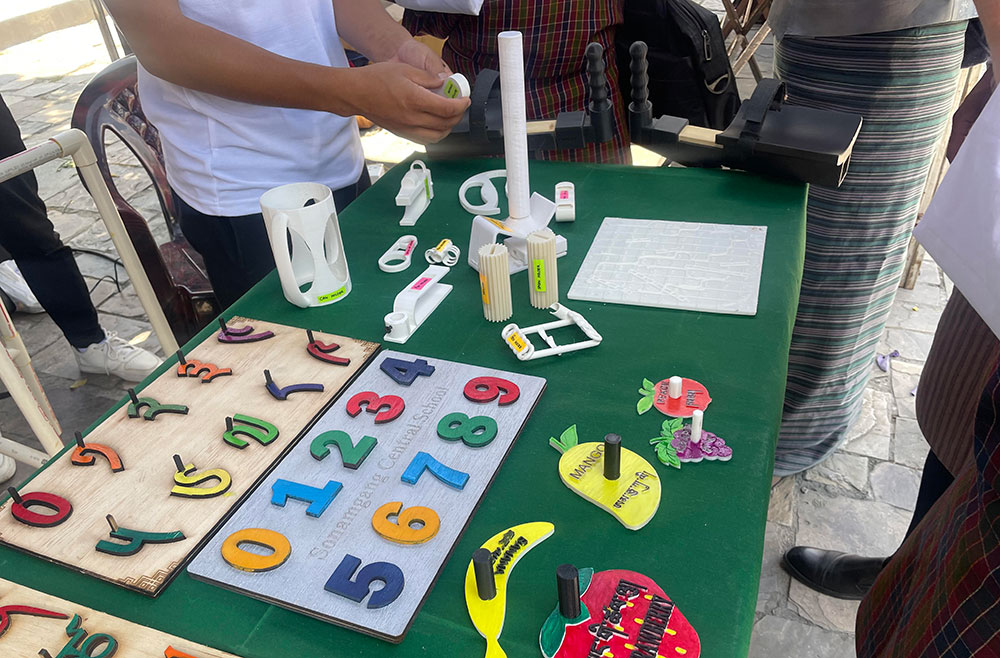
Students use 3D printers to create assistive devices to help people with limited hand strength
Students use 3D printers to create assistive devices, such as pen holders and cup holders, to help people with limited hand strength who must rely on their arms or wrists to grasp.
They also created a new learning tool: an alphabet board for primary school students. This board allows children to insert 3D Dzongkha and English letters. In addition, they created a weather board and mood board that can display weather inserts.
Kamal Chapagai, one of the members, said that after interviewing the disabled people, they used 3D printers and laser cutting technology to make these products according to each child’s preferences.
Jigme Namgyal Super Fab Lab (JNSFL) showcased their equipment, also using 3D printers and laser cutting.
They have designed a gesture-controlled robotic arm for people with physical disabilities and the elderly; these devices can help them complete daily tasks such as picking up objects while working seamlessly with gestures. This reduces the burden of their daily tasks such as fetching objects, opening doors, etc.
The sensors recognize gestures through a wireless control glove interface. Bluetooth Low Energy helps simplify wireless communications, and the programs can be customized for a variety of tasks.
The team also created an app called “eSpeak” that has icons for tasks ranging from greetings to daily requests. Users simply click on the desired icon — and the corresponding audio message will play in Dzongkha.
For example, to say good morning, users just need to select the greeting icon and the voice will say “Kuzuzangpo La!”
The team is working on future iterations to provide more powerful features, such as user voice and sentence input. These features will be available to the public soon.
Another team at CST created an affordable bilingual braille system – English and Dzongkha. Using their system, they type in what they want, and it wirelessly connects to a braille printer, which prints out the words and letters.
Gyembo Tshering, one of the members, said the group presented the same project at FAB23 last year. This year, they modified the device so that users can use it in two languages and print words on Braille paper and A4 paper, which was not possible in the past.
Gyembo said they have already made three braille devices which they plan to distribute free of charge to Draktsho School and Muenselling College soon. They also plan to distribute to other schools for educational purposes.
The Technical Trainer Training Resource Centre (TTTRC) Fablab in Sarpan has created equipment such as smart canes, smart headlights and smart wrists to help the blind detect objects in front of them through a buzzer. Whenever the blind encounter an object in front of them, they can hear a buzzer.
One of the members, Yeshi Pencuo, said that this device allows blind people to find objects in front of them without having to use a cane to touch them.
Participants of the Fab fest include Jigme Namgyel Wangchuck Super Fab Lab, Faculty of Science and Technology Fab Lab, Faculty of Natural Resources Bio Fab Lab, Technical Trainer Training Resource Center Fab Lab, Choego Fab Lab and Druk Gyalpo Institute Fab Lab.
Four Year 9 students from the Royal College of Art have created a prototype of an affordable radio telescope. Kinley Tsheyang Seldon, one of the team, said their technology is used to detect radiation from stars.
She said that stars produce specific radio waves at specific stages of their lives. After receiving the radio waves, they input them into the system through the program they created and display the images of the radio waves.
The team plans to complete the back end of the radio telescope and share it with other schools.
Sonam Wangchuk of the Royal College of Physics built a robotic arm that can pick up objects using a joystick and sensors. Using sensors, it helps detect the location of the object.
He said that the design was done by his predecessors, and he used the design of his predecessors to write the code with the help of ChatGPT to make the robotic arm. He shared that although ChatGPT was helpful in writing the code, it was not accurate. He modified the code himself according to his needs.
He plans to enable the robotic arm to move in all directions.
[ad_2]
Source link

