

[ad_1]
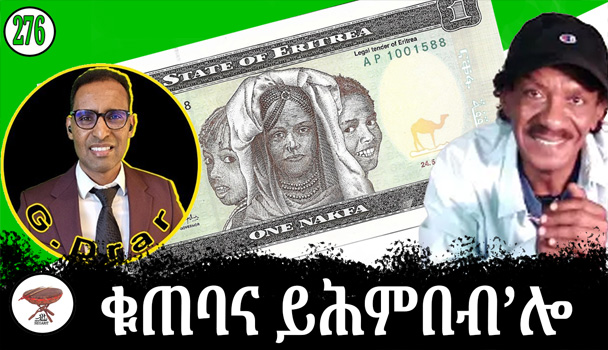
Gerghis Drar is an Eritrean who gives tutorials on basic finance – stock market, retail consumer finance, investing, debt and politics. This caught my attention and I have been following him for a while.
When the PYD propaganda began to spread a few months ago, I thought it was time to counter the misleading propaganda with facts – it needed to be countered. I took the initiative to call several people in the “media”, including Gerges.
When I discovered that he knew me, I didn’t need to introduce myself; he reminded me that we had met at a seminar in Bologna, Italy, where I had been invited as a speaker. I think I was told that he was a man who had recently arrived from Eritrea.
Last week I saw a tweet from Gerghis in which he commented:
“#Eritrea One of only three countries #Africa Never from #International Monetary FundAs the Bible says, “The borrower is a slave to the creditor.” Eritrea has not only avoided loans, but has survived and thrived despite severe sanctions from the United Nations, the United States, and the European Union. It continues to stand firm in one of the most volatile regions in the world. This country is full of untold stories. What would you like to add to this story? ”
Given what I know about financing and debt, I was surprised to find that Gerghis’s knowledge was shallow.
Key Points
It is unprofessional to quote sacred books to support financial views; finance is not a metaphysical realm, but mathematics and science; it must rely on facts. Gerghis should do his research and read the views that have been put forward over the decades. It is disappointing that he repeats government propaganda and ignores the vast amount of arguments and content written by Eritreans on the issue. Some of these can be counted as first-hand accounts, and ignoring them makes any argument untenable.
Gerges cites the Bible to support his view that borrowing is wrong. But Marx condemned not only borrowing but the entire capitalist system, and he was not a fan of sacred books. In modern parlance, the biblical citations can also lead us to conclude that employers are slaves to their employees because, to some extent, the employees’ livelihoods depend on them.
The financial system that rules the world operates on loans, which are a means of obtaining financing to create wealth.
It is ironic that a man who teaches investing would be against loans, since investing is inseparable from loans and interest (which is collected by wealthy “slave owners”!). This could destroy the credibility and value of his educational career.
Furthermore, he provides no evidence that the Eritrean economy is booming, or how it is surviving economic stress. Yet it is a fact that Eritreans are struggling not only to survive, but to live in dignity. In this context, the phrase “it stands” depicts a sense of pride that cannot be objectively measured. It is a political statement, not an economic one. Is Eritrea standing economically?
He then asked: “What would you like to add to the narrative of this tweet?” Unfortunately, it is impossible to distort or dramatize Eritrea’s dire economic reality with a favorable narrative.
Gerghis asserts that “Eritrea is one of only three countries that has never borrowed a penny!” However, economic health depends on many factors; borrowing and efficient investment is an important factor.
A loan that doesn’t exist?
The IMF and World Bank are the main institutions and anything owed to them is foreign debt. It helps to remember that according to 2022 reports, Eritrea’s foreign debt is $776 million (Eritrea does not regularly release statistics or budgets). Can anyone say that Eritrea has not borrowed a penny? Importantly, would Gerghis help his “students” and viewers by discouraging them from borrowing money, giving up credit cards, canceling mortgages, business loans, etc.? The fact is, Eritrea has been borrowing money, and borrowing more than “a penny”!
Qatar took Eritrea to court over its failure to repay a $250 million loan; the court ruled in Qatar’s favor.
In 1993, China provided Eritrea with a loan of US$98 million to repair the Hejigo power plant.
Eritrea owes its depositors an internal loan for implementing a poorly designed banking policy. Depositors can only withdraw 5,000 Nakfa per month. For example, if a depositor has a balance of 1 million Nakfa, it would take him 200 months (nearly 17 years) to withdraw the entire amount if the bank recognized ownership of the deposit. Check withdrawals only transfer balances from one account to another; they do not affect ordinary citizens in a cash society. Moreover, the same withdrawal restrictions apply to checks that cannot be fully cashed.
Eritreans cannot safely invest within Eritrea (except those close to political parties or nepotism); the business climate does not encourage internal investment, let alone external investment. Add to that unclear policies, absent courts, etc. So the economy is not at risk of collapse; it has already collapsed.
It is hard to understand whether the PADJ despises the loans or the lenders. Perhaps it is the conditions set by the wealthy lenders, be it the US, Australia or other institutions!
The stock market that Gergis promoted was owned primarily by wealthy Westerners, who also happened to be the main lenders.
Yet, no one in their right mind would consider financial institutions to be benign lenders. The stakeholders (the West) have influence and they usually influence the decisions of the institutions. But the West is the main donor in times of crisis! It is worth remembering that lenders occasionally invoke debt relief mechanisms for countries in trouble.
There is a saying (not in the Bible): Either the lonely person dies, or the borrower dies (wey zeleqeHe ymewt wey z’teleqeHe ymewt), This means that loans are sometimes not repaid. Financiers have a pejorative term for this, “taking good money to save bad money”. Banks lend more to borrowers who can’t meet their obligations to save them from bankruptcy; they would rather help the borrower and prevent the borrower’s business from collapsing so that they don’t lose the loan altogether.
Weaponization of information
Information should not be weaponized to promote one’s political views or ideology. Sadly, many do so because those who know will not question misleading or distorted information. Perhaps they are lazy, incompetent, don’t care or don’t know. I am upset with economists, bankers, financiers and businessmen who know about this topic but choose to remain silent.
This requires deep thought, which is what I try to encourage.
It is no secret that the internet is full of noise, mainly from the PFDJ elements who are too emotional and do not understand the damage they are doing to Eritrea and its economy. Those who should be challenging and correcting them are instead retreating and hiding in defensive corners. The PFDJ and its supporters do not have a mature culture of debate; they only care about emotions, chauvinism and bravado. They love to discuss banal topics; they are all emotional. But they are good at firing fast and fast. As obedient soldiers, they repeat and base their arguments on what they have said in the recent “Parties“seminar.
Debt relief
Countries have credit scores and credit worthiness, just like personal credit. If you can’t pay back your loans, your credit score is low. Eritrea has a low credit score. All bravado aside, Eritrea has lost a lot of credibility since the 1990s.
In the early 1990s (during the Clinton presidency), Eritrea and Ethiopia were the darlings of the West, when they were called the Renaissance Nations, the Tigers of Africa (as in the Tigers of Southeast Asia). Eritrea lost that reputation due to war and poor governance.
It has also damaged its relations with many countries, leading to it being subjected to various sanctions and being treated like a pariah state.
So, which country do you think is willing to provide loans or investments to Eritrea?
Finally, the reality is: In 2022, the latest year for which there are reports, Eritrea’s external debt is $715,304,700. So that means every Eritrean, including expatriates, asylum seekers and refugees, whether children or adults, owes debtors about $204.00. But since no bills and late fees are delivered to our residence and no one comes to collect the debt, we assume they don’t owe it. It’s all on Eritreans in Eritrea.
Ordinary citizens of Eritrea are not aware of the specifics of the debt but feel its impact as they bear the heavy burden of higher prices for goods and services.
The next time someone in Eritrea complains about economic hardship and rising prices, remember at least one reason; that’s what I tried to explain above. Now take out that $204!
[ad_2]
Source link

