

[ad_1]
Report Online CitizenshipIn an interview with ISNA, ISPA Chairman Ebrahim Shir Ali explained the latest results of the center’s survey and said: The last ISPA election poll of the Iranian Student Public Opinion Survey Center (ISPA) was held on June 19-20, 1403 (the second wave) before launching qualified candidates. The Guardian has sought public opinion on the 14th presidential election. The project conducted face-to-face interviews with 3906 people aged 18 and above living in 31 provinces (urban and rural areas) across the country. It was calculated that the response rate of the questionnaire was about 41%, and this figure should be taken into account when analyzing the survey results. In other words, 59% of citizens across the country do not agree to cooperate with ISPA questioners to fill in the questionnaire.
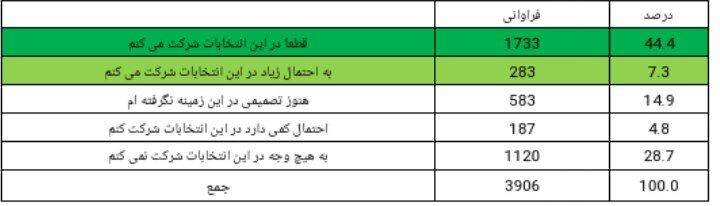
He added: The most important finding of the survey program is one of the core questions in the survey program on election issues, that is, the participation rate of the people. The results of the second wave of ISPA surveys show that 44.4% of citizens said that they would definitely participate in the presidential elections, and 7.3% of citizens said that they were most likely to participate in these elections. 28.7% said that they would not participate in this election in any way, and nearly 15% were undecided whether to participate in the election. The reasons given include the lack of impact of the elections on improving the situation in the country, protests against economic and livelihood issues, the possible disqualification of candidates preferred by the respondents, and the lack of efficient candidates among the candidates in the upcoming elections. Those who said that they would not participate in the upcoming elections said that they would not participate or that the possibility of participating in the elections was very small.
Hill Ali reminded: The way to pay attention to election-related news, the survey results show that 28.4% of citizens do not pay attention to election-related news at all. In contrast, 38.3% of citizens follow news related to the presidential election through radio and television, 14% through internal websites and web pages (Isna, Elkhet, Fars, etc.), 9.4% through foreign websites and web pages (BBC, Iran International and…), 3.6% through relatives and acquaintances, and 2.9% through satellite channels. The participation rate in incremental elections depends on many factors, and the participation rate will change in the remaining time before the election day.
He added that the second wave of surveys was conducted before the Guardian Council approved the qualifications, and the approval and introduction of the final six candidates will definitely change the level of people’s participation. In addition to this factor, the media, the advertising programs of the final candidates, and the holding and broadcasting of radio and television election debates will have an impact on the participation rate and volume. In general, based on past experience, it is expected that the level of people’s participation in the upcoming elections will increase as the election day approaches and the atmosphere of competition among candidates heats up. In the first wave of election surveys conducted from June 6 to 10, statistics were collected from the national population over 18 years old (urban and rural areas), and the prediction of the national situation after the new ISPA president took office (regional), with a sample size of 5,009 people. He questioned their assessment of the national situation after the new president took office. The results showed that 39.5% of the respondents in the above survey said that the national situation will improve with the arrival of the new president. On the other hand, 16.2% of people believed that the national situation will deteriorate, and 22% believed that the national situation will not change with the arrival of the new president. In addition, 22% of the respondents did not evaluate the national situation after the change of president and said they did not understand.
The ISPA President stressed: In addition, in the first wave of the survey on the priorities of the government and the future president, people were also asked to answer the question “What do they expect from the next government?” From the perspective of 58.5% of the people, the government and the future president should prioritize the issue of “poverty and scarcity.” “Creating jobs” accounted for 39.7%, “inflation and the value of the national currency” accounted for 36.5%, “foreign policy and relations with other countries” accounted for 28.7%, “national security” accounted for 28.4%, “housing sector system” accounted for 20.6%, and 19.6% mentioned “anti-corruption, anti-rent.” The survey results show that economic and livelihood issues are still the most concerned issues for the people, and it is appropriate for the government and the next president to prioritize economic stability, poverty and scarcity elimination, and increasing social welfare. Explain that in this question, respondents can choose 3 options, so the total number of options exceeds 100. Regarding the implementation and publication of the next wave of survey results, ISPA has always been in favor of publicly publishing survey results and results, taking into account the public interest of the country, and has insisted on the importance of this in the presidential elections of 1996, the elections of 1400, and most recently the 12th Islamic Council elections held in March 1402. In the next wave of surveys, attempts will be made to measure the participation rate of the people and the level of happiness of the people with the six approved candidates, and will be published in the media.
[ad_2]
Source link

