

[ad_1]
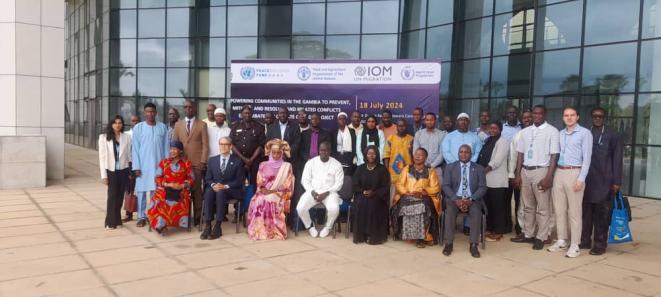
The United Nations in The Gambia yesterday launched a 36-month, $3 million Peacebuilding Fund project.
The project, which aims to address climate-exacerbated conflicts over land and natural resources, is titled:Empowering communities televisionGambia PagePreventing, mitigating and resolving land-related conflicts exacerbated by climate change”
The programme, held at the Sir Dawda Kairaba Jawara International Conference Centre in Bijilo, will be jointly implemented by the Food and Agriculture Organization (FAO), the World Food Programme (WFP) and the International Organization for Migration (IOM).
The project will also raise public awareness and solicit opinions on climate change-related conflicts affecting land and natural resources in The Gambia.
A strong Project Steering Committee will also be established to provide strategic guidance and oversight for the entire project implementation.
In his launch remarks on behalf of the Secretary General and Head of the Civil Service, Permanent Secretary of the Department of Strategic Policy and Delivery, Allieu Lom, said the project aims to reduce inter-community conflicts arising from land disputes, enhance food security and nutrition, and improve climate resilience.
He said the project is in line with the National Development Plan (2023-2025) “Yiriwaa”, which identifies land governance, social cohesion and climate vulnerability as key drivers of conflict. “The initiative is fully aligned with the country’s priorities, which emphasize sustainable development and climate adaptation,” he added.
In his speech, Carl Frederick Paul, the UN Resident Coordinator in The Gambia, said: “The climate crisis is not a distant threat, but a present reality in The Gambia.”
He clarified: “Sea level rise threatens our coastal areas, while changes in precipitation patterns affect our communities that rely on agriculture. These environmental changes are more than just ecological challenges; they are also catalysts for social tensions, particularly around land use and ownership.”
He said the project represents their shared commitment to transform these challenges into a path for peace and sustainable development. “By empowering communities, we can not only resolve conflict; we can also build resilience, promote sustainable livelihoods and pave the way for lasting peace. This initiative embodies the spirit of the Sustainable Development Goals – it is comprehensive, inclusive and transformative,” he said.
“By addressing land-related conflicts through the lens of climate change, we are addressing SDG 13 (climate action), SDG 16 (peace, justice and strong institutions) and SDG 1 (no poverty), among others. The United Nations system fully supports The Gambia in this effort.”
FAO Representative in The Gambia, Mohibudi Lampedi, said the initiative underscores the countries’ shared commitment to addressing the urgent challenges exacerbated by climate change.
She said rising temperatures, abnormal weather and rising sea levels are not only environmental issues but also have far-reaching socio-economic impacts, especially on agriculture and land use.
She noted that these changes have led to the intrusion of salt into agricultural land, rendering it infertile and sparking disputes over the reduction of fertile land, which calls for accelerating efforts to achieve the goals of the 2030 Agenda.
She stressed that the project uses a progressive approach to engage communities in conflict hotspots in implementing sustainable soil and water management practices. “FAO will take the lead in promoting climate-smart agriculture and sustainable land management,” she said.
She confirmed that efforts will also be made to undertake ecosystem and landscape management to protect ecosystem services that are critical for food security, agricultural development, adaptation and mitigation, and to provide services to farmers and land managers to better manage climate risks/impacts and will contribute to mitigation actions.
[ad_2]
Source link

