

[ad_1]
In the working paper, Tuvajri explained that the Basic Law of Governance provides that the governance of the Kingdom is based on justice, consultation and equality, and that the State protects human rights in accordance with Islamic law, and on this basis, the Kingdom’s governance system, institutions and remedies together constitute the legal and institutional framework for the promotion and protection of human rights, and that the Kingdom’s Vision 2030 was issued based on these starting points and is consistent with this approach, becoming an approach to define human rights. The overall national policies, plans, initiatives and objectives that are directly or indirectly linked to human rights.
His Excellency also touched upon a number of human rights, both literally and implicitly, most notably: the right to security, the right to health, the right to work, the rights of women, children, persons with disabilities and the elderly, development, strengthening participation in political and public life, forming and supporting civil society associations, and a number of other social and economic rights, indicating that in line with this ambitious vision, many plans, procedures and implementation measures of the Kingdom’s Vision 2030 have been launched in harmony and unity.
Speaking about the role of human rights institutions and national institutions, Dr. Tuvagiri noted that human rights are one of the topics that have received international attention over the past decades, as the world celebrates the 75th anniversary of the Universal Declaration of Human Rights this year, including the Human Rights Council (which was established in 2006 to support, promote and protect all human rights without discrimination and to make recommendations on human rights), the Universal Periodic Review (UPR) and the Special Procedures, which are composed of independent experts who provide reports and recommendations on human rights issues.
The Chairperson of the Human Rights Committee said that one of the most important agreements issued by the United Nations that relates to the subject of our meeting is the Convention on the Elimination of All Forms of Discrimination against Women (CEDAW), which aims to abolish the Kingdom of Saudi Arabia acceded to the agreement in 1999 AD, and that the agreement does not have any provisions that conflict with the provisions of Islamic law, noting that the Kingdom is a party to the five fundamental conventions. The nine main United Nations conventions in the field of human rights are: the Convention on the Rights of the Child, the Convention against Torture and Other Cruel, Inhuman or Degrading Treatment or Punishment, the International Convention on the Elimination of All Forms of Racial Discrimination, the Convention on the Elimination of All Forms of Discrimination against Women, the Convention on the Rights of Persons with Disabilities and the Optional Protocol to the Convention on the Rights of the Child on the involvement of children in armed conflict and the Optional Protocol to the Convention on the Rights of Persons with Disabilities on the complaint, the Optional Protocol to the Convention on the Rights of the Child on the sale of children, child prostitution and child pornography and the Protocol to prevent, suppress and punish trafficking in persons, especially women and children, all of which are directly or indirectly related to women’s rights.
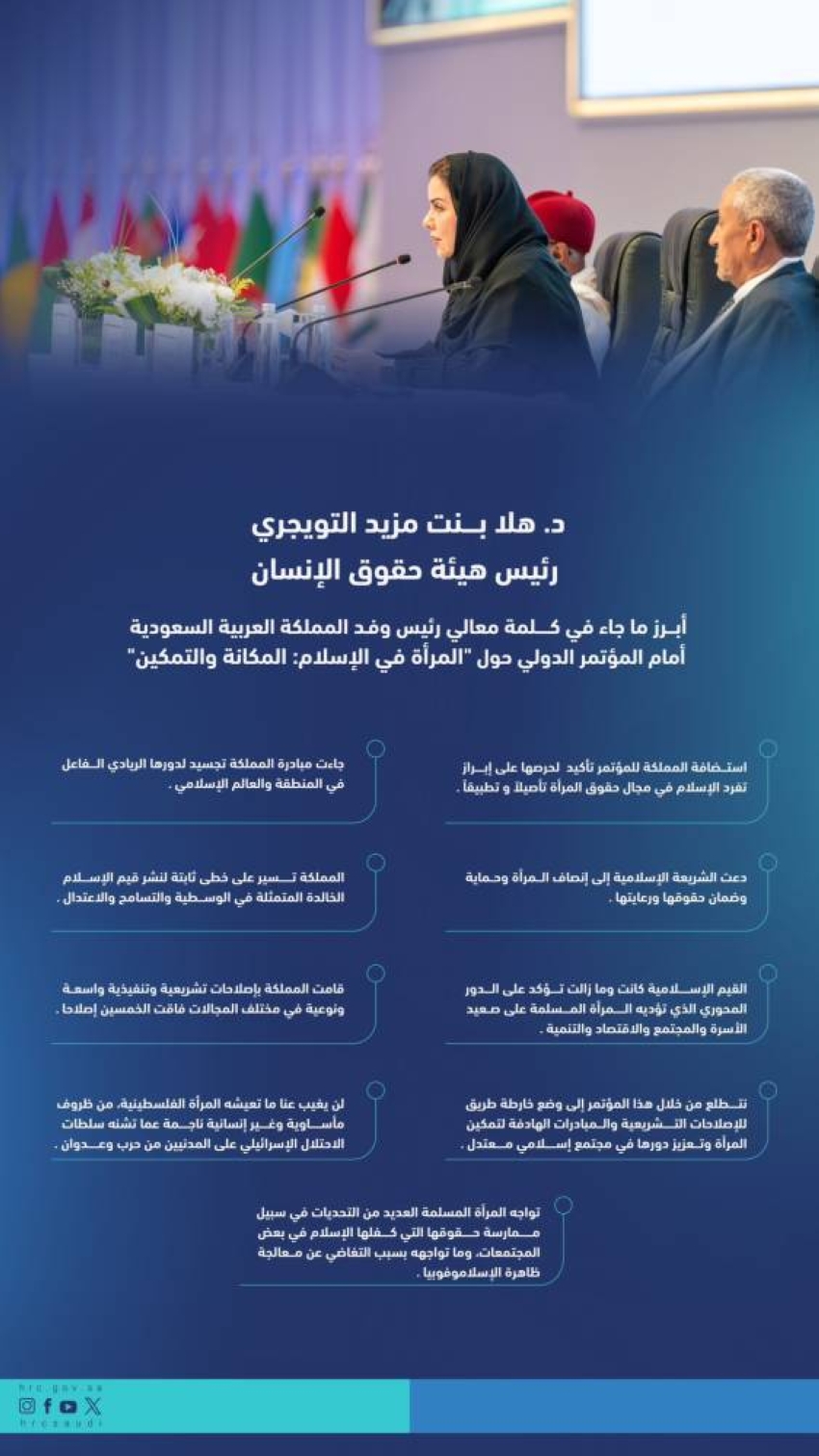
His Excellency the Chairperson of the Human Rights Commission confirmed that the Kingdom has fulfilled all its obligations under its agreements and submitted all reports to the United Nations treaty bodies on the human rights conventions to which it has acceded, explaining that the Human Rights Commission, as the representative of the Kingdom, is keen to cooperate with the treaty bodies, committing to prepare and submit periodic reports on the specified dates and answering questions raised by the treaty bodies on some of the issues and themes included in the reports.
His Excellency stated in the working paper that, in accordance with its Islamic values and humanitarian principles, the Kingdom is witnessing significant developments in the field of promotion and protection of human rights in general, and women’s rights in particular, and their empowerment, including all regulatory measures and institutional frameworks, noting that the Kingdom’s concern for human rights led to the establishment of the Kingdom Human Rights Commission in 2005 AD. It is a government body directly linked to the King and is dedicated to the protection and promotion of human rights. In general, this includes the elimination of all forms of discrimination against women in accordance with international standards and the provisions of the Islamic Sharia. According to its organizational structure, the Commission has broad powers that allow it to independently and freely carry out its tasks, which include monitoring and follow-up, remedies, consultation, awareness and education, as well as national, regional and international cooperation, indicating that the recommendations of the Human Rights Commission (contained in its annual reports and their implementation) represent qualitative indicators through which the impact of the progress achieved can be measured.
It reviews the most prominent initiatives and programs related to the empowerment of women through the Kingdom’s Vision 2030 goals, including increasing the proportion of women in the labor market, increasing the proportion of women in executive positions, enhancing work culture and developing skills (personal and technical) to join an active workforce, and developing enablers to support women’s work, such as transportation, childcare, an attractive work environment, raising awareness of the importance of women’s participation in the labor market, and empowering women to contribute to the sports system through the establishment of specialized clinics for women’s health and the development of programs to attract and support female athletes.
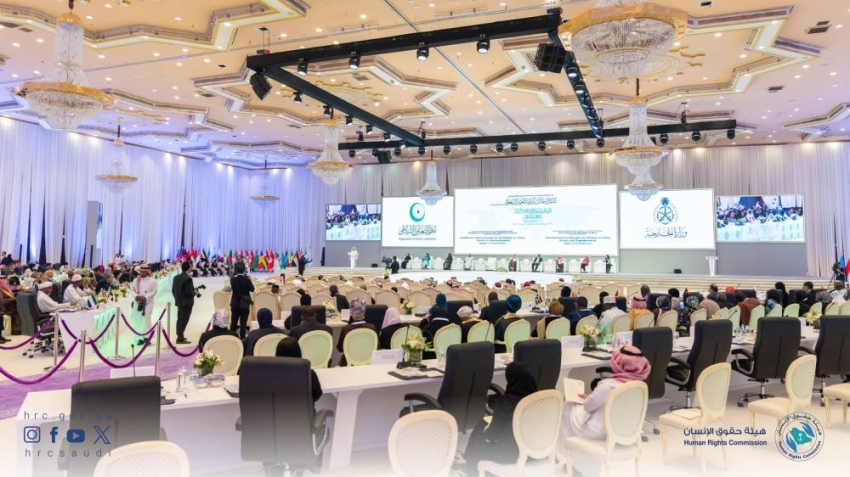
Tuwaijri said that in terms of the goals of the Kingdom’s Vision 2030, in the past few years, the Kingdom has carried out extensive and high-quality legislative reforms in various fields, including the field of women’s rights, which has helped to activate the legal framework to promote the realization of women’s rights, protect women’s rights and empowerment, and eliminate discrimination against them, the most prominent of which are the promulgation of the Personal Status Law and the establishment of the Family Affairs Council in 2016, which is responsible for handling family affairs in the Kingdom, and the promulgation of the Organization of the Disability Care Authority in 2018, which aims to care for and protect this group, including women and girls with disabilities, and the revision of the citizenship system and the labor system to ensure equality for all in terms of rights, obligations and service conditions, and to confirm that work is the right of all Saudi citizens and that discrimination based on sex, disability, age or gender is not allowed. The Saudi Federation of Community Sports aims to eliminate any other form of discrimination and revise the social insurance system to achieve equal retirement age for men and women, empower community members including women and girls to engage in sports activities, and allow women to participate in sports facilities on an equal footing with men, the participation of Saudi women in the 2016 Olympic Games, the “Women’s Empowerment” initiative launched by the Ministry of Human Resources and Social Development, and the launch of a women’s leadership training initiative in collaboration with INSEAD International University.
She pointed out that the Kingdom is working with the countries of the region, the Islamic world, the G20 countries and the international community to support and empower women in all fields, and that this auspicious gathering is nothing but a true reflection of the Kingdom’s interest in empowering women, upholding their rights and strengthening their participation in all development activities, stressing that the Kingdom pays equal attention to all human rights, as they cannot be reduced or concentrated on one another, based on the principle of complementarity and indivisibility of human rights, and on this platform I call on the international community to adhere to this principle in all its decisions.
[ad_2]
Source link

