


[ad_1]
Report: Yamama Badwan
Dr. Maryam Sultan Lootah, Associate Professor at the Department of Political Science at the UAE University, affirmed that the civil society we aspire to build in the Arab world must contribute to the state’s achievement of security, stability and improvement of the lives of its citizens, but we see the re-drawing of the civil society map according to their sectarian and ethnic beliefs, while regionalism and civil institutions begin to function in a way that entrenches ethnic and religious intolerance and works to promote divisive options. Division and fragmentation at the expense of national unity and sovereignty is not in the region’s international and regional strategic interests, while also weakening civil society and the state.
She said that in some Arab countries the idea of civil society has crystallized and become strong, unlike in other countries where it remains weak due to the intervention of the state itself or external parties, noting that if we do not pay attention to the current situation, we, as states and civil society, will slide to a dangerous turning point that represents a division between the state and society at the same time, and therefore we will not be able to save our countries from this slide.
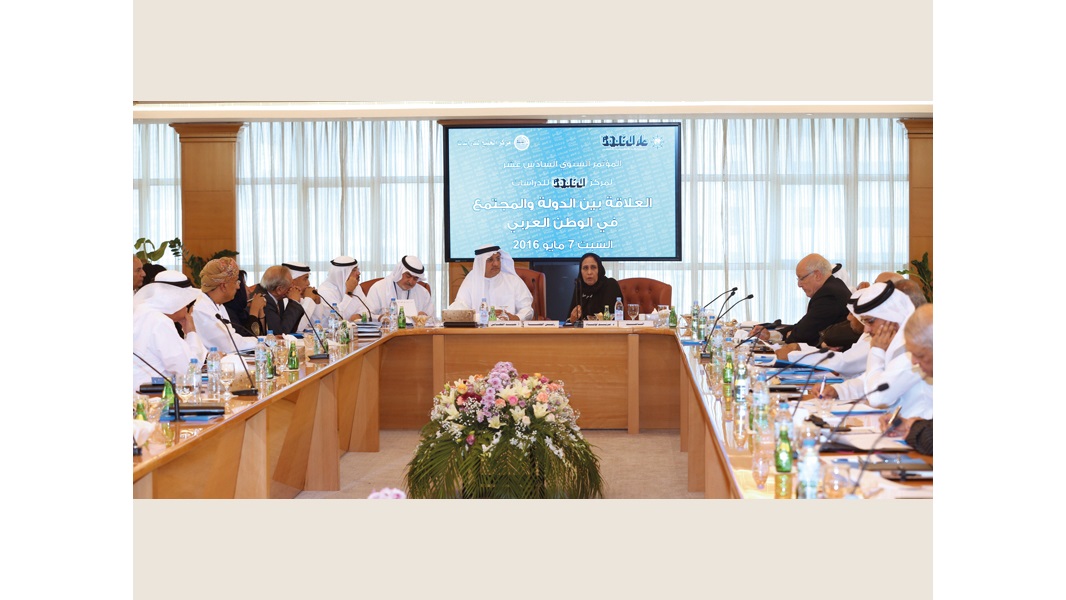
She added at the third session of the 16th Annual Conference of the Gulf Research Center held at the headquarters of Dar Al Khaleej Press, Printing and Publishing, which was chaired by Humaid Al Qatami, Chairman of the Board and Director General. Dubai Health Authority In its working paper titled “Civil Society between Internal Demands and External Pressures”, from what we have witnessed in the past five years, we have noticed the role of external parties in analyzing the internal situation in a way that serves the external agenda, without denying that this interference is carried out through certain symbols.
In the working paper, the researchers spoke about the importance of reframing the relationship between the state and civil society in a cooperative and complementary way to address the political, security, economic, social and cultural challenges posed by developments, especially the impact of the chaotic state of affairs in some countries of the Arab world since the negative impact, since the outbreak of the wave of popular movements in November 2010, which has affected the structure of both the state and society and has become a representation of the threat to Arab political reality and nation-states, facing the rise of ethnic, religious, sectarian and regional identities, which could cause divisions and fragmentation, as well as the decline of a unified Arab identity.
Luta said that the challenges that threaten the survival of the state and society require the study of the problems faced by civil society through three axes, the first of which is entitled “State and Civil Society: A Conceptual Study” because of the differences between the two concepts, which are controversial due to the confusion between the concepts of state, authority, government and political system, as well as the differences in definitions. Western civil society, based on Western experience and its comparison with the Arab experience.
She continues, saying that the second axis, titled “State and civil society in the Arab world: a discussion of an ambiguous relationship”, must discuss this relationship and prevent going beyond it, with the goal of establishing a cooperative relationship, given that the description of this relationship is ambiguous, due on the one hand to the context in which the state emerges and on the other hand to the emergence of civil society in its framework concept, as well as the power of civil society. The state has power in its relationship with civil society, it is the institution that has the power to enact laws to establish its organization, define its activities and is able to dissolve its institutions, the state sometimes deals with issues of superiority and a certain form of authoritarianism with civil society for reasons of maintaining security and stability, sometimes it deals with a movement of totality or restriction because it believes that this will increase its power.
She pointed out that while recognizing that civil society institutions are the fruit of Western experience and their active and influential role in policy making, it cannot be said that they provide real guarantees for the protection of social interests, given their growing role. The status of the private sector and its ability to influence the decision-making process, first of all in a way that serves reconciliation, because when examining the state problems in the Arab experience, it can be said that it represents four different models, the first experience is the civilized state established by the Messenger (may Allah bless him and grant him peace), while the second experience is the Rashidun era after the demise of the Caliphate. The Messenger, while the subsequent experience is represented by the transformation of the Caliphate into a monarchy, representing the longest period, and the fourth experience is represented by the Qatari state that emerged in the Arab world after the departure of the colonialists, and the political boundaries drawn by the colonialists before leaving the region, with the concept of Qatar to establish the modern Arab state.
Luta pointed out that the title of the third axis is “Arab civil society between internal challenges and external pressures” because the differences in social experience from one Arab country to another and the civil society organizations that have emerged from them make the relationship between civil society and Arab countries present a variety of situations. Some common points of Arab experience in this area are in the field of civil society, as well as the impact of cultural globalization and technological revolution, which make it possible to exchange and strengthen experiences. The capacity among activists and those concerned with civil society has prompted some to talk about a single Arab civil society that transcends political borders, and sometimes even forces others to talk about a civil society that transcends regional and national borders and extends along communication networks and dissemination networks. Their ability to influence ideas and practices, especially among young people who use knowledge and technology the most and are most willing to accept everything new.
Personality
Lootah explained that the second category of internal challenges is related to the socio-culture and civil society itself, including the decline of values that promote voluntary work, especially after the transition to citizen work within institutions, the elitism of civil society in the Arab world, its separation from society and its needs, and the dominance of individual personalities over the work of civil society institutions, as well as the lack of administrative performance of civil society institutions, their focus on disputes among each other more than on the interests of the social role assigned to them, the external infiltration of some civil society organizations through funding and influence on some of their symbols, as well as the transfer of foreign agendas and arbitrary projections on Arab society, as well as the opportunism and interests of some citizens of the Arab world. Social figures.
Civil society approach
Humaid Khatami said that throughout the ages, several paths have contributed to the manifestation of civil society, including the emergence of values, religious philosophy and beliefs, as well as the educational situation and backwardness of some countries, in addition to economic development and cognitive activities.
He explained that there is a lot of concern about some civil society organizations that receive foreign aid because they have to complement the state.
Interventions and responses
Many participants participated in speeches and inquiries, including Dr. Samah Mahmoudi of the Emirates College in Abu Dhabi, in which she said that civil society has always been the greatest in the establishment of the nation-state, but through Tunisia’s experience, we witnessed that the number of civil associations of all kinds reached 16,000 in 2012, which meant that a large amount of external funds poured into the country.
In her speech, Fatima Al Shamsi explained that, unlike the rich in the Arab world, the rich in the Western world contribute significantly to supporting civil society institutions and that the role of these institutions is currently declining due to the lack of a culture of voluntary work in the Arab region.
“Legal Adviser” Mohammad Ali Hafez said that the attack on unity, the refusal to divide and working together will help solve the problem of sliding towards a dangerous turning point, and it is important to find a solution to stop this trend. Institutions and state authority are simultaneously infiltrated from the outside.
External agenda
Dr. Maryam Lootah responded to some of the statements, saying: Arab countries emerged under the weight of colonialism, but this does not mean that they have complete political independence, but it is relative. Moreover, in the fifties and sixties. After that, the international and regional climate strengthened independence, and then there emerged a climate that promoted isolation.
She added that electronic media can pose dangers, which requires us to be more vigilant for the advancement of society.
She explains that civil society institutions face external pressures, which manifest themselves in the external penetration of some of them, either through dubious external funding, or by influencing their logos and forcing them to adopt external issues, or by influencing internal agendas, abandoning external issues regardless of social priorities, and disbanding and reorganizing the map of civil society institutions according to external agendas, instead of serving all sectors of society according to national priorities. In the past few years, civil society institutions have emerged according to ethnicity, they have begun to function in a way that is rooted in ethnic and religious intolerance and is committed to promoting divisive and fragmenting options at the expense of national unity and sovereignty, and in line with the interests of international and regional strategies aimed at the region. The report reviews the external pressures faced by civil society institutions in the Arab world, the most important of which is cultural globalization, as the opening of spaces created by the technological revolution and cultural exchanges between peoples has put pressure on Arab civil society.
[ad_2]
Source link
