

[ad_1]
The agreement comes after a recent cross-border trade dispute between the two countries.
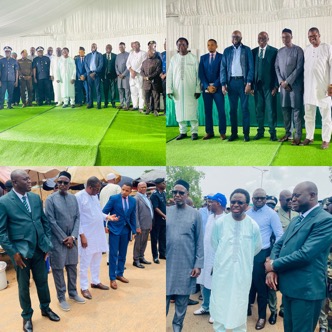
Earlier on Tuesday, officials from both countries met at the border village of Ker Ayub and exchanged greetings. Later, they went to Mansakonk in Lower RR where a closed-door meeting was held that lasted for over five hours.
Key agreements reached between the two countries include that trucks will not have to pay export fees, vehicles will not be stopped for security reasons and trucks will not have to pay new tariffs, but will pay the recent usual fee of 63,000 CFA francs.
The two countries agreed to continue using the Gambia Revenue Authority’s electronic tracking system, and Senegal agreed to develop its tracking system.
Upon arrival in Mansakonco, the delegates briefed the media and participants on the latest situation. Senegalese Minister of Transport El Malick Ndiaye noted that the two presidents had spoken, which was a positive sign for peace, as in other countries, leaders did not communicate when there was a dispute.
After closed-door talks, the two countries agreed that Gambia should submit a list of goods exempted from tariffs to the Senegalese authorities.
In addition, the validity of the pass (passavant) for Gambian vehicles entering Senegal has been increased from 10 to 30 days, with a fee of 5,000 CFA francs, and renewal for 15 days is allowed at 10,000 CFA francs.
In addition, all Senegalese vehicles entering The Gambia will be issued a 30-day pass at a cost of 5,000 CFA francs, which can be renewed for a further 15 days at a cost of 15,000 CFA francs.
The pass for vehicles entering The Gambia and the pass for vehicles entering Senegal do not apply to transit trucks. Senegalese trucks in transit only need to pay the electronic tracking service fee.
Gambian trucks travelling through the Senegal corridor to Bissau, Mali and Conakry will be charged escort fees.
In addition, the ferry toll for the Senegalese “Dakar Democracy Bus” and the Gambian “GTSC” buses has been restored to the original price of 63,000 CFA francs, and all Gambian and Senegalese vehicles using the bridge will have the option of paying in two currencies (Dalasi or CFA francs) at a fixed exchange rate published weekly.
They also said that goods purchased from Senegal to The Gambia would no longer be subject to a fee of 80,000 CFA francs (this fee is levied on goods worth 500,000 CFA francs or more).
Minister of Trade, Industry, Regional Integration and Employment, Baboucarr O. Joof, said the discussions held between the two sides were aimed at promoting trade, reducing trade costs, removing trade barriers and ensuring smooth flow of trade between the two countries.
The Gambian Trade Minister acknowledged that the two sides had made significant progress in the dialogue and expressed optimism that in the coming months, their decisions would bring results in poverty alleviation for the people of both countries.
He said the two sides did not resolve all issues during the closed-door talks, but had significantly resolved some issues.
Minister Yoff spoke highly of the recent closed-door meeting, saying they had taken the “right step” considering the enforcement monitoring mechanism they had envisioned during the meeting, as well as the integrity of the decision to bring together the Minister of Trade and Industry and his team to look at the challenges facing both countries in terms of exports to Senegal and imports to The Gambia, in order to reduce trade imbalances.
Minister Joffe added: “We think we are solving a decades-old problem.”
Minister of Transport, Works and Infrastructure Ebrima Sillah also spoke, expressing the government’s commitment to promoting the spirit of “SeneGambiaism” and advancing Senegambia cooperation.
Minister Sylla hinted that Senegal also wants to introduce its parking platform, which he said could integrate and coordinate the tracking of goods between the two countries.
He also noted that at the customs level of the two countries, they are working to integrate and harmonize the two customs solutions used by the two countries within the framework of the ECOWAS initiative to enhance the flow of goods and services among member states.
[ad_2]
Source link

