


[ad_1]
Posted: Tuesday, August 6, 2024 – 7:50 PM | Last updated: Tuesday, August 6, 2024 – 8:03 PM
In 921 AD (309 AH), a religious and political mission was commissioned by the Abbasid Caliph “Al-Muqtadir Billah” to travel from Baghdad to the heart of the Asian continent, what was then known as the “Holy Land”. In response to the king’s request to introduce the Islamic religion, the embassy consisted of jurists and politicians as well as historians, the most important of whom was Ahmad ibn Fadlan, who was chosen by the Caliph for his rich experience.
When Hollywood expressed the Abbasid Caliph’s choice of Ahmad ibn Fadlan in the famous movie “The 13th Warrior”, it implied that the Caliph wanted to capture his beautiful wife and include her in his harem, so he eliminated Ibn Fadlan on a deadly mission and never returned.
Beyond the Orientalist fantasies and temptations of Hollywood, the sources at our disposal indicate that the Bulgarian Tsar “Almush ibn Yaltavar” sent a request to the Caliph Muktadir Billah to send an envoy to the Bulgarian Tsardom to explain the principles of Islam to the Caliph. Send someone to build a mosque for the Tsar to overlook his people from the mihrab and build a strong castle to fight against the enemies, and here the choice fell on a man who combined jurisprudence and wisdom, “Ahmad ibn Fadlan”.
Over the river
The caravans set out from Baghdad, passed through various Persian cities, and from there crossed the Oxus and Sihon rivers to the Khwarezm and Oghuz regions of Turkey.
Ibn Fadlan had not received the funds that the Caliph had ordered him to collect from the city of Khiva to meet the demands of the Bulgarian Tsar, and the convoy had lost men due to cold and disease, so it seemed more effective to return to Baghdad, where the princes of Khiva, Samarkand and Bukhara would inevitably receive the due punishment for refusing to provide the necessary funds for the mission.
In the transitional area between Khwarezm and the Turks of Central Asia, where alms to beggars and passers-by became permission to sit by the fire and bathe, Ibn Fadlan observed the clothing culture. Due to the density of the clothes, only his eyes could be seen from the man. He first discussed the idea of climate adaptation.
Along the way, Ibn Fadlan began to face the first problem of his pagan environment when a man asked:
“Tell your Lord what He wants us to do to remove the cold from us?
Ibn Fadlan replied: He wants you to say: There is no god except Allah
The man responded: “If we knew this would work, we would have said so.”
Then some people from that country asked him: “Is our Lord a woman? Ibn Fadlan exaggerated the matter and asked God for forgiveness and honor. The Turks repeated the request for forgiveness and honor after him, trying to apologize.”
Moving north, near the land of the Bulgarians, Ibn Fadlan encountered a people with many gods, of whom he said:
“We see those who worship serpents, and those who worship fish, and some of them claim that there are twelve lords: there is a lord in winter, a lord in summer, where there is rain, a lord… and so on. The Lord of heaven is the greatest of them all, but he meets them with an agreement and pleases each of them… God is greatly exalted, above the words of those lawless men.”
If you understand the geography of the region, you will be surprised when you follow these events and ask yourself:
Why did Ibn Fadlan choose the difficult and problematic route through Khiva and Oghuz rather than the shorter route directly to Bulgaria via the Caspian Sea?
The same question aroused our wonder as we traced the sufferings of Moroccan, Egyptian, and African pilgrims as they journeyed to the Hijaz in the Middle Ages.
Instead of taking the traditional, easy route through central Sinai (the Egyptian Hajj route), they were forced to take a long, arduous road, suffering through Egypt’s Eastern Desert until they reached the port of “Adab” at Halayeb, a region in present-day southeastern Egypt that some believe is an illusion and derives its name from the “torture” of the pilgrims.
The reason for the torture of the pilgrims was the rise of the Crusader Emirates in Palestine and east of the Jordan River, which lurked and killed Muslim pilgrims crossing the Sinai Peninsula, which damaged the reputation of Egypt, especially in the time of Saladin Ayyubid. Through the Eastern Desert of Egypt, to the areas of today’s “Halayeb” and “Abu Ramad”, and from there directly across the Red Sea in destructive ships to Jeddah and Mecca.
If this painful experience was known to Egypt in the XII-XIV centuries, then Ibn Fadlan’s journey was already known to Egypt in the XIII century, this time as the creation of a Jewish state with a white leader and people in the face of the obstacles of the Abbasid Caliphate.
The country was called the “Khazar State” and the Caspian Sea was called the “Khazar Sea” for many centuries.
At the time of Ibn Fadlan’s travels, the Khazars were a powerful kingdom and a people of diverse races, abilities, and skills who were an obstacle to four geopolitical powers in the region:
• During the Abbasid Caliphate, Arabs introduced new religions from the south.
• The Russians (Saqaliba) made a brutal invasion from the northwest.
• Byzantium as seen from the west, southwest, and across the Black Sea.
• The Volga Bulgarian Principality in the northeast.
The Khazars were able to conquer a vast area from Kiev (Russians) in the west to the Bulgars on the Volga River in the east (see attached picture).
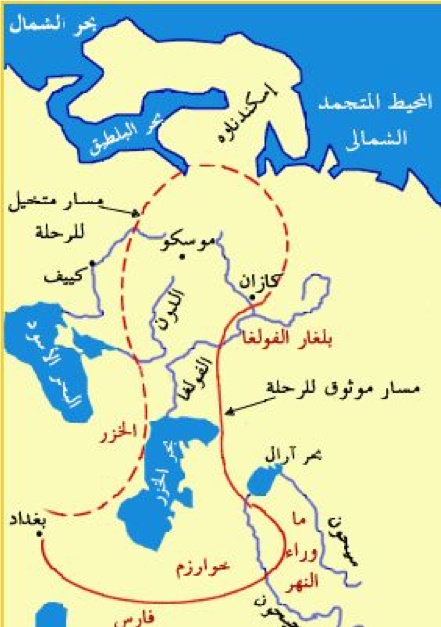
Khazar Kingdom
After the relative decline of the Khazars’ power in the 10th century and the liberation of the Volga Bulgars from their control, the Bulgarian king began to look for new allies to gain strategic allies and ideological references, so the embassy of Ahmad ibn Fadlan came to build a mosque and a castle, teach Islam, and announce the adoption of Islam as the official religion of the country, with its scope extending throughout the middle Volga River basin.
It is noteworthy that the Khazars consisted of a unique national component, whose citizens were generally followers of natural religions, Christianity or Islam, while the rulers were Jews.
This was one of those unique periods in history when the ruling class did not believe in the religion of the people, the rulers did not impose their religion on the people or preach it (as we all know, Judaism was against proselytizing).
The fact that the Khazars Jews originally came from the Levant region is an interesting story.
After the Romans conquered and expelled the Jews from Palestine, Persia welcomed them, especially because the powerful Persian state was an enemy of the Romans, and then the expelled Jews were welcomed and Persia embraced them, and they lived under its umbrella for centuries. Special circumstances.
But the following centuries saw civil wars in Persia, and especially a popular revolution known as the Mazdak movement, which sought socialist rule in order to distribute wealth to the poor, and to take the wealth of the rich, the kings and princes, and distribute it to everyone.
The Jews of Iran were divided between supporters and opponents of Mazdakism, and they were forced to flee the heat of the civil war to Byzantium and Khazars, and then the Byzantines expelled the Jews (accusing them of treason on behalf of the Arabs), so they joined their brothers in Khazars.
Thus, the Khazars had an established Judaism and were strongly hostile to the Abbasid Caliphate.
Here a paradox arises, on the one hand the view that Islam arrived in the cold regions of the deep Volga region of Asia due to spiritual reasons, religious support and admiration for Islam, and on the other hand the view that the arrival of Islam was a “great strategic game” in the tenth century AD.
This was due to the fact that the Bulgarian king wanted to seek the help of the Abbasid Caliphate, whose religious dimension was different from that of the Jews, and also due to the hostile relations between the Abbasid Caliphate and the Khazars.
Surprisingly, the fate of history went against the Bulgarian decision from the very beginning, the Bulgarian king ignored the fact that the Abbasid Caliphate was beginning to collapse and decline, and Baghdad was unable to provide any practical assistance to the Bulgarians.
But the historical surprise is that with the decline of the Abbasid Islamic Caliphate, an unexpected surprise occurred, which was the rise of unorganized Bedouin tribes represented by the Russian Saqqarabi, who from time to time worked for the benefit of Byzantium. Before that, they even worked as mercenaries for the Khazars, and finally they decided to work for themselves and attacked the Khazars’ borders, and among other factors, they contributed to the downfall of the Khazars. state’s dominance and position in Eurasia.
In such an atmosphere, Ibn Fadlan arrived in 922 AD to become the king of the Bulgars, and no one knew that history would cover up the expansion of the Bulgars, the collapse of the Khazars and the rise of the Russians from primitive tribes, to become the rulers of the Bulgarians. They had the first say in the region and would control the fate of the Khazars and subsequently threaten the Volga Bulgars.
[ad_2]
Source link

