

[ad_1]
August 7, 2024 at 4:00 AM
August 7, 2024 at 4:00 AM
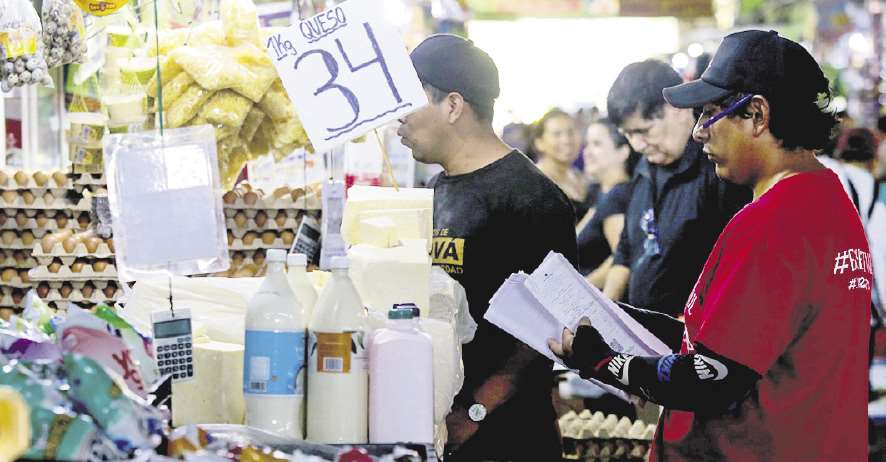
Bolivia has been characterized by a high fiscal deficit, low government responsiveness, foreign currency lending by the central government, low international reserves and a trade deficit since last year, which are likely to intensify, with a strong impact on price increases, economists point out.
Analyst Martin Montero noted that the shortage of foreign exchange will lead to higher prices for different products. “The current economic environment could easily get out of control, and no one wants to lend money to the national government,” the analyst said.
Montero added that he has considered since last year that Bolivia’s current crisis is similar to the one in Lebanon, with a high fiscal deficit, low government response capacity, commercial banks lending foreign currency to the central government and low international reserves.
“If we use that as a reference for what might happen in Bolivia, what will happen is that the gap between the official dollar and the parallel dollar will be larger, leading to higher prices for imported goods,” he said.
Claudia Pacheco, president of the Santa Cruz Institute of Economists, said rising food prices and a shortage of dollars have led to higher product prices.
“Inflation has a path, but the conditions that lead to hyperinflation are different from those in previous years, and the central government still has room for decision-making.”
In turn, economist Jaime Dunn points out that the appreciation of the dollar must be seen as a loss of purchasing power for Bolivians over the dollar.
“So rather than the dollar becoming more expensive, the bolivian boliviano has depreciated relative to foreign currencies. This has obviously increased the price of imports,” he said.He added that if inputs become more expensive, the final product will also become more expensive as these prices are usually passed on to consumers, thus creating inflationary pressure.
“Bolivia has had inflation at some point of 25,000% annualized, 10,000% annualized, 5,000% annualized, 1,000% annualized, 100%, 10%, and 20% annualized; that is, inflation started low and then began to rise rapidly. The probability of increasing and accelerating inflation in Bolivia is very high,” the analyst said.
Economist Wált Morales, in turn, is concerned about the increase in input prices, suggesting that it is a supply problem rather than an increase in demand. “Either, because of the difficulty in obtaining foreign exchange to pay for imports, these products are not available in the same quantities and at the same pace as before, which leads to an increase in prices,” he said.
Finally, economist Juan Fernando Subirana said that the actual scale of inflation is worrying, as some products in the basic basket have already reached double-digit inflation levels.
“I think that while we are experiencing uncontrolled inflation, the risk of hyperinflation is still low, but not zero; but if the wrong decisions continue to be made in the real economy, we will face a situation similar to Argentina.”
The leader of the union, Edgar Alvarez, announced that the sector will begin mobilization by sector and, as a result, the union has scheduled a march for this Thursday, the 8th, in the city of Cochabamba.
“The lack of seriousness of the government in solving economic policies due to the lack of dollars, which affects the union sector and the production sector, worries us,” said Alvarez, who also decried the increase in product prices.
[ad_2]
Source link

