


[ad_1]
Sharjah: Shadi Saladin
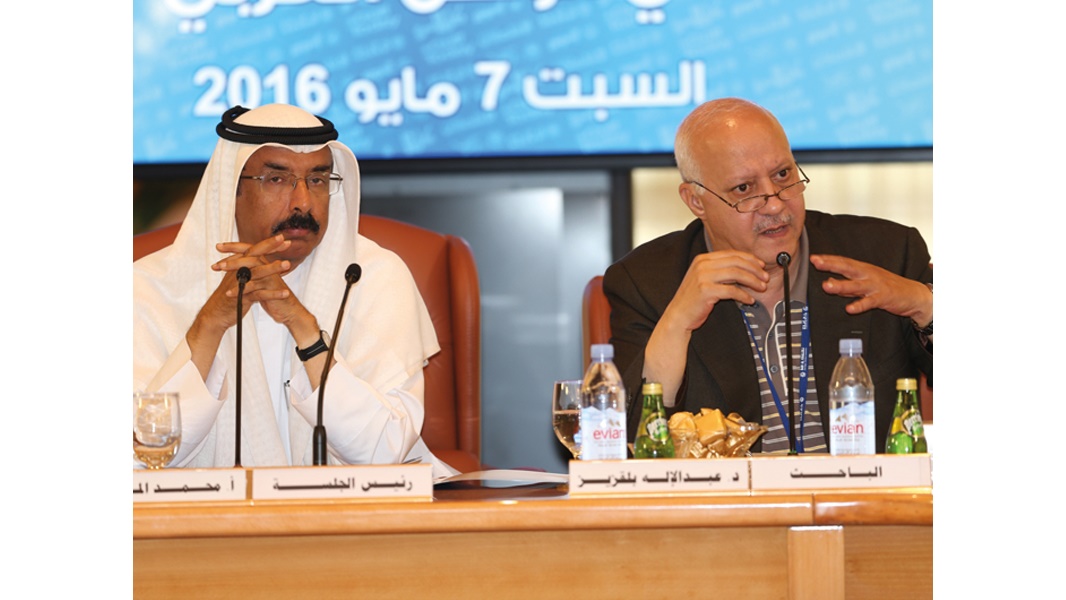
Dr. Abdel-Ilah Belkziz, Secretary General of the Moroccan-Arab Forum and former Director of the Arab Center for Unity Studies in Beirut, presented his views on democracy and the relationship between the State and society in the Arab world, one of which creates the other, stressing that (society and state) are not two opposing entities, because – in the words of Dr. Belkziz – there is no society without the State, Dr. Abdel-Ilah Belkziz tried to resolve the confusion between society and the State, a traditional saying in the Arab reality.
This was the first session of the 16th Annual Conference of the Gulf Research Center, which began yesterday, Saturday, at the headquarters of the Gulf Press, Printing and Publishing Authority, and was chaired by Mohammed Mur, the former President of the Federal National Council, who began by stressing that the “Gulf” conference is considered one of the most important platforms for expressing opinions, given the importance of the topics discussed.
Dr. Abdul Ila Belkziz said at a conference attended by many researchers that Arab countries have opened a new chapter in contemporary history in terms of relations between the state and society, and between the opposition and the authorities.
He explains that there is no reason in modern political thought to regard society and state as two opposing, conflicting entities, since there is no society without the state. And since conflicts between them, even if they occur, are only the result of a temporary crisis in their relationship, there is reason to explain that popular empty talk about “state versus society” is meaningless. The implication of these remarks is that those who say them know nothing about the origins of political theory, just as they know nothing about the real – at least modern – state and society.
The state is society
Belkizi stressed that the state, both in terms of theoretical definition and historical reality, is nothing more than an organized society. That is, a people is subject to a set of rules and legal systems that safeguard rights, security and sovereignty, and provide conditions for the satisfaction of material and moral needs and the acquisition of means of progress. Society creates the state, because it is the principle of its organization, without which it cannot exist, and it emerges in it as an objective need, but the state also creates or re-creates society, because it organizes society, provides it with a reason to exist and prosper, guarantees its freedoms and rights, and protects its sovereignty from external aggression, allowing it to develop and devote its energies, and consolidates his values of public interest, citizenship and loyalty to the motherland.
The state is not an authority or a political system
He explained that the State is a socio-political entity in which emerge public systems, institutions and bodies that perform the function of managing public interests and public affairs, and therefore the State does not represent a specific social group. If it did so, it would abandon the exclusive right of representation and the identity of the State as a representative of a social group or nation and become a salad. The State does not intervene in conflicts of social interests, because it is essentially supposed to remain neutral, that is, above the internal conflicts of society. Its only acceptable and necessary intervention, reflecting its nature as a State, is to protect the law that expresses the general will from any infringement and impose its sovereignty by applying its provisions to everyone.
Western Democracy
Regarding the emergence of democracy in Western countries, Dr. Belkizi said: The modern state did not emerge as it is today in Western countries in Europe and America, but it developed over a long period of time. It went through four centuries of historical development until it acquired the characteristics it has today. Just two examples show how much the state needs to wait for accumulation and maturity before solving problems. The two examples that can be cited are both political rights systems, or civil rights systems, and both involve representation.
The first concerns the general right to vote and representation. Until the beginning of the twentieth century, this right was exclusively monopolized by the owners of the means of production. If workers, peasants and other producers were excluded; they were a large group of people in society. However, over time, the struggles of the working class and trade unions, as well as the uprisings of peasants and marginalized forces, forced these social classes and groups to be given the right to vote and to run for parliament and parliament, in a way that ensured a better distribution of democratic rights in Western societies, in which the concept of citizenship as one of the cycles was completed.
The second concerns women’s rights, especially the right to vote and representation, because for hundreds of years in the history of the modern state, until the borders after World War II, women were deprived of this right, even though they were – citizens according to the customs of the state, and even though they made up half of the population of society. However, the struggle of the women’s movement and the progressive movement that followed it took away this right, and later it was accepted to open up other rights, such as the holding of women in the highest positions in the state: ministerial and presidential.
Thus, the first two examples confirm – without giving others – that the modern nation-state system has a cumulative political history that cannot be ignored, and that it was established in countries that had no political history. The same developments in the economic (Industrial Revolution), political (English and French Revolutions, American Constitution, state units…), intellectual (Enlightenment) and religious (Protestant Reformation) fields cannot be replicated; the will to build a modern state must recognize the need to develop within the framework of the dual historical development of the state and society. The developed Western countries are the product of advanced societies, and what is society is also the state.
Dr. Abdul Ilah Belkziz concluded his paper by emphasizing that democracy has a cumulative history, which continues to cycle until it becomes a complete system. In our Arab society, we want democracy like the current Western democracy, but this must be impossible. It is a social contract that expresses the will of the state.
Ibtisam Al Ketbi: Our Arab society needs a realistic view, not a theoretical one
Dr. Ibtisam Al Ketbi, President of the Emirates Policy Center and Assistant Professor of Political Science at the UAE University, confirmed that in addition to our countries, she asked: Do countries in the traditional sense still exist today? She concluded by saying: “Our Arab society does not need theoretical cognition, but realistic cognition based on reality.”
In his comments to the conference, Mohammed Shali said: We must distinguish between the state and the political system, but from all the examples presented, it seems that the political system swallows up the state and it is impossible to change the state system. The political system and the state remain, which shows that from a theoretical point of view we understand the state as something and the political system as something else.
Mohammed Diab Musa, Education Advisor to His Highness the Ruler of Sharjah, said that the relationship between the state and society refers to the relationship between the executive branch and society, but we cannot separate the state from society.
Dr. Omar Abdul Aziz, Chairman of the Board of Directors of the Sharjah Arab Cultural Club, asked in his speech: Where is the fair and free country? He continued: We cannot consider the United States to be a fair and free country. He asked a counter-question: While China is growing, can we consider China to be a free and unfair country?
Younis Nasser stressed that society is the one who creates the nation because it has a real interest in building the nation, our people elect their leaders or authority and this authority comes back to take revenge on those who elected it, and the examples are many.
Dr. Sabah Al Mahmoudi of the Emirates Polytechnic Institute concluded his speech by saying that all Arab countries are at the same level, with differences in their level of social development, the degree of centralization of institutions and laws, and even social debates within countries.
[ad_2]
Source link

