

[ad_1]
________________________________________
(Hassan Al-Rashidi)
____________________
Safar 1446
May 8, 2024 AD
__________________
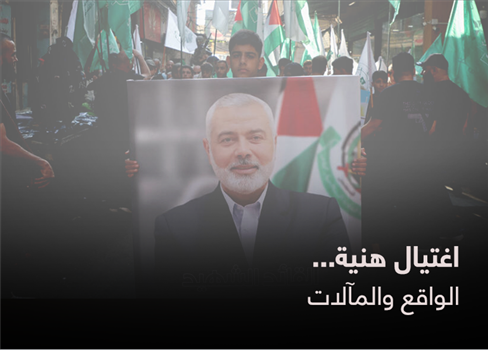
Israel’s assassination of Hamas politburo chief brings mixed results "Ismail Haniyeh" There are many theses in Tehran’s heart, many messages it sends to the outside and to the inside, whether Netanyahu succeeds in achieving his goals, what are the consequences for Iran, and to what extent does it affect relations with the resistance as a whole?
"This isn’t the first time Israel has assassinated a Hamas leader, but every time the movement grows in strength…it seems like we lack a strategy."
This was the statement made by former Israeli Defense Minister Avigdor Lieberman after the assassination of Hamas leader Ismail Haniyeh, in which he expressed condemnation of Prime Minister Netanyahu’s policy, because from his point of view it was futile.
Within hours, Israel carried out two major, unprecedented assassinations:
The first was in Haret Hreik south of Beirut, Hezbollah’s main headquarters, targeting the party’s military commander, Fuad Shoukr, who held a position there similar to that of Qassem Soleimani in Iran’s Revolutionary Guards.
As for the second assassination, it was the strangest and most mysterious one because it targeted Sheikh Ismail Haniyeh, the head of the Hamas movement’s political bureau, who was martyred along with his guards in the center of Tehran.
The most important question to ask in this context is: Why did the Zionist entity carry out these assassinations, especially at that time?
To answer this question, we need to analyze two elements:
The first element: the truth about the assassinations of Hamas leaders and their details, because they will shed light on some of the motives behind these assassinations.
The second element: developments in the Gaza war, the current strategic positions of the conflicting parties, the expected negotiations on a swap agreement, Netanyahu’s real wishes in this regard, and the role and capabilities of the Shiite resistance axis.
Mysterious assassination
The assassination of Ismail Haniyeh is filled with many oddities and mysteries, the most bizarre and surprising being how did the Zionists identify his place of residence, rather than his bedroom, and assume that the Iranian Revolutionary Guards were guarding it?
Interestingly, the Hamas movement was the first to officially announce his assassination, issuing a statement nearly three hours after the assassination, while the Iranian authorities, the country where the assassination took place, remained silent and did not officially announce the assassination until hours after the Hamas statement was issued.
Faced with the inability of Zionism to defeat the Palestinian resistance, their means were to defeat the resistance by putting pressure on its most glaring weakness – the civilian population, thus launching a brutal campaign of extermination against defenseless old men, women and children.
She remained tight-lipped about the assassination for two full days, and the Iranians did not release photos of the assassination site, especially since some reports said Haniyeh was in a building 150 meters away from the residence of Iranian President Bazarshkian. , and only recently did they reveal the method of the assassination, despite that he was killed by a missile fired from a drone that penetrated Iranian airspace, or by a missile guided from outside Iran, or inside Iran. Is this a scenario where an assassination took place that we don’t know about?
Iran’s delay in issuing an official statement clarifying the circumstances of the assassination has made it easy for the assassination to present many imaginary scenarios. Those who pay attention to Iran’s official statements know very well that issuing an official statement clarifying the details of the assassination will not solve the problem, because Iranian officials have the habit of not telling the truth and concealing the truth for political considerations. There are many examples of this.
To complicate matters further, Iran is trying to indirectly blame Hamas and Qatar for security negligence. Abbas Hamayyar, a prominent Iranian political analyst who has close ties to the IRGC and served as its cultural adviser. The Iranian Embassy in Lebanon has released a new story related to the assassination. The head of the Hamas movement said the assassination was carried out through a non-Iranian phone line used by Ismail Haniyeh’s bodyguard Wassim Abu Shaaban.
He went on to say that Haniyeh used an international telephone line granted to him by the official authorities of Qatar, which was of the Thuraya type that worked via satellite, and his location was determined using advanced technology, which was not a difficult problem.
And the American newspaper The New York Times published a new story with pictures of the building where Haniyeh was located.
The assassination was carried out by planting an explosive device in his room that was hidden in the hotel about two months ago, according to the newspaper, which cited five Middle Eastern officials. The hotel is operated and protected by the Revolutionary Guards and is part of a large complex in an upscale neighborhood in northern Tehran.
The five officials added that the story that the bomb was detonated remotely when he was confirmed to be in the hotel room seemed the most realistic.
A report released by Iran indicated that the missile attack came from inside Iran, just meters away from Haniyeh’s residence.
Whatever the circumstances of the assassination, it represented a strong blow to Zionism against Tehran.
Gaza War and Dead Ends
The Al-Aqsa flood on October 7 was able to achieve several objectives, the most prominent of which was to destroy the strategic deterrent capabilities of the Zionist entity state, which for decades represented in Zionist political thought the fundamental pillar of the state’s protection of itself from surrounding threats.
After the Gaza Strip’s defenses collapsed in a matter of hours before Palestinian resistance forces, Zionist Prime Minister Benjamin Netanyahu tried to revive the theory.
His strategy was based on invading the Gaza Strip and disintegrating the military structure of the Palestinian armed factions, but these factions, as part of a strategy of conquering by flood, prepared for a long guerrilla war and succeeded in inflicting heavy losses on the occupying forces. army.
Seeing that the Zionists could not defeat the Palestinian resistance, he tried to defeat it by putting pressure on its most prominent weakness – the civilian population, and he launched a brutal campaign of extermination against defenseless old men, women, and children, until his crimes extended to the destruction of the infrastructure of the Gaza Strip, including electricity, water, sewage, hospitals and schools, leaving only 17% of the people in Gaza in their homes, while the rest, out of 2.4 million, were displaced, leaving their homes and refugees, migrating from one area to another.
Assassination has been a strategic tool of Zionism, and they have long used it to achieve many goals, some linking it to the establishment of the Zionist entity on Palestinian land in 1948. In the seven decades since the establishment of the Zionist entity state, some have monitored 2,700 assassination attempts.
The Tatars at that time were not satisfied with this and implemented a systematic policy of starvation of the Gazan people, followed by attempts to undermine the rule of Hamas and replace it with others, but this strategy seems to have achieved little results. This is needed because the decisive actions shown in resisting all attempts to infiltrate and control the Gaza Strip have failed, and the Gazan people have so far shown a firm attitude towards starvation that has exceeded everyone’s expectations.
At the same time, the negotiations have encountered resistance from Netanyahu because they have not achieved the entity’s goals in Gaza, the most important of which is to restore deterrence, eliminate resistance, and prevent it from flood-like attacks. Meanwhile, Palestinian negotiators have been resolute and have not made the concessions that the man wanted.
Here Netanyahu finds himself in a dilemma: international demands to stop the massacre, heroic resistance causing huge losses in equipment to his soldiers, anger and demonstrations by prisoners’ families, growing resentment in the army, religious Zionist allies, and at the same time time lurking and low popularity.
Jump forward
In order to get out of this deadlock, Netanyahu adopted an escape strategy, using the weapon that the occupying power has historically been best at: assassination weapons.
Assassination has been a strategic tool of Zionism, and they have long used it to achieve many goals, some linking it to the establishment of the Zionist entity on Palestinian land in 1948. In the seven decades since the establishment of the Zionist entity state, some have monitored 2,700 assassination attempts.
These numbers were monitored by Zionist journalist Ronen Bergman and published in his book, Rise and Kill First: The Secret History of Targeted Assassinations in Israel.
Throughout the history of the Zionist entity, the image of victory presented by the entity’s state government in wars was the capture of lands and assassinations, but in the last thirty years, the image of victory has been limited to the assassination of leaders and leaders.
But what is the purpose of this wave of assassinations by the Zionist entity?
Netanyahu believes that by assassinating controversial resistance leaders he will weaken and disorient the entities led by those assassins.
But the goal of the assassination is not limited to confusing the resistance, but also targets the external dimension, involving changing the conflict environment in favor of the entity, and this is what Netanyahu is doing now.
Netanyahu is sending a message to the entire region that he can attack the leaders of the resistance and those who dare to support them or provide them with aid, even if only in the form of something like Iran and its weapons.
Instead, he assassinated the head of the Hamas Political Bureau in the backyard of the supposed leader of the resistance axis and challenged her to respond in order to prove that Iran was nothing more than a paper tiger, which it was.
Netanyahu’s message on the assassination also included a message to the Jewish community, which has been frustrated over the past few months as it has seen its military and political leadership fail to deliver promised victories, whether it be eliminating Hamas or freeing prisoners.
These assassinations are an image of Israeli victory that Netanyahu presents to a Zionist public in need of healing and pride, regardless of their long-term strategic viability.
But Netanyahu, without realizing it, has rendered a great service to the resistance, as these assassinations may actually expose the false nature of the axis of support, which is nothing more than a false image of power trying to get among the ranks of its supporters. Iran is using its weapons against the major regional powers, and Iran is only using the resistance as a bargaining chip to achieve this end…
This will certainly prompt the resistance to take a gradual rather than immediate stance towards moving away from the so-called “unity of the block”. The harm to the resistance from allying with him is greater than the benefits it will gain, but such a separation will not happen overnight, but will undoubtedly take time.
As for the issue of assassinating leaders, the resistance knows very well how to deal with this painful reality, and history is full of Hamas leaders assassinated by this entity, starting with Yahya Ayyash, passing through Sheikh Ahmed Yassin, and ending with Sheikh Ismail Haniyeh.
Hamas’s capabilities are well known, and its enduring success is demonstrated by its ability to replace the sacrificial leader with a new one, and the speed with which this can be accomplished, given its high level of institutional capacity. Enemies precede friends.
____________________________________________
[ad_2]
Source link

