

[ad_1]
__________________________________________________
(Hassan Al-Rushdie)
_________________
January 17, 1446 AH
July 23, 2024 AD
_____________________
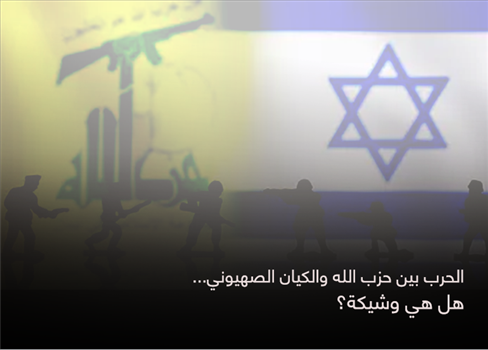
There are escalating statements and threats, sometimes from the Zionist side that if Hezbollah attacks do not stop, Lebanon will be destroyed and made like Gaza, sometimes Hezbollah threatens "Israel" If the attacks were more widespread and violent, would the rhetoric and skirmishes between the two sides escalate into a full-scale war?
The cyclone is essentially steam rising from the mouth of the cup, disappearing quickly and leaving no trace.
Just like the wind swirls around itself, lifting things up several meters into the air, which people think are lofty dreams, but then they fall to the ground and disappear in the dust.
This is the idea of some people who believe that Hezbollah, in the face of the fanaticism of the occupying entity and the Zionist government’s threats to make Lebanon devastated and annihilated like Gaza, will have a war between the party and the entity, and then days and weeks will pass and we will not see a full-scale, destructive war, but small conflicts according to carefully calculated rules.
How to explain what is happening between Hezbollah and the Zionist entity?
How do we view the bipartisan threats of war from time to time, and then the discussion of war disappears?
Is it true that one of the reasons why the Zionist army is anxious to stop the war in Gaza is that they will be engaged in a war with Hezbollah?
Why are Hezbollah spokesmen and those close to them keen to emphasize that the Zionist entity will not be involved in the Lebanon war?
To answer these questions and understand what is happening between the two parties, we must first understand the equation of the conflict between Hezbollah and the Zionist entity and the foundations that govern them, and then analyze the relationship of the Al-Aqsa flood to this equation.
The Zionist Entity and Southern Lebanon
Historically, Sunnis can be considered the origin and majority population of southern Lebanon, while the Shia sect was historically a minority, centered around Mount Amal, where the great scholars of the sect emerged, but Iranian migration southwards changed the demographic balance in the south within a century, making Shia the most populous sect, with the Christian Maronites being a strong force.
The area of southern Lebanon is estimated to be 1,045 square kilometres and the population is estimated to be approximately 800,000. The Southern Governorate includes 181 towns and 146 municipalities, with an estimated number of 412 villages.
The Zionist occupation of southern Lebanon coincides with the beginning of the new Ayatollah regime in Tehran, which plans to expand its hegemony over the Islamic world by deploying weapons to implement its plans, whether it is the spread of Shia Islam, or the domination of cities and regions dominated by Sunnis, using them as cards in the game with the major global powers.
Southern Lebanon includes five Palestinian refugee camps: Ain al-Hilweh, established in 1949 and located near the city of Sidon, is the largest in terms of area and population; Rashidieh, located 7 km south of Tyre, is home to more than 10 Palestinian refugees. According to UNRWA, the camp has 22,000 people and is one of the largest Palestinian refugee camps to be bombed by Israel due to its proximity to the border.
There is also the Beita refugee camp, which includes refugees, most of whom come from villages in northern Palestine, the Mieh Miyeh refugee camp, which is home to about 5,000 Palestinians, and finally the Al-Bass refugee camp in the south of the city of Tyre, which is home to about 10,000 refugees.
In general, southern Lebanon represents a long-standing geopolitical crisis for the Zionist entity, especially since the late sixties and early seventies.
In that era, the Palestinian resistance movement led by Yasser Arafat used southern Lebanon as the starting point for guerrilla operations against Palestinian Zionists, especially after the resistance movement was expelled from Jordan in 1970 and the emergence of a strong government in Egypt and Syria prevented any hostile actions against that entity from its territory, so there were no other countries in the circle except Lebanon.
The Sunnis and refugee camps in the south represented an incubator for the popular resistance, while the Shias and Maronites viewed the resistance with resentment and apprehension, but the strength of the military resistance kept them silent until 1982, when the Zionist army invaded southern Lebanon, and here the Shia prejudice against the Zionists emerged, when photographs were taken of men and women leaving Shia villages with flowers and throwing them at the invading Zionist tanks, as they freed them from the Palestinian resistance and its rule over the region.
The emergence of Iranian forces
The Zionist occupation of southern Lebanon coincided with the beginning of the plan of the new Ayat regime in Tehran to expand its hegemony over the Islamic world, by deploying weapons to implement its plans, whether it is the spread of Shiism, or the domination of urban Sunni areas, using it as a card in the game with the major global powers and even the Zionist entity, recognizing it as a regional power with hegemony in the region.
Thus, when Iran entered Lebanon, it discovered the Amal Movement led by Nabih Berri, a Shiite organization supported by Hafez al-Assad, the ruler of Syria at the time, and Iran directly infiltrated the organization and received support from Shiite elements. The Amal Movement, with the support of Assad and Iran, successfully waged a guerrilla war against the Zionist forces in the south and forced the Zionist withdrawal after reaching a secret understanding with Assad, according to which the entity recognized Assad’s regime. hegemony over Syria in exchange for the Shiite militias preventing the presence of Palestinian resistance forces and preventing Palestinian operations in northern Palestine from the south.
But Iran’s ambition and domination of Lebanon has not been realized, so it strives to separate its own faction in the Amal movement and call it Hezbollah to express Iran’s direct inclination, and to arm and support Hezbollah economically and socially to expand and dominate the Shia community and marginalize the Amal movement, but allow it to continue to play its role and serve its interests.
The Iranian armed group (Hezbollah) entered the second phase, trying to limit the role of other Lebanese sects, especially Sunnis, and successfully limited their role through intimidation, weapons and assassinations, and then turned to the Maronites. Its role is to distinguish between those who are loyal to the party and those who are against the party and the Iranian presence.
After relatively successfully dominating Lebanese political decision-making, the party entered a third phase, in which the party, under the guidance of Iran, worked to extract from the Zionist entity its recognition of it and its hegemony over Lebanon following the 2006 war.
The party withstood the fierce blows of the Zionist army, after which the entity state recognized its role and dominance over Lebanon, especially its ability to put an end to any Palestinian actions launched from southern Lebanon, thus maintaining the integrity of the entity state’s northern borders from any external infiltration.
The Hamas leadership, seemingly unhappy with Iran’s failure to support its position in the deadly war with the Zionist entity, appears to be expecting more cooperation than the limited actions of Hezbollah, which are carried out according to the rules of engagement that the Zionist side understands and is well aware of.
October 7 and the new formula
Prior to October 7, Iran was able to develop relations with Palestinian resistance factions in Gaza.
Its full funding and adoption of the Islamic Jihad resistance faction was a long time ago, and it was also able to find a relationship with Hamas, so Iran provided it with training and weapons.
However, Hamas is unwilling to fully identify with Iran like the Islamic Jihad, but maintains an independent stance to avoid being counted as Iran’s other armed forces, and the differences between the two parties are reflected in their positions on the Syrian issue. Revolution.
However, Iran is keen to find cards for itself in the region that would allow it to overcome Hamas’s insistence on independence, so it treats it from the perspective of an ally rather than as its arm.
So while Hamas was leading the Palestinian resistance in the Al-Aqsa flood, Iran, represented by Khamenei, and the Lebanese armed group Hezbollah, represented by Hassan Nasrallah, were keen to show that they knew nothing about the Palestinian incursions into settlements around Gaza.
But at the same time, Iran cannot give up its Palestinian card, which it supports through limited and planned operations carried out by its Lebanese armed group Hezbollah, expanding and shrinking the northern borders of this entity. The illegal actions of the Zionist army itself also instruct the Houthis in Yemen and the Shiite factions in Iraq to escalate … The calculations are similar.
The Hamas leadership, seemingly unhappy with Iran’s failure to support its position in the deadly war with the Zionist entity, appears to be expecting more cooperation than the limited actions of Hezbollah, which are carried out according to the rules of engagement that the Zionist side understands and is well aware of.
This requires a direct response from Khamenei. On November 15 last year, Reuters disclosed details of a meeting between the Iranian leader and Ismail Haniyeh, the leader of the political wing of the Hamas movement, and wrote that Khamenei informed Haniyeh that Iran would not go to war with Israel on behalf of Hamas.
Latest Upgrades
One of the strategic consequences of the Al-Aqsa flood is that the Zionist entity has lost one of the pillars of its national security, namely, its deterrence capacity, which it has maintained since its founding in 1948 but which it cannot currently restore. This has become evident even during the genocidal campaign against Gaza.
Thus, the Zionist entity is committed to escalating the assassination campaign against the leaders of the Iranian Revolutionary Guards in Syria and the military leaders of Hezbollah in Lebanon, while the Iranian security services seem unable to contain the alarming infiltration of Zionism and its knowledge of the military leaders of Hezbollah in Syria, as well as the dates of these leaders and their meetings.
The steadfastness and resistance of the Palestinians against the army of the Zionist entity encouraged Iran to respond to the assassination of its military leaders carried out by the entity, so it launched attacks with aircraft and missiles deep into the Zionist territory, the Iranian response was planned to ensure that the Zionist side would not suffer losses, but the entity considered the Iranian attack to be reckless, and under the deterrence of Zionism, the response was the assassination of Iranian President Raisi, Iran tried to hide this so that it would not need to respond and at least a regional war with the Zionist entity would break out, which Iran did not want to happen and was not in its interests.
But in order for Lacy’s assassination not to be in vain, Iran must make some response.
Iran’s response was represented by an Iranian weapons upgrade that surprised the media community and could also be considered a timid response to the assassination of the second most important figure in the Iranian political system.
That is, the escalation carried out by Hezbollah was not a response to the Zionist massacre of Palestinians, as some believed, but was at least a carefully planned response to the assassination of the Iranian president.
But it is unthinkable that things could escalate into war, the Financial Times quoted a US official as saying: Both Israel and Hezbollah have told the US that they do not want a full-scale war.
As we said at the outset, this is a storm in a cup that will soon fade with time.
________________________________________
[ad_2]
Source link

