


[ad_1]
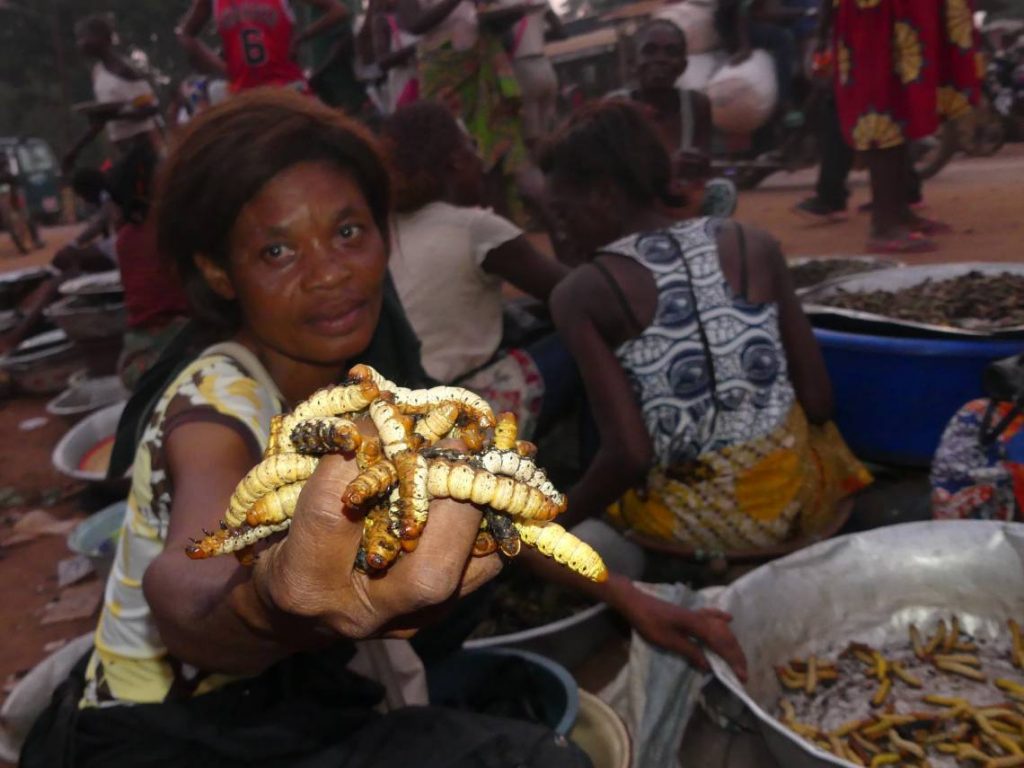
this Non-timber forest products, or products collected in the forest and highly valued by the people of Central Africa, have not escaped the consequences of climate change. This is the case of caterpillars, which generally appear between the end of May and the beginning of June. This year they appeared in July, but in insufficient numbers. This discrepancy worries consumers and sellers, who accuse forestry companies of being the source of the product.
At the Bimbo market, southwest of Bangui, women are busy selling caterpillars and greeting customers. These species, popular among Central Africans, are found along both sides of the route. However, this year’s caterpillar market is clearly different from last year’s. According to consumers, the quantities sold are negligible. So we regret the price.
‘They travelled a long way to get supplies’
“This year the caterpillars appeared late and in insufficient quantities. The sellers are complaining because they have to travel a long way to get the goods. We have also cut down a large number of trees that produce these caterpillars. The longer the sellers have to travel, the higher the transportation cost. That is why they sell so expensively.” sighed Edith, a housewife.
The sellers offered some reasons. “We no longer have caterpillars in our forests. Before, we used to get up at five or six in the morning and go out into the countryside. Even walking around behind the house would bring back caterpillars. But today, that’s not possible; people have destroyed so many trees. The number is gradually decreasing. If it rains four or five times, the caterpillars disappear” explains Prince, a resident of Saranga, 35 kilometres southwest of Bangui.
Collectors and sellers blame deforestation, while experts track them and draw attention to human behavior.
“This is the result of our actions.”
“This timeline change is due to the fact of climate change. The effects are there. It’s the result of all the bad practices we’ve done. So we need to think about this to inform good practices in mitigation and adaptation.” said Alfred Sepamio, director of forests at the Ministry of Water and Forests.
To minimize this problem, the Central African Agronomic Research Institute (ICRA) developed adaptation solutions through reforestation in the affected areas.
“We start by raising awareness among the communities. Because they also destroy. First, they choose the host species for the caterpillars, especially the ayous. Last year, we reforested 70 hectares. This year, with the help of the community, we are planting 100 hectares.” said Thomas Célestin Mengui-Togny, ICRA’s Director of Sustainable Management of Natural Resources.
In order to reduce the effects of climate change and guarantee the emergence of regularly harvested products, it is important to encourage responsible behavior and the rational use of natural resources.
-Also listen: Caterpillar tree taming on the menu for Agro-Agriculture magazine
[ad_2]
Source link

