

[ad_1]
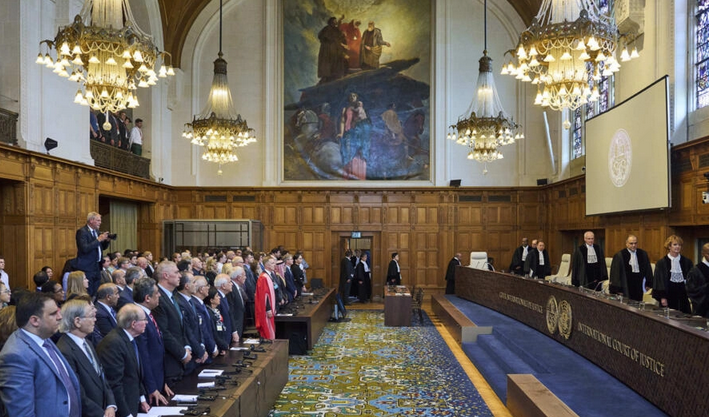
July 19, 2024. – The ruling issued by the Hague-based International Court of Justice (ICJ) is not binding but is likely to add to growing international legal pressure on Israel over the war in the Gaza Strip.
“This is a great day for Palestine”
According to a press release on the advisory opinion, the court concluded that “the State of Israel is under an obligation to end its illegal presence in the Occupied Palestinian Territory as soon as possible,” “immediately cease all new settlement activity and evacuate all settlers in the Occupied Palestinian Territory” and “repair the damage caused to all affected natural or legal persons in the Occupied Palestinian Territory.”
The court added that “international organizations, including the United Nations, are obliged not to recognize as legal the situation resulting from the illegal presence of the State of Israel in the Occupied Palestinian Territory”.
The Court also “notes with deep concern reports that Israel’s settlement policy has intensified since its 2004 advisory opinion”.
“This is a great day for Palestine,” said Varsen Aghabekian Chahine, deputy foreign minister of the Palestinian Authority. The Palestinian Authority president welcomed the decision in a statement carried by its official Wafa news agency and called on Israel to “end the occupation” and “the settlements.”
An unprecedented case
On December 31, 2022, the United Nations General Assembly adopted a resolution requesting the International Court of Justice to provide a non-binding “advisory opinion” on the “legal consequences of Israeli policies and practices in the Occupied Palestinian Territory, including East Jerusalem,” which is the “protracted occupation” of the Palestinian territory since 1967.
In June 1967, Israel launched the Six-Day War, seizing the West Bank and East Jerusalem from Jordan, the Golan Heights from Syria, and the Gaza Strip and Sinai Peninsula from Egypt. Israel then began to occupy the 70,000 square kilometers of Arab territory it had seized, an occupation that was later declared illegal by the United Nations.
Most speakers at the February 2024 hearing called on Israel to end its occupation following the Six-Day War, with some warning that a prolonged occupation posed a “great danger” to stability in the Middle East and beyond.
Palestinian officials accused the Israeli occupiers of a system of “colonialism and apartheid” and urged the judge to call for an “immediate, complete and unconditional” end to the occupation. South Africa’s ambassador to the Netherlands declared before the judge that Israel’s policy in the Palestinian territories was a “more extreme” form of apartheid than what South Africa experienced before 1994. Washington defended its ally, saying Israel should have no legal obligation to withdraw without considering its “very real security needs.”
The hearings were separate from a case South Africa brought to the International Court of Justice, accusing Israel of genocide in Gaza. In January 2024, the court ordered Israel to prevent any possible genocide in the small Palestinian territory. In May 2024, he ordered Israel to stop its military offensive against Rafah.
[ad_2]
Source link

