


[ad_1]
ASOJ.ORG – The Somali Journalists Association today released new guidelines (recommendations) on how journalists and media outlets in Somalia can carry out their media duties while dealing with the impact of the coronavirus pandemic.
After the government announced a curfew in Mogadishu, the Somali Journalists Association filed a complaint with the Federal Government, calling on the government to classify the media as an “essential service” that would not be restricted during the curfew. The union explained why journalists must be considered essential key workers in times of crisis. Within 24 hours, the government responded positively to the Somali Journalists Association’s call, with Somalia’s Prime Minister Hassan Ali Khair officially classifying the media as an essential service.
In light of this positive development, ASOJ released this 
“Securing the media is classified as an essential service is an important victory for us in this situation, as we want to ensure that journalists who are doing important public interest journalism, reporting on the impact of the COVID-19 crisis, can do their work without disruption or restriction,” said ASOJ Secretary General Ali Adan Hashi.
During this crisis, ASOJ aims to highlight why quality journalism – leveraging unrestricted access to information – is vital, and the huge role Somali journalists and their media outlets play in providing information to citizens and working with relevant authorities.
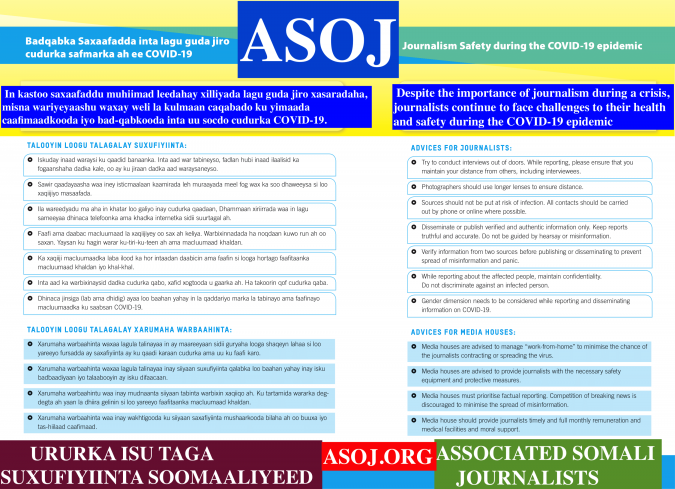
Conduct interviews outdoors if possible. During the interview, make sure to keep your distance from others, including the interviewee.
~Photographers should use longer lenses to ensure distance.
~ The source of infection should not be put at risk of infection. All contacts should carry Whenever possible, by phone or online.
~ Only spread or publish verified and true information. Keep your reports factual and accurate. Do not be swayed by rumors or misinformation.
~ Information should be verified from two sources before publishing or disseminating to prevent the spread of misinformation and panic.
~ Keep it confidential when reporting the affected person. Do not discriminate against the infected person.
~ Gender considerations need to be taken into account when reporting and disseminating information about COVID-19.
Advice for media companies:
Media outlets are advised to implement “work from home” to minimize the chances of journalists contracting or spreading the virus.
Media organizations are advised to provide necessary safety equipment and protective measures to journalists.
The media must prioritize reporting facts. Competition for breaking news should be discouraged to minimize the spread of false information.
News organizations should provide journalists with timely and adequate monthly remuneration as well as medical facilities and psychological support.
Editor-in-Chief Hassan Mude
e-mail: (email protected)
[ad_2]
Source link

