

[ad_1]
As actors committed to promoting sustainable development in Madagascar and as representatives of civil society and the rural population, we welcome the Government’s commitment to modernizing the country and promoting transport between Antananarivo and Toamasina.
However, we wish to express our deep concern about the current design of the highway project. Our duty is to highlight the elements of the project that, as far as we know, could have a negative impact on the country and its people, and to contribute to the collective search for the best solution.
This is what we know so far about the planned route for the entire highway.
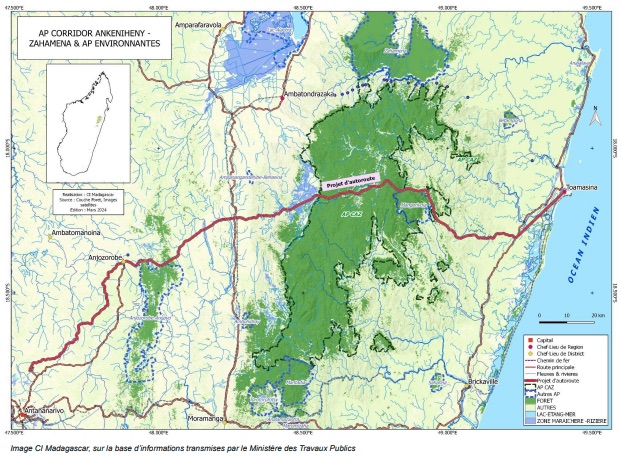
We believe that the project has problems in the following aspects:
Food security and social well-being
The planned route will affect 195 hectares of rice fields and cultivated land, 559 hectares of agroforestry and 69 waterways. This goes against national policy aimed at achieving agricultural self-sufficiency and is likely to increase the number of people living in poverty and vulnerability, exacerbate food insecurity, cause internal migration and increase social inequality, which is already unbearable for the population.
Protecting forests and biodiversity
The planned route directly threatens the new Anjozorobe Angavo reserve and the Ankeniheny-Zahamena Corridor (CAZ) natural resource reserve created in 2015. These two reserves cover more than 10% of Madagascar’s native forests. The route will irreversibly fragment the CAZ corridor, one of the main remnants of the great forest that once spread across the east of the country. This will result in a direct loss of 1,490 hectares of wild native forest.
Irreplaceable, rich in the world’s unique and endangered species such as Indri, Crowned Sifaka and Giant Coua.
Worse still, the highway could eventually lead to the destruction of several kilometers of forest on both sides. Studies around the world have shown that 95% of forest destruction occurs within 50 kilometers of a road, and it only takes one road to destroy a forest (Lawrence et al., Science, 2001). By providing access to the heart of the forest, the highway will bring in activities more destructive than development: hunting, coal mining, trafficking, illegal mining, etc. Specifically, the CAZ corridor will most likely no longer be one large mountain mass, but two distinct forests, much smaller in size and with far less ecological resilience.
Climate resilience
These forests are not only wildlife sanctuaries, but also wildlife reserves. They are our country’s water towers. They play a vital role in maintaining humidity and rainfall patterns, including in the highlands. Madagascar is one of the five countries most threatened by global warming, and protecting the last large tracts of forest is crucial, as their evaporation has been shown to help nourish the clouds. In addition, the CAZ forest corridor supplies water to the large valleys of Alaotra (one of Madagascar’s rice valleys) and the rice-growing plains around Toamasina. By splitting up important forest blocks and affecting 69 waterways, the proposed route will reduce Madagascar’s climate and agricultural resilience.
International reputation
Protecting Madagascar’s last pristine forests is a globally recognized priority. If the highway destroys forests on a large scale, it will profoundly affect the country’s image on the international stage. What will then be the credibility of Madagascar’s international credits on resilience, sustainability, climate, forest protection and carbon? The country will lose the opportunity to position itself as a champion in these areas, even though they are still thriving. It will also affect the country’s image as an ecotourism destination.
Funding transparency
Available information shows that the budget is US$920 million, of which 20% is borne by the Government of Madagascar, or US$184 million. Civil society and the public have the right to ask where this money comes from, while the health needs are urgent.
Education and food security are not satisfactory. In addition, information on the remaining 80% (or $736 million) has not been made public so far. Will the country increase such a huge national debt? Which donor will agree to finance a project that destroys primary forests? These questions are crucial to the viability of the project and the country. They called for urgent clarification.
Compliance and good governance
The project being implemented so far raises concerns about governance. The selection of the company Samcrete does not appear to have been the subject of a tender, and there is no guarantee of the company’s experience and ability to execute such a project. Basic steps appear to be sorely lacking, in particular a thorough assessment of environmental and social impacts, public consultation and the collection of free, prior and informed consent from the communities concerned.
Moreover, the route known so far would directly contradict Madagascar’s commitments at the international level, whether to reduce poverty, protect forests and biodiversity or combat global warming and its impacts. Likewise, the project is inconsistent with very important national frameworks such as the Environmental Charter, the Decree on Environmental Compliance of Investments (MECIE) and the Protected Areas Act.
“If the country decides to violate its own legislation on protected areas, this would set a serious precedent that could jeopardize all protected areas in Madagascar. It would also be a very bad signal: how can the authorities still ask people to respect protected areas? Respect for protected status is essential.”
suggestion
We ask the Malagasy authorities to:
- Suspend current projects and conduct a strategic and public reflection on viable alternatives, such as intensive modernization of existing national roads (RN2, RN3, RN44, etc.), large-scale development of railways (freight and passenger), or explore other possible routes, such as avoiding Anjozorobe Angavo AP and passing between the CAZ corridor and Zahamena National Park.
- Adhere to the standards for implementation of large infrastructure projects in terms of consultation, transparency (including financial) and thorough analysis of social and environmental risks and solutions and alternatives.
- According to the MECIE decree, before any route is validated, the results of the environmental and social impact assessment are submitted in a fully transparent manner and without exerting undue pressure on civil society organizations and organizations managing the protected areas.
We asked potential donors for the highway project (whose identities are not yet known):
- Respect existing environmental and social management standards at national and international levels, in particular with regard to respect for protected areas and environmental and social impact studies.
We ask all donors in Madagascar to:
- Make respect for protected areas a central point in the dialogue with the Malagasy government on the conditions for bilateral and multilateral funding.
- Initiate a dialogue with the Malagasy authorities on solutions to modernize transport between Antananarivo and Toamasina and provide assistance if a satisfactory solution is found.
We firmly believe that such major projects require huge resources and even greater national debt, and require extensive consultation and collective reflection, putting the common well-being first.
We appreciate your attention to these critical issues and stand ready to initiate a dialogue with the authorities. It is not too late to engage in transparent, constructive and inclusive consultations, which is the only way for the country to succeed.
July 10, 2024
Newsletter support:
Aika – Malagasy Youth Alliance for Climate, Biodiversity and Desertification Control
Alaminos – Madagascar Landscapes and Forest Markets
AVG-Gas Alliance
Asiti Madagascar
BIMTT – Liaison Office of Farmers’ World Trainers (Association
Farmer Community Trainer)
CCOC – Collective of Citizens and Civic Organisations
CNPE – National Coalition for Environmental Advocates
CI – Conservation International – Madagascar
Faculty of Science, University of Antananarivo
Francophone Association
FAPBM – Madagascar Foundation for Protected Areas and Biodiversity
FEKRITAMA – Federation of Malagasy Farmers (Federation of Malagasy Farmers)
Green Bangorawa Association
Tanny Mewa Foundation
Madagascar Fossa Association
FTM/CPM – Farmers’ Federation of Madagascar
FVTM – Federation of Women Farmers of Madagascar (National Federation of Rural Women of Madagascar)
GERP – Primate Research Group
Seeds of Life
Green ‘N’ Kool
NGO Sisi
INDRI – Development, Ecological Restoration and Innovation Initiative
Koloharena
Wang Lalana
Madagascar Biodiversity Partnership
Calculate Madagascar
MBG – Missouri Botanical Garden
Michincho Association, Andasibe
MSIS Tatao – Multisectoral Information Service
MWC – Madagascar Wildlife Reserve
MYBN – Madagascar Youth Biodiversity Network
Natural Justice
our country
Planet Emergency – SOS Group
PFNOSC – National Platform of Civil Society Organizations of Madagascar
Post your payment
Onravensara
Ancestors of Washibola
Sadaba Madagascar
Singapore Armed Forces/Kunming, Fujian
That Saha
SIF – Property Federation Forum (Owners United)
Tafo Mihaavo – Community Network for the Management of Natural Resources in Madagascar (Community Network for the Management of Natural Resources in Madagascar)
TAMIA – Tahosoa Alandriake Mitambatse Ianatsono Andatabo
Farmers’ Building (Madagascar Chamber of Agriculture)
TI-IM – Transparency International – Madagascar Initiative Vahatra
VOI Didy – Didy Ambatondrazaka Local People’s Group (Didy Ambatondrazaka Local Community)
World Resources Institute
WWF Madagascar
[ad_2]
Source link

