

[ad_1]
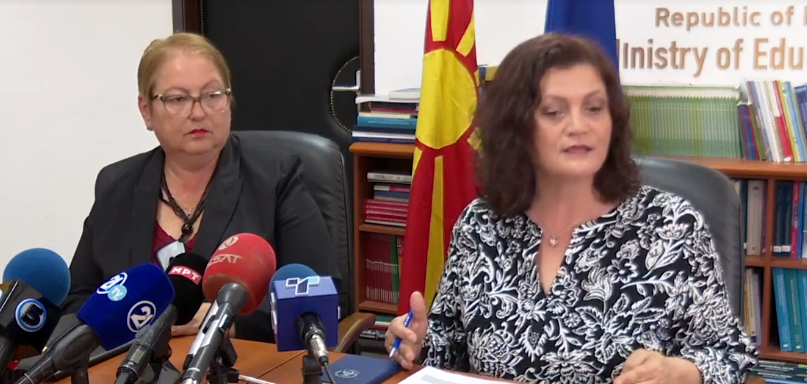
Compared with last year’s score of 3.65, 3.78 in 2022 and 3.61 in 2021, Mihaylovska emphasized that this year’s score of 3.25 is the result of strict measures taken during the college entrance examination.
“A total of 14,834 registered candidates took the mandatory external exams in their mother tongue on June 1, while the optional subjects were conducted on June 8. The tests were conducted in school halls and gymnasiums to increase visibility as well as control of students by observers,” added Mihaylovska.
According to him, the average score for mother tongue was 3.37, English was 3.06 and French was 4.47.
“For the results of the mother tongue and English, we think that this year’s results are much more realistic than in previous years. As for the measures we have taken this year to improve the examination conditions and achieve more objective results, this year we have two measures, one is the large space, that is, the examination in the school auditorium, and the examination in the gymnasium. “We have reviewed the schools and clarified the punishment measures and the operation methods of testers and observers,” Mihaylovska said.
The results showed that 49 students were found to be using mobile phones while doing questions, and 4 students were found to have copied answers after receiving them. When assessing the papers, assessors found 175 students copying papers and 22 cases of plagiarism. The 268 students who were ordered to cancel the exam will be able to take the exam again during the August exam period.
As Mihajlovska said, the school “Arseni Jovkov” in Skopje was found with the most violations of the rules of the state entrance exam, with 32 cases, followed by the “Dr. Pance Karagjozov” school in Skopje, with 18. In Tetovo “September 8”, 14 measures were implemented, in Skopje “Metodija Mitevski – Brico” and Debar “November 28”, 13 measures were implemented for violations of the rules of the test. In Skopje “Cvetan Dimov”, 12 measures have been taken to disqualify the state Mathura.
She reminded that students who failed the exam for any reason during the June exam period can register again during the August exam period. As he pointed out, before that, on Monday and Tuesday, students who are not satisfied with their results can file objections to the school, which will then be forwarded to the DIC and the Objection Resolution Committee.
“From today, all students who do not object can actually get their diploma at school. If they do not object, the result is final. If they object, they will wait until July 16, when the objection is resolved and the result will be sent to them. The August deadline registration period starts on the 10th and lasts until the 18th. Then, from August 12th to 14th, those students who did not pass the exam during the June exam period or were absent for any reason will take the exam again during the August exam period,” Mihaylovska said.
She believes it would be good to consider providing barriers in venues where entrance exams are conducted, as well as providing some benefits to testers and observers who perform well and some measures for those who do not. That is, they end up not following the rules.
Minister of Education and Science Vesna Janevska announced two innovations to better organize the state entrance exam. He said he would insist that the state entrance exam be held in amphitheaters and other rooms with blockers at public colleges.
“I insist that state entrance exams are held in amphitheaters and other rooms at public universities, where there are jammers and other technologies that prevent the use of communication devices during the exams, since most of the time individual and collective rewriting requires location through the use of mobile phones and other devices with installed communication applications,” Janevska noted.
He added that invigilators, testers and all those who share the venue with students who take the exam and make mistakes must be sanctioned. Next year, he also announced a measure to amend the national entrance examination regulations from the perspective of increasing the responsibility of those involved.
In response to a reporter’s question about how the achievement scores are calculated, the DIC director said that instead of publishing scores, percentiles are published because this is a more realistic way to reflect student success.
“Percentiles do not show the percentage of solved problems, but how many students among a particular group performed better, regardless of how many solved the test. If the test is 100 points, if the experts who make the test say that 90 points are needed for 5 points, then there may be situations where the test is difficult, and if we say that 90 points are needed for 5 points, there may be situations where there is no test. Domestic children did not get 5 points, so it has nothing to do with the specific score, but when we get the results, it is determined how many points a couple gets, that is, to pass the test. The way percentiles are determined is described very transparently in the state maturity rules. It is not something that can be decided arbitrarily by one person. These are experts,” said Mihaylovska
She confirmed that all students who raise objections have the right to view the test after the objection process is complete.
[ad_2]
Source link

