


[ad_1]
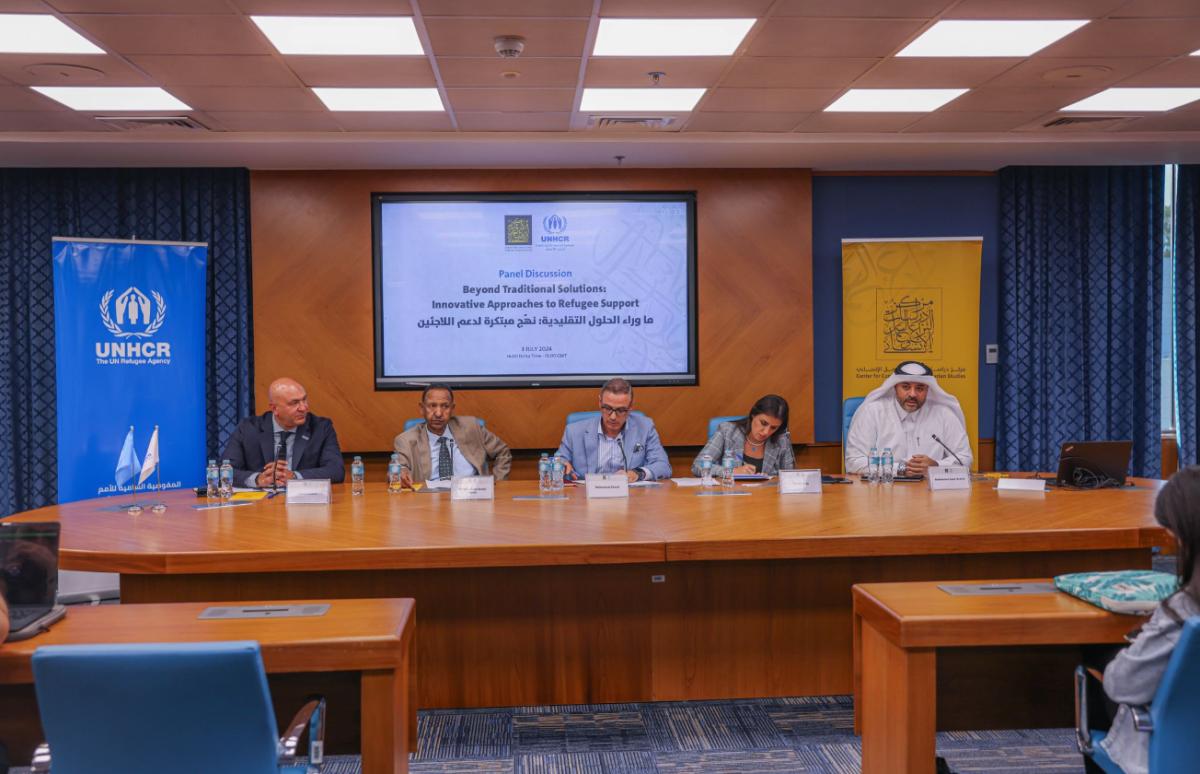
On the occasion of World Refugee Day, which is celebrated every year on 20 June, the Centre for Conflict Research and Humanitarian Action and the Office of the United Nations High Commissioner for Refugees organized a discussion entitled “Beyond Traditional Solutions: Innovative Approaches to Support Refugees”. This year, the aim was to explore innovative and sustainable approaches that can support refugees, strengthen traditional solutions and address their shortcomings, while providing new ways to support refugees more effectively.
Speakers at the session, moderated by Dr. Mohamed Susi of the Center for Research and Humanitarian Action, stressed that the refugee crisis is a major challenge to the traditional solutions sought by the United Nations, the High Commissioner for Refugees and other international agencies, which naturally affects the concept and practice of international protection principles, given the significant obstacles faced by refugees in resettlement and voluntary return home.
They warned that statistics show that there are more than 120 million refugees and displaced persons in the world, a number that is expected to increase to 130 million by the end of this year in view of the ongoing crises and wars in Ukraine, Sudan, Gaza and other countries, noting that more than 50% of them belong to the OIC countries.
They noted that host countries face many challenges related to the economic situation in those countries and the influx of a large number of people in a short period of time, including challenges related to the legal and administrative situation, such as registering refugees, arranging their conditions, placing them in hospitals and schools, integrating them into the local community, including language and cultural barriers and rigidity in the receiving communities, which are disadvantageous to refugees as they are affected by the lack of resources and a sense of competition for employment opportunities and small and medium-sized enterprises.
Speakers called for the need for cooperation and coordination between States, Governments, regional and international organizations and civil society institutions to develop a strategy whose components are studied and used in refugee situations, as wars, conflicts and the resulting displacement will never end.
In this context, Mr. Ahmed Mohsen, Representative of the United Nations High Commissioner for Refugees to the State of Qatar, spoke of the increasing number of refugees in the world, but the scarcity of funds to care for them. 85% of the host countries are considered the poorest countries, noting the need to raise community awareness and stress the importance of voluntary donations and launching an Islamic donation system to support efforts and services for refugees and displaced persons, the need to combine humanitarian work with development work through a clear international commitment, and to coordinate through partnership and solidarity between the various international and regional institutions dealing with refugee issues in politics, law, media and humanitarian affairs to end war and peace.
He said that due to the long duration of conflicts, the average duration of asylum has doubled in the last decade, from 10 to 25 years, as there is no humanitarian solution without a political one, and explained the conditions for voluntary returns and the challenges they face, whether it is good conditions for refugees in host countries or lack of services in their countries of origin.
Ms. Yara Khawaja, deputy head of the ICRC delegation in Qatar, said that the Committee balanced its humanitarian mission with political differences in carrying out its work and worked on the following principles: it would remain neutral and impartial towards any party to the conflict and the armed groups and countries supporting them.
She added that the number of countries experiencing conflict had tripled in the past decade, while the number of displaced persons had increased more than fivefold. She explained that the Commission worked with States, groups, the media and host communities to develop a full understanding of etiquette in dealing with weapon bearers and hate speech.
Dr. Mohamed Salah Ibrahim, Director of Relief and International Projects at the Qatar Red Crescent, reviewed the tremendous efforts made by the Qatar Red Crescent to support refugees around the world through its work in countries around the world and its collaboration with competent authorities and civil society. He also presented the Qatar Red Crescent’s projects to alleviate the burden of asylum and displacement in the countries where it works, noting that the Qatar Red Crescent works in five main areas: “health, shelter, food, livelihoods, and water and sanitation”.
He added that the Red Crescent has established many projects and community partnerships among “host and vulnerable” communities and is always keen to involve the Qatari community in supporting its work, by highlighting the issue, launching advocacy and volunteer campaigns, establishing partnerships with local institutions and agencies, donation campaigns, and educating young people in schools and universities and through social media.
In the same context, Dr. Mustafa Osman Amin, Professor of Islam and Global Affairs at Hamad Bin Khalifa University, spoke about the current crisis in Sudan and the ongoing war there and the conditions it generates, which are reflected in the people seeking asylum and refuge. The number of displaced people is for the first time in its history and it happens several times, as in the case of the displacement of Khartoum residents, who were displaced to Madani, then to Sennar, and then to other states and regions, which shows that the pressure of internal displacement is less than external asylum. Because Sudanese abroad face language problems, difficulties in integrating into the new society, poverty in the host country, as well as problems with education and finding employment opportunities.
[ad_2]
Source link

