

[ad_1]
_____________________________________
(Ahmad Darwish)
______________
December 25, 1445
January 7, 2024 AD
____________________
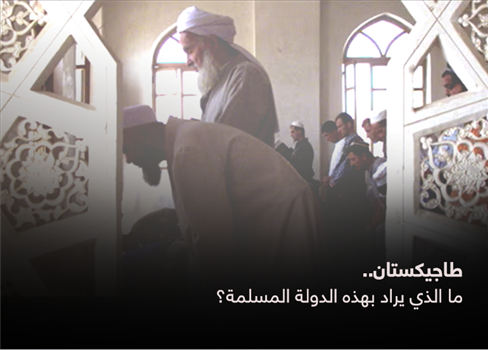
Islam was introduced to Tajikistan very early, and today the proportion has reached 98%, but Muslims there have been subject to many restrictions from the Soviet era to the present. So the question is, what does being a Muslim mean in that Muslim country?
It is not common to see something and its opposite in the same pot, but this is the situation that Muslims in Tajikistan have lived for a long time, and until today, when we wake up every morning to the news of a ban on Muslims wearing headscarves or restrictions on celebrating Muslim holidays (Eid and Eid al-Adha), especially for children, in a Muslim country, the majority of whose population is Muslim, then signs of surprise and astonishment quickly appear, however. When the truth hidden in the background of such decisions is revealed, they quickly fade away, because the teachings of Islam seem strange among Muslims.
The headscarf is officially banned
Recently, Tajikistan banned the wearing of headscarves and other items "Foreign Fashion" According to the country, parliament approved a new law regulating "Islamic clothing" and Eid al-Fitr and Eid al-Adha celebrations.
The new law marks an escalation of informal restrictions on Islamic dress in Tajikistan, where headscarves have been banned in schools and among university students since 2007, a ban later expanded to include all public institutions.
The law was approved by the Supreme Council of Parliament, which is controlled by Tajikistan’s president’s party. "Emam Ali Rahmon" Has ruled the country since 1992.
The controversial law comes after years of informal restrictions on wearing headscarves in the Muslim-majority country.
Under the new law, wearing… "Headscarves or other prohibited religious clothing" A hefty fine of up to 7,920 somoni (Tajik currency), equivalent to (about $740).
As for companies that allow their employees to wear… "Prohibited clothing" Under the law, you could face a fine of up to 39,500 somoni ($3,680).
Government employees and religious leaders who violate the rules will be subject to stiffer fines of 54,000-57,600 somoni ($5,030-5,370).
The Tajik parliament also passed a law prohibiting confusion "Burqa and veil" With regard to women, the decision was justified in order to encourage national culture and traditions against foreign culture and to combat religious extremism.
The law stipulates that each woman wearing a burqa will be fined 3,500 Samani ($322).
The new law also restricts and prevents children from participating in celebrations and gift-exchanging traditions associated with Islamic holidays, which are generally prohibited. "Edgar Duck" This is a custom associated with Eid al-Fitr and Eid al-Adha. During these days, children take to the streets and walk between houses to express congratulations and receive sweets.
Weak reasons for power
A statement from the head of state’s press office said the country’s president "mercy" He signed 35 laws, including new versions of the law on the organization of ceremonies and rituals, parental responsibility for the education and upbringing of children, a ban on children celebrating Islamic holidays and wearing clothing that is incompatible with national culture.
According to the statement, this is legal "Organization of celebrations and ceremonies in the Republic of Tajikistan" and"Responsibility for the education and upbringing of children"The new version adopted aims to protect the true values of national culture, prevent superstition, prejudice, abuse and extravagance in celebrations and ceremonies, and to improve the spiritual, social and economic level of the people. Tajikistan protects the rights and freedoms of children, educates and raises children in the spirit of humanity, national pride and respect for national values.
In May 2015, the British newspaper The Observer quoted an official from the Tajik Ministry of Justice as saying: "mercy" He ordered parliament to consider a draft law that would ban the registration of names in Arabic characters, especially "Muhammad
In March 2024, he said "mercy" In meetings with the public and religious figures, he pointed out that national costumes reflect the material and spiritual values of the country’s people in the past, allowing people to identify a nation through the form and style of its clothing, and pointed out that imitating foreign cultures in clothing, such as wearing foreign clothes, is a "Hijab"which has caused problems for Tajik society.
Rahmon explained that deviating from dress etiquette and rituals is tantamount to… "Cultural alienation undermines the independence of thought and the national and cultural identity of the nation"proving his claim that the Tajik national costume is recognized all over the world, including "UNESCO" Global heritage.
A war between old and new
The new law marks an escalation in unofficial restrictions on Islamic dress in Tajikistan, which has banned headscarves in schools and among university students since 2007, a ban that was later expanded to include all public institutions. Authorities also encourage and continue to informally encourage men to shave their beards, following reports that police have forcibly shaved the beards of thousands of young men over the past decade.
Human rights groups have criticised Tajikistan’s headscarf ban as a violation of religious freedom in a Muslim country where more than 98 per cent of the population is Muslim.
In May 2015, the British newspaper The Observer quoted an official from the Tajik Ministry of Justice as saying: "mercy" He ordered parliament to consider a draft law that would ban the registration of names in Arabic characters, especially "Muhammad".
Under the country’s law in force since then, if the child’s parents fail to name their child in accordance with the rules imposed by the authorities on citizens, the Ministry of Justice will prepare a list of suggested names that do not contain Arabic or Islamic characteristics.
There are newspaper reports "independent" In early 2016, British police in Tajikistan shaved the beards of 13,000 men in Tajikistan to combat… "Extremism"More than a thousand women were also forced to remove their headscarves.
In December 2016, Parliament approved "mercy" His family was granted lifetime immunity from prosecution and was formally awarded a title "National leaders"and"Founder of peace and national unity in Tajikistan".
History tells us
After Tajikistan declared independence in September 1991, a presidential election was held in the same year and the winner was Tajikistan. "The most merciful is the prophet of Yev" Dramatically, large demonstrations led by Islamic groups opposed him and rejected his rule over the country, and then the protests turned violent. In the first few months of the protests, the president of Tajikistan was forced to resign and was replaced "Akbar Shah Eskandorf" He served only a few months as interim president.
Then came the emergence of prominent figures who played an important role in suppressing the demonstrations with Russian support "Emam Ali Rahmon" He suppressed the demonstrations, and the situation subsequently degenerated into a civil war, killing 100 Tajik citizens.
He succeeded "mercy" After quelling the demonstrations and amending the constitution to allow him to continue his presidential campaign and remain in power, he gradually began a war on religious expressions in the country under the pretext of fighting extremism, beginning with laws that banned religious activities, such as worship and visiting mosques for those under 18 without family consent, and then banning gatherings. "regeneration" The only opposition party in the country; he subsequently listed it as a banned group in the country on the pretext of participating in a coup against the regime.
Rahmon continued to consolidate his power, appointing his son as speaker of parliament, and later instructed the government’s Fatwa Committee to issue a fatwa prohibiting women from praying in mosques. He then began informally issuing instructions to government agencies to produce television programs to dissuade women from wearing headscarves to fight.
Rahmon went out and addressed the people: "Everything external has nothing to do with religion, God’s love is only in the heart".
He then began imposing severe restrictions on Tajik citizens who wanted to perform Hajj or Umrah, a new attempt to sever all ties between Muslims and their religious observances and prevent them from performing them freely and easily.
at last
For a regime that wants to continue to rule its people through oppression, restricting people’s religious rituals, especially Muslims, will not achieve any victory or any stability, otherwise, the Mongols, Tatars and Crusaders would have been the leaders of the world. Today, if things go this way, just like everyone will experience the darkness of the dawn of light, because soon all restrictions on Islam and its people will be eased anywhere on God’s Earth, and God will control everything. His affairs, but most people don’t know.
______________________________________
[ad_2]
Source link

