

[ad_1]
June 28, 2024 9:00 AM
June 28, 2024 9:00 AM
The stories of the LGBTQ+ community are full of resonance, of love and struggle. Each person, with their own identity and sexual choice, faces a sometimes hostile world, but is also sheltered by a community where support, compassion, and solidarity are constant and unbreakable.
LGBTQ+ is an acronym used to represent sexual and gender diversity. It is a new term as diverse as the colors of the rainbow, referring to lesbian, gay, bisexual, transgender, and Queer o question.
Since the beginning of the month, Bolivia has held various events to mark the International LGBTQ+ Pride Day, celebrated around the world every year on June 28. The festive agenda will end this Saturday, the 29th, with the Great Pride Parades that will be held in the country’s main capital cities.
“I’ve never been in a closet.”
David Aruquipa, also known as Dana Galán, grew up feeling different. Born into a traditional environment, he accepted being gay from an early age. “I was never in the closet,” he recalls. His ability to accept himself is a beacon of hope for a society that often doesn’t understand gender diversity.
“I have always dealt with negative reactions with sarcasm and laughter, not sarcasm. From a young age, my mom taught me to be outgoing and to fight for what I want. His training enabled me to protect myself without getting hurt,” Aruquipa said.
This attitude enabled him to handle situations of ridicule with extraordinary skill. He turned critical glances into moments of humor, making those who tried to belittle him uncomfortable and even laughing at themselves. This strategy not only accompanied him in his daily life, but also became an important resource when he faced street attacks together with the Garland family.
When insulted with homophobic terms, they confidently responded, “Yes, we are queer and we like you.” This bold response not only disarms the attacker, it also makes the audience laugh, changes the dynamics of the conflict, and shows that the power to decide who to respond to and how to respond always lies in their hands.
Years later, in an environment where society was more open and the LGBTQ+ community still faced many challenges, David found his current partner, Guido Montaño. They have started a family and are the first same-sex couple to legally marry in the country. Aruquipa is a well-known cultural manager and LGBTQ+ rights activist whose work was and is fundamental to making known the struggles and achievements of these communities in Bolivia.
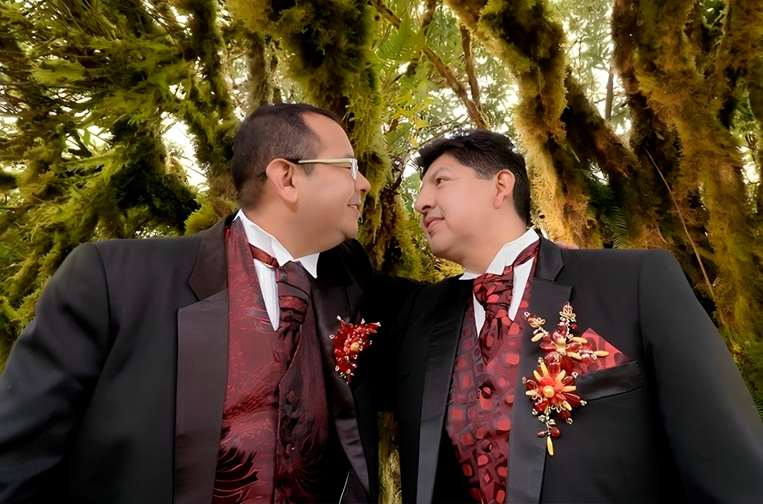
Pride Day is not only a celebration of identity and diversity, but also a reminder of struggles past and present
For José Rodolfo Vargas, coming to terms with his sexual identity was a difficult process because until about 25 years ago, Bolivia was a not very tolerant place and coming out was not an option.
“I faced a lot of fear,” he admits. However, the need to be true to himself ultimately helped him overcome his fears with great courage.
“I was educated in a priest school. My family was and is very Catholic. This forced me to hide a fundamental part of my identity and life to protect myself from discrimination and stigma, but after receiving professional therapeutic support, I was able to come out and truly show who I am,” said Vargas.
For José Rodolfo, dealing with negative reactions was a difficult part. His family initially did not accept his sexual orientation, which led to his decision to immigrate to Colombia, where he lived for 10 years. During that period, he found an environment that greatly empowered and strengthened him.
During her stay in Colombia, José was able to articulate speech and plead for her life. Surrounding herself with people who understood and supported her was crucial to her emotional and mental health.
“Being a part of the Galán family and the LGBTQ+ community is essential to my emotional and mental health,” he said.
These communities not only helped him face negativity with patience and education, seeking to change perceptions through dialogue, but also gave him the courage to make difficult decisions.
In some cases, he had to distance himself from toxic people in his family, friends, and work environments who didn’t accept his sexuality. While these decisions were painful, he learned that distancing himself from negativity was essential to maintaining his own peace and happiness.
For Vargas, it is crucial to be surrounded by supportive and understanding people who are committed to defending and promoting human rights. He believes it is better to live in an environment where he can be authentic and receive support, rather than endure the emotional pain caused by a lack of acceptance.
These experiences not only strengthened his sense of identity and self-esteem, but also led him to a path of authenticity, rebellion, and openness in life.
Despite the rejection and prejudice he faced, his determination led him forward. Today, he is a successful professional. José Rodolfo Vargas Aramayo holds a Bachelor’s degree in Philosophy from the Pontifical Javeriana University in Bogotá and a Master’s degree in Gender from the Latin American School of Social Sciences (FLACSO) in Uruguay.
“I’m a person who is constantly constructing,” emphasizes Vargas, who has been practicing activism through drag for more than a decade. Drag Queena member of the Galan family. He works in radio, television and theatre, and is president of the Bolivian TLGB collective, a social movement.
Jonathan, a story of perseverance and self-acceptance
Jonathan Arancibia also faced a huge challenge when he revealed his sexual orientation to his parents, who rejected him.
“It was a bit of a complicated process because I wasn’t out yet, but was discovered, and although it was a bit complicated to deal with my parents at first, every year it gets better,” mentioned Arancibia.
Dealing with the negative reactions to coming out was difficult for the now 30-year-old. His parents initially did not accept his sexual orientation, which led to his decision to take an autonomous path away from his family.
Over time, she began to participate in activism and support for people of all sexual orientations and people living with HIV.
Currently, he serves as a supervisor at an agency working with LGBTQ+ people and people living with HIV, fostering strong and meaningful relationships based on friendship and shared activism in both professional and personal spheres. These experiences not only strengthen their commitment to the community, but also play an important role in their own growth and emotional well-being.
His activism has allowed him to find a sense of purpose and fulfillment in collaborating with people who share the same values. On the other hand, his story reflects a personal evolution marked by perseverance, self-acceptance, and commitment to the cause of human rights and equality for all.
Why June 28th is LGBTQ+ Pride Day
LGBQB+ Pride Day is celebrated every year on June 28 to commemorate the Stonewall Riots in New York (1969), a protest against the police raid on the Stonewall Inn bar, a well-known gathering place for the LGBT community.
A year later, in 1970, New York organized its first Pride Parade to commemorate these events. Since then, June 28 has become a landmark date for LGBTQ+ communities around the world, according to National Geographic.
Pride Day is not only a celebration of identity and diversity, but also a reminder of the struggles of the past and present. While acceptance and rights for these people have increased significantly, there is still much work to be done. Pride parades and celebrations are a gathering, but also a protest, and a way to make the presence and resistance of a community visible.
Paola Hoyos, professor of psychology at Unifranz Franz Tamayo, believes that overcoming prejudice and increasing empathy for the LGBTQ+ community requires a collective effort to better understand the diversity of human experience.
“Through effective education that explains the realities of sexual and gender diversity, we can dispel the myths and stereotypes surrounding the issue,” he said.
The stories of David, José and Jonathan, and the commemorations of Pride Day, remind us that the journey toward acceptance and human rights is long and challenging, but also filled with hope and love for a more inclusive and equitable world for everyone.
[ad_2]
Source link

