


[ad_1]
sponsor

This week, a major workshop on multi-hazard early warning in the Solomon Islands was held in Honiara, bringing together key national stakeholders and international agencies.
Opening the workshop today, Minister of Environment, Climate Change, Disaster Management and Meteorology, Trevor Manemahaga, said the conference marked an important step in the shared journey towards a more equitable and resilient Solomon Islands, where early warning information is not a privilege but a fundamental right that must be accessible to all.

Minister, the Honourable Trevor Manemahanga.
Minister Manemahaga stressed that due to climate change, weather, climate, ocean and water extreme events are becoming increasingly unpredictable, frequent and intense, often with adverse impacts on livelihoods, property and sometimes even loss of life, which in turn affects national economies.
“Unfortunately, this impact is now exacerbated by many other factors, which clearly highlights the urgency and greater need for effective early warning systems and proactive response measures,” he said.
This National Early Warning Systems Consultation Workshop is an important platform to explore innovative approaches, share best practices, and build a global network committed to expanding early warning coverage to everyone and leaving no one behind.
The workshop will pave the way for the development of specific multi-hazard policies and related frameworks through collective contributions to guide the successful implementation of multi-hazard early warning systems under the Universal Early Warning Initiative.
Minister Mane Mahaga said the Government of National Unity and Transformation (GNUT) looks forward to supporting the initiative through a legislative review.
Multi-hazard early warning systems are a key element in disaster risk reduction and climate change adaptation as they help reduce or avoid the harmful impacts of hazardous events.
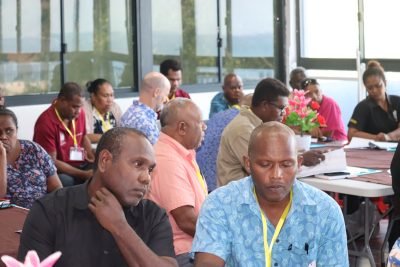
Workshop participants.
To be effective, the system needs to cover the four key pillars of universal early warning and strengthen national coordination.
Stakeholder input on existing gaps and challenges and finding a way forward is important to ensure the country has an operational, effective and inclusive end-to-end early warning system that saves lives, minimizes impact on property and builds community resilience.
The three-day workshop was supported by the Solomon Islands Government’s Ministry of Environment, Climate Change, Disaster Management and Meteorology (MECDM), the World Meteorological Organization, the United Nations Office for Disaster Risk Reduction (UNDRR), the International Federation of the Red Cross and Red Crescent (IFRC) and the International Telecommunication Union (ITU).
over///
– Government Communications Department
[ad_2]
Source link

