


[ad_1]
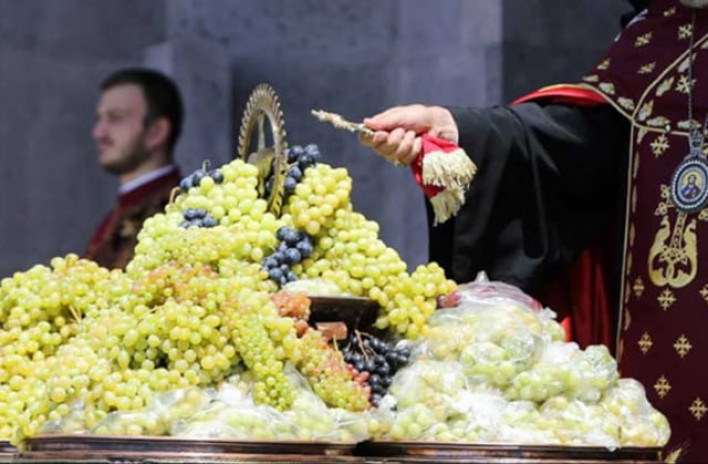
On the feast of the Apparition of Our Lady, the grapes are blessed immediately after the liturgy, and the blessed bunches of grapes are distributed to the people.
This custom has nothing to do with the festival itself, but comes from very ancient times. According to ancient custom, the first harvest of the year was dedicated to God. According to the law, these crops were wheat, barley, grapes, figs, pomegranates, olives, honey, etc.
Through this donation ceremony, people expressed their gratitude to God for the good things they were enjoying, and in doing so, received God’s blessing for the upcoming harvest.
Similar practices are mentioned in the Old Testament (Genesis 26:1-2). These rituals existed in Armenia in pre-Christian times, as in Judea and other nations. The Armenians dedicated the first fruits and harvests of the year to the temple.
Thus, when the Navasadh festival begins, people solemnly bring goodies from their gardens to the temple and offer them to the god of harvest and fertility.
In the Christian era, grapes were chosen as a symbol of a good harvest for the year, and only grapes were taken to the church to be blessed. This ceremony was generally held in the church. Once, this ceremony was held in the garden of a priest or someone else. The priest, holding a pair of scissors in his right hand, marched in a procession to the church garden, which was called heaven. If the church did not have a garden, it went to the garden of the elders of the village or city, where, in the presence of the faithful, a ceremony of blessing and blessing of the grapes was held. Then the harvest was blessed. People also had the custom of distributing birds, for which purpose people would hang bunches of blessed grapes on high.
During the blessing of the grapes, the hymn “Glory to the Holy Cross” is sung in the church, passages from the Holy Book are read, and then St. John enters the grace prayer. The prayer mentions that God created plants on the third day and gave Adam and Eve a paradise life of ease and luxury. But because of their sin, they were expelled from heaven and the divine blessing turned into a curse. However, God did not ignore man. With the birth of his only son, the chains of the curse were removed and people were freed from the slavery of sin and death.
When blessing the grapes, people pray not only for the grapes, but also for the people, farmers and land that grow grapes, asking the Creator to grant a good harvest, a bountiful year, without any accidents and disasters, and without strong winds. Those who bear the fruit also seek God’s blessing to make them worthy of the heavenly reward.
During the ceremony, accompanied by the sermon of the deacon, we are pleased with the merciful God, asking Him to bless the fruits of the grapes with His original blessing, to give us wine of joy and food for health, soul and body. At the same time, we invoke the intercession of the Virgin Mary, through whom we receive the fruit of life and immortality – Jesus Christ. The priest then blesses the bunches of grapes donated by the people, adding God’s blessing to the fruits, so that by tasting these fruits in our souls, we accept God’s known grace. The priest also prays that in this world, for the glory of the Lord, we enjoy the material wealth He has given us, and in the afterlife, we should eat and drink the harvest of the heavenly table with the Lord, according to the true promise of the Lord.
Humanity was blessed again with the coming of Christ. But the bunch of grapes is the most blessed of all fruits, because the Lord exalted the vine above the mightiest trees and exalted it above other plants, calling himself the vine, according to this statement: “I am the true vine” (John 15:1). Those who are bound by the love of the Lord are called branches, and the Father is the cultivator, so the Father prunes the vine to make it fruitful in the works of righteousness and turns the pruned branches into eternal fire. Among the fruits, the grapes were offered to Christ in the form of wine at the Last Supper as a symbol of his holy blood. In the upper chamber, our Lord took the wine and blessed it, saying: “This is my blood of the new covenant” (Matthew 26:28), by which we are redeemed and freed from the service of sin and death.
In the southern regions, where grapes ripen earlier, people perform a blessing on the grapes of Vardavar.
Compiled by Karine Sugikyan
Subzorawo
[ad_2]
Source link

