

[ad_1]
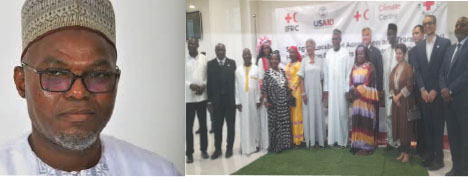
The launch ceremony was held at the Sir Dawda Kairaba Jawara International Conference Centre on Friday and was organized by the Gambia Red Cross Society (GRCS).
Scaling up locally-led adaptation and transformational humanitarian response to climate change is a two-year project funded by the United States Agency for International Development (USAID) and implemented in partnership with the International Federation of Red Cross and Red Crescent Societies (IFRC).
The transformative initiative aims to help vulnerable groups adapt to climate change through a locally-led, integrated and multi-sectoral approach.
According to stakeholders, the project aims to build sustained climate resilience at the community level and ensure that the National Red Cross and Red Crescent Society’s institutional setup, programmes and operations are transformed to become climate-smart.
While launching the project, the Vice President said the project is more than just an initiative but a beacon of hope in the country’s ongoing fight against the devastating effects of climate change.
Vice President Jallow stressed that Gambia’s main environmental issues are deforestation, desertification, waste management and water pollution, as well as “more recently the adverse effects of climate change”.
The Gambia has a forest cover of 480,000 hectares (about 44% of the country’s total area), but the deputy resident officer revealed that nearly 70% of the forest has been degraded. He said: “Continued deforestation and forest degradation leading to climate change pose a huge threat to the country’s environment and natural resources.”
He said the underlying reasons for the concern were “increasing population pressure and lack of adequate socio-economic/livelihood opportunities”.
He said that The Gambia has been a party to the United Nations Framework Convention on Climate Change (UNFCCC) since 1994 and submitted its Nationally Determined Contribution (INDC) in 2015, before the signing of the Paris Agreement.
“The Gambia’s 2015 Nationally Determined Contribution targets a 45.4% reduction in emissions by 2030,” the Vice President said. “In 2022, The Gambia submitted its long-term climate change strategy, which clearly sets out mitigation and adaptation targets from now until 2050.”
He also said that Gambia’s “government is committed to achieving net zero emissions in the power generation sector by 2050”.
Speaking about the country’s vulnerability to weather, Fabakar Kalle, president of the Gambia Red Cross Society, said: “The Gambia faces increased vulnerability from extreme weather events and shifting climate patterns.
“If it’s not floods, then droughts or other climate events will have devastating impacts,” he said worriedly. “We need to act now to address some of the adaptation challenges.”
He said the project aims to ensure long-term benefits by fostering community ownership and promoting sustainable practices. The project also “contributes to achieving the goals of USAID’s 2022-2030 Climate Strategy,” which aims to increase climate resilience of “500 million people” by 2030 and strengthen local community engagement and leadership in climate action.
[ad_2]
Source link

