

[ad_1]
____________________________
(Ahmad Mustafa Algar)
____________________
July 2, 1446 AH
November 8, 2024 AD
____________________
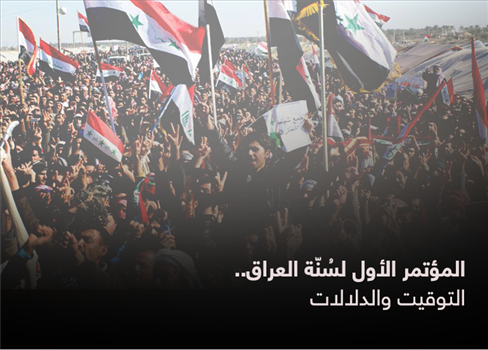
What is the future of Iraqi Sunnis, especially given the growing calls for the creation of a Sunni region in Iraq, bringing together Sunni provinces, similar to the Kurdish region, especially since the Iraqi constitution allows for such a process? What are the challenges that stand in the way of this step?
Today’s Iraq is like a ship heading towards the abyss, in which Sunnis are almost the only victims, while others have lifeboats; the Shia control the government, the Kurds have an independent region, and we find that Sunnis do not have a region that shelters them, nor a government to protect them, although the discussion on the issue of the Sunni region in Iraq has been going on for quite some time. The past few weeks have witnessed an unprecedented escalation in the demands for the establishment of this committee, with the explicit provision that a conference will be held in Anbar province in September next year to discuss the issue of the region, which will be attended by a large number of representatives from the provinces with a Sunni majority (Anbar, Nineveh, Diyala and Saladin). To what extent can this conference be a turning point for the future of Sunnis in Iraq? Can this conference achieve the intended goals, or will it be just a meeting without real results? What challenges do Sunnis face in achieving their goals? How can these challenges be overcome in the current situation?
Sensitive issues
Despite Iraq’s wealth, what has been observed over the years is that the situation is difficult and requires serious action by all concerned, especially when corruption and injustice reach a critical point and there will be no escape except explosion. It is worth noting that the Sunnis in Iraq are not weak, but their sphere of influence is wide and widespread, which gives them a force and presence that cannot be ignored, but the challenge is to use this force and guarantee their rights and achieve a balance in the country, especially because Iraq today needs fundamental solutions to prevent explosions and preserve unity, and constructive dialogue between the parties is the only way to achieve this goal. Instead, we must work seriously to achieve political and social reforms and guarantee stability and prosperity for all Iraqis.
Faced with subsequent political developments as well as economic and security pressures, Sunni Arabs found themselves in a critical position in this complex situation, which prompted some Sunni groups to consider resorting to federalism as a solution.
In the complex political and social conditions of Iraq, despite the lack of strong reliance on the propaganda campaign led by tribal figure Raad Suleiman, the discussion on the establishment of Sunni regions has become a sensitive topic, raising many questions and controversies. However, the idea is widely welcomed by the Sunni population, but everyone recognizes that achieving this goal requires the approval of Shia partners who control the country’s governance levers and influence, as well as the support of regional and international factors.
Iraqi federalism
It includes the Iraqi constitution, which was drafted under the US occupation and under the direct supervision of its godfathers "Paul Bremmer" There are also provisions that pose a serious threat to the future of Iraq, since the constitution gives any Iraqi province, or three or more provinces, the right to form a regional government governed by a local government semi-independent from the capital. Enjoys extensive powers, including appointing the president of the region and forming special ministries, in addition to the right to conduct diplomatic exchanges with other countries, sign contracts with foreign companies for oil extraction, and conclude agreements and treaties. Kurdish leaders use reasons related to ethnic, linguistic and geographical specificity to promote federalism. However, these calls are actually just flimsy arguments that hide malicious intentions of division… Iraq is divided into small countries, which leads to its fragmentation. Striking the core of Arab unity and breaking through the high walls of its national security in the interests of the enemy.
After the invasion of Iraq in 2003 AD and the fall of Saddam Hussein’s regime, the Sunni section painfully accepted the idea of dividing Iraq. For years, Sunni Arabs, some loyal Shia Arabs, and other sects worked to divide Iraq. Iraqi national unity strongly resisted these calls and thwarted many plans aimed at dividing Iraq; as with the projects for Basra and Missan provinces, this resistance showed a deep awareness of the dangers that threaten Iraq’s unity and stability. On the surface, calls for Iraqi federalism appear to be democratic steps aimed at achieving autonomy and improving local governance, but internally they seek to divide the country and fracture its unity.
However, in the face of subsequent political developments and economic and security pressures, Sunni Arabs found themselves in a critical position in this complex situation, which prompted some Sunni groups to consider resorting to federalism as a solution to the problem. Protecting the interests of Sunni Arabs, guaranteeing their rights, and establishing a Sunni Arab special zone in Iraq are the urgent needs of the Sunni Arabs in the face of a series of persecutions and repressions.
Sunni Iraqis have suffered systematic marginalization and ongoing persecution by successive Iraqi governments, particularly during the reign of Nouri al-Maliki and the Dawa Party, a persecution that was not limited to political activists but included the entire Sunni community, as Sunnis were persecuted. Raids, arbitrary arrests, torture, displacement, assassinations, and restrictions on educational institutions, deprivation of development projects and investments in Sunni provinces, leading to the deterioration of the economic situation and infrastructure in these areas, not to mention the deliberate insults to religious symbols and the sanctity of Sunnis, have created a sense of injustice and oppression among Iraqi Sunnis, and some Sunni groups have found themselves forced to seek solutions to protect their rights and ensure a better future for their children, from which came calls for the establishment of a Sunni autonomous region where Sunni Arabs could manage their own affairs without the control of the central government, which is not fair to them.
There is no religious or central political authority among Iraqi Arab Sunnis that can lead the majority of Sunni society, and there are competition and divisions among multiple parties, figures and alliances.
Challenges and obstacles
There are political and regional challenges and internal obstacles to the success of the first Sunni conference. Even if it is held, its results and goals will not be easily seen. It requires continuous efforts and high-level coordination of all parties. It is difficult – if not impossible for all political and social forces in Iraq to achieve this. In general, we can summarize the most prominent of these challenges as follows:
● Resistance from Shia forces:
Although the constitution recognizes the right of provinces to establish their own regions, Shia forces openly reject this, not even in Shia-majority areas such as Basra province. It was ratified in the 2005 constitution, and today they openly oppose the creation of regions, which makes it very difficult to achieve Sunni regions without the approval of Shia partners who control most of the country’s governance, power and influence.
● Splits within the Sunni community:
There are divisions among Sunni political forces that have hampered unity in efforts to achieve common goals, and these internal disputes have reduced the chances of the conference’s success and the implementation of any decisions made at the conference, especially since some major Sunni leaders do not currently support the idea of the region or even discuss it within their political backrooms. This reservation reflects the current reservations of the Sunni political leadership about realizing the region. No religious or central political authority exists among Iraqi Arab Sunnis that can lead large segments of Sunni society, and there are competition and divisions between multiple parties, figures, and alliances.
● Regional and international factors:
Establishing a Sunni region requires regional and international support, and the political situation in the region and the influence of neighboring countries may greatly affect the possibility of achieving this goal. Balancing regional and international support, carefully dealing with external influences from Sunni countries and Iran, and the successful achievement of this goal depends on whether Iraqi Sunni leaders can unite and gain strong and sustainable support from their regional and international partners, in addition to skillfully negotiating with local and regional Shiite forces to ensure that their goals are achieved without escalating tensions and conflicts.
It is no secret that there are pressures in Iraq from regional and international powers with intertwined interests, as well as internal pressures from various parties vying for power and influence, which make it difficult for the construction of Sunni regions to progress without confrontation and conflict. It is also no secret to anyone that Iran has a huge influence in Iraq, and that this influence, through its support for Shia factions and political groups, makes it a major player in any negotiations or arrangements regarding the creation of Sunni regions, which Iran may see as a threat to its interests in Iraq, which makes it stand against the idea.
● Fluctuations in public support:
While most Sunnis welcome the idea of the region as an age-old popular demand, some Sunni regions and groups remain unconvinced or divided on certain aspects of the project. Its details weaken the momentum of popular support and require a comprehensive understanding of Iraq’s importance, not just media support that lacks national consensus and sustained security and economic capacity.
● Security, economic and legal challenges:
Establishing an independent region requires security capabilities to protect it and economic capabilities to guarantee its continuity, but as it stands, potential regions lack adequate self-protection capabilities and the economic infrastructure necessary to support it is weak. Although Article 119 of the Constitution grants the right to create regions, its actual application requires overcoming many legal and constitutional obstacles and must be successfully held in a referendum and approved by one-third of the members of the provincial parliament or one-tenth of the voters, which is not an easy challenge.
● Geographical and historical challenges:
The Sunni regions of Iraq, such as Nineveh, Anbar, Saladin, etc., are geographically interconnected and connected to each other, but at the same time are separated by vast uninhabited areas, making it difficult to favor any one region over the proposed geographic center or capital of the province. In addition, the Sunni provinces are very different historically, culturally, and socially, which also complicates the question of which province to choose as the center of the Sunni region, as each province has its own distinct characteristics and unique history that make it not superior to another.
● Issues of concern to the central government:
It is worth noting that the Sunni region of Iraq has the corridors of the Tigris and Euphrates rivers, in addition to a large number of minerals, especially sulfur and phosphates. It is expected that if a Sunni region is formed, the central government will lose its decision-making power over these resources. The idea of the region will be adopted in the Sunni-majority provinces, which will encourage Shia-majority Basra to reintroduce the Basra regional project that failed in 2008. In 2013, it was Iraq’s only port and the most important trade route, holding about 80% of Iraq’s oil reserves.
The future of the Sunni region
As the discussion about the creation of Sunni regions has re-emerged, so too has the discussion about the obstacles to their creation and the uncertainty about their future. There is a large geographical overlap between the regions and borders inhabited by Sunnis, Shias, Kurds and Turkmens. It is impossible to separate the Sunni regions from the rest of Iraq without displacing at least 2 million people. The cities of Tal Afar in Nineveh province and Balad and Dujail in Saladin province are both Shia cities and are also Shia cities. Moreover, any attempt to disrupt the distribution of populations will be met with political resistance from other parties, making it difficult to find the necessary basis for the creation of Sunni regions and sectarian regions. The Sunni demands in this area can be met by granting them provincial powers within the framework of a unified Iraq.
When some Sunni parties proposed the idea of creating Sunni regions, this approach stemmed from a natural reaction to the persecution of Sunnis, but what increased the desire of Sunnis to create their own regions was what they noticed during their displacement due to the attacks of the Islamic State in the Kurdistan Region, the degree of its political, security and economic stability, and the praise of the international community for the experience of this region of Iraq, which was almost the best in terms of the implementation of laws and the provision of services. Despite the efforts that have been made and continue, the future of the Sunni regions in Iraq remains unknown and will continue to be limited to the circumstances and developments of the political situation and the achievements made. This goal is impossible to achieve under the current circumstances.
___________________________________________ _
[ad_2]
Source link

